
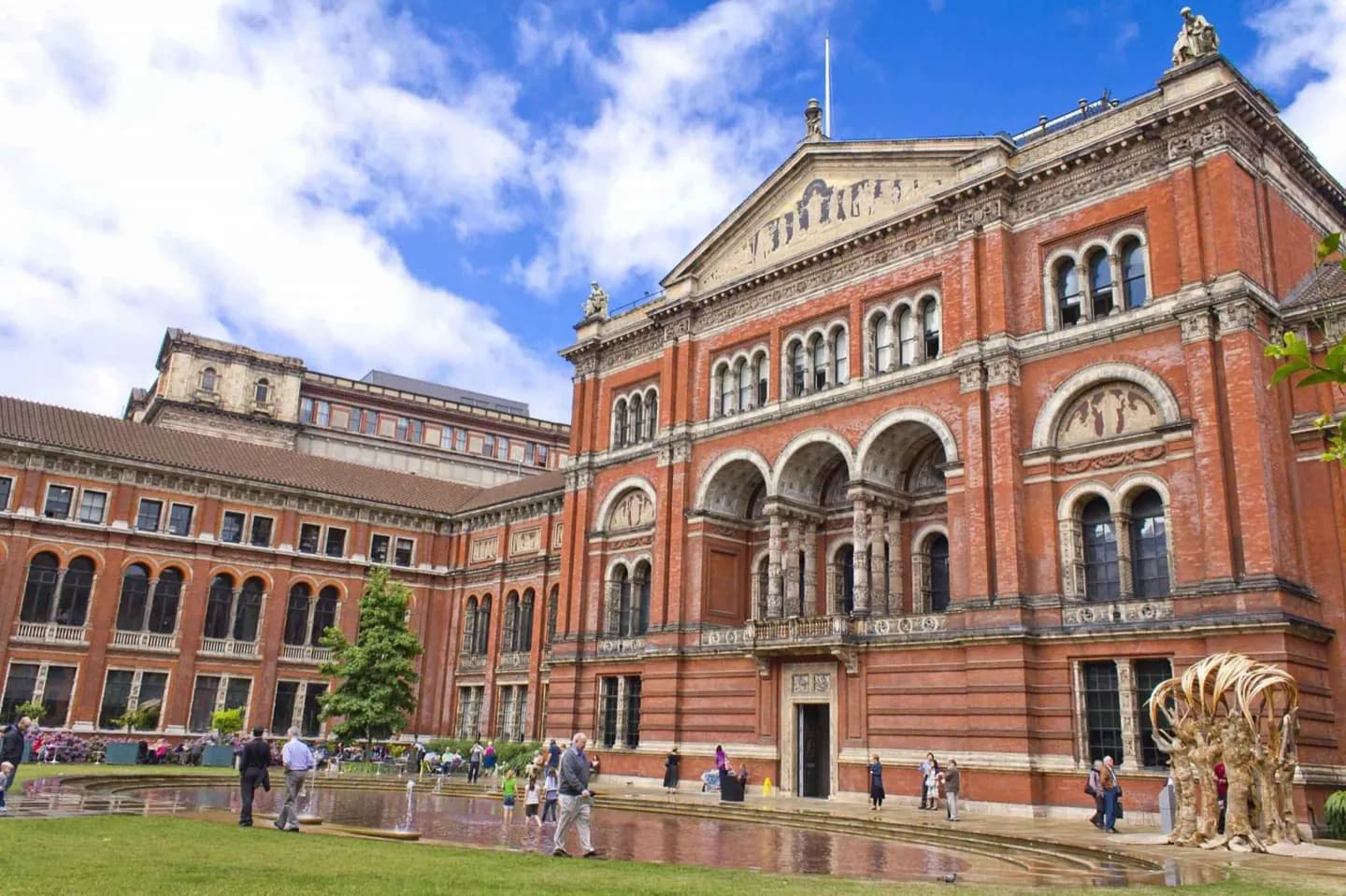
Why go
The answer, from Bryan Davies was that the museum intended to preserve and care for the collection and keep it available to the public, with items being redistributed to the British Galleries, the Medieval & Renaissance Galleries, and the planned new galleries for Furniture and Europe 1600–1800, and that the Horniman Museum and other institutions were possible candidates for loans of material to ensure that the instruments remained publicly viewable.
What to look for
- There is an extensive collection of sculpture, mainly of a religious nature, Hindu, Buddhist and Jain.
- By 1948 most of the collections had been returned to the museum.
- There is a "Search the Collections" feature on the Victoria and Albert web-site.
The full story
The V&A is located in the Brompton district of the Royal Borough of Kensington and Chelsea, in an area that has become known as "Albertopolis" because of its association with Prince Albert, the Albert Memorial and the major cultural institutions with which he was associated. The museum is a non-departmental public body sponsored by the Department for Culture, Media and Sport. Like other national British museums, entrance to the museum has been free since 2001. The V&A covers 12.5 acres (5.1 ha) and 145 galleries. Its collection spans 5,000 years of art, from ancient times to the present day, from the cultures of Europe, North America, Asia and North Africa. The holdings of ceramics, glass, textiles, costumes, silver, ironwork, jewellery, furniture, medieval objects, sculpture, prints and printmaking, drawings and photographs are among the largest and most comprehensive in the world.
Your next visit
Estimated · Declared scenario and planning estimates; no live opening, weather, queue or booking service.
Indoor visit · 60–120 min
World planning estimate; admission, opening, visit duration and access need checking.