
Why go
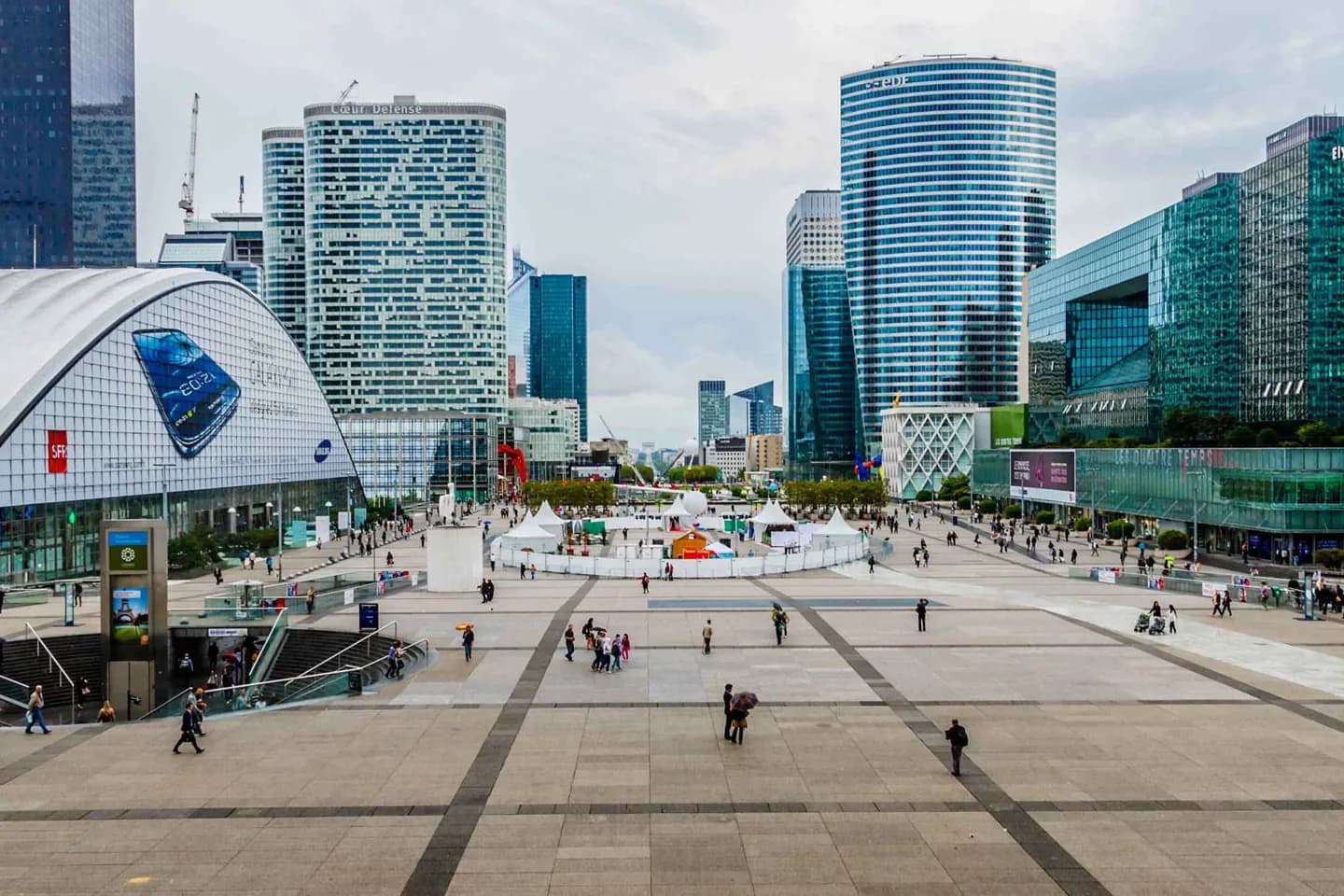
La Défense makes Paris’s urban scale visible in a way central streets cannot. The Grande Arche, Parvis and Esplanade du Général-de-Gaulle form a pedestrian sequence among glass and steel towers, while the view east connects the district with the Arc de Triomphe and Louvre. It suits visitors interested in contemporary architecture, planning and open-air sculpture.
What to look for
- The Grande Arche frames the sky at the western end of the historic axis.
- The pedestrian Parvis and Esplanade place towers, artworks and public space on a large scale.
- César’s Thumb and works by Miró, Calder and Takis make the district an open-air art setting.
The full story
La Défense grew from a western industrial fringe into Paris’s purpose-built business district after 1958. Its name comes from Louis-Ernest Barrias’s statue La Défense de Paris, which commemorates the defence of the city during the Franco-Prussian War. CNIT was an early landmark, and successive waves of towers replaced factories, shanties and a few farms. The RER A and later Métro Line 1 made the district part of the wider city. The Grande Arche was chosen in a competition to complete the historic axis and opened in 1989, turning the western end into a deliberate counterpoint to the Arc de Triomphe. The result is not a traditional quarter but a planned sequence of infrastructure, towers and monumental public space. That is why its open-air artworks and long views matter as much as individual buildings.
Useful to know
- Build the visit around the Grande Arche, Parvis and Esplanade instead of trying to enter office towers.
- Use RER A or Métro Line 1 for the cross-city journey, then allow time to walk the broad pedestrian spaces.
- Treat any rooftop, exhibition or shopping visit as a separate choice from the public-space walk.