
Why go
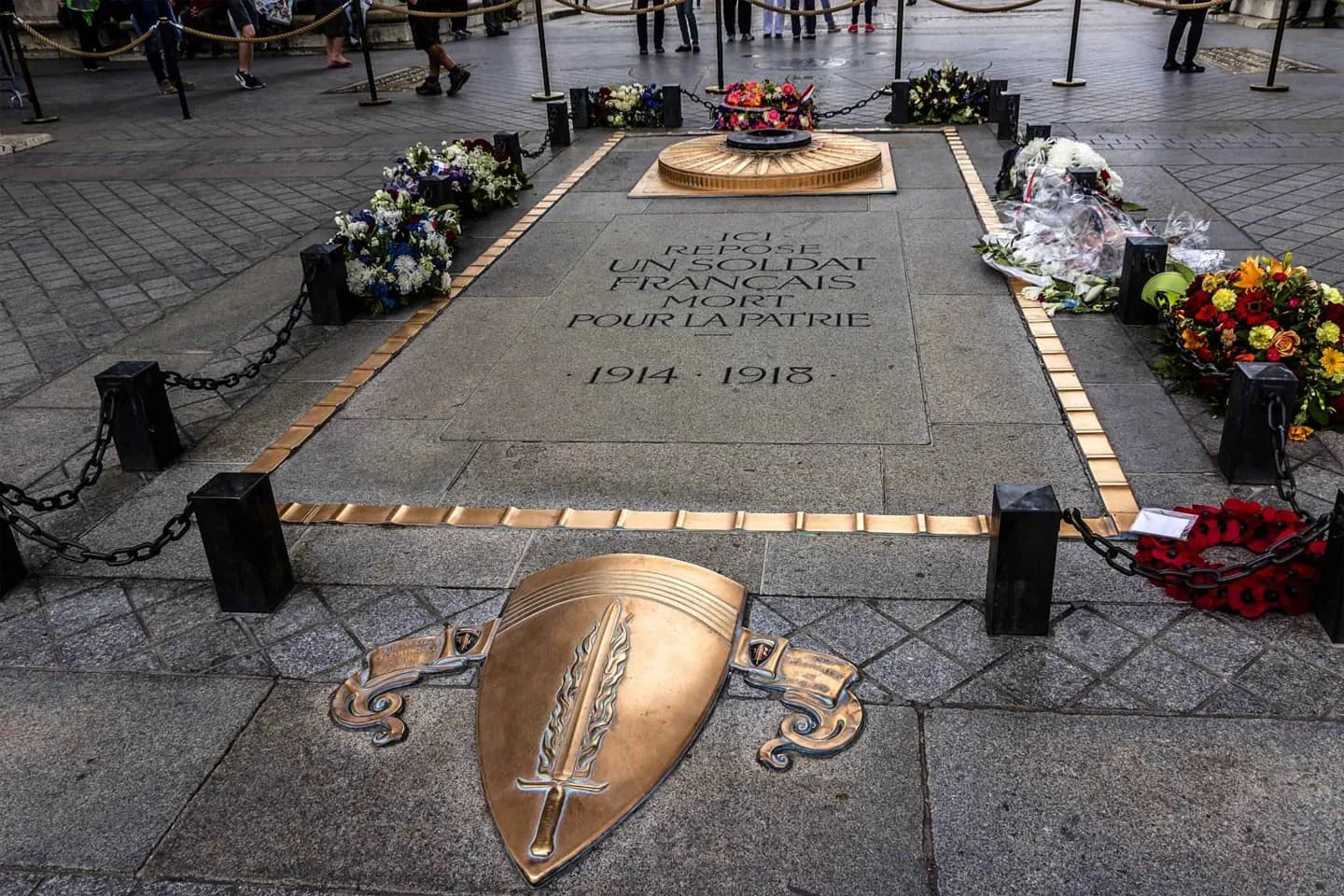
At the western end of the Champs-Élysées, the arch gives the avenue a destination and the surrounding streets a common center. Its scale is most apparent beneath the vault. The memorial below makes this more than a viewpoint: the monument joins public celebration of military victories with the memory of an unnamed soldier.
What to look for
- Names of French victories and generals cover the inner and outer surfaces.
- The Tomb of the Unknown Soldier lies beneath the vault.
- Twelve avenues radiate from Place Charles de Gaulle.
The full story
Napoleon ordered the arch in 1806 after victory at Austerlitz. Designed by Jean Chalgrin and inspired by the Roman Arch of Titus, it was not finished until 1836, under Louis-Philippe. Napoleon had already died; he passed beneath it only when his remains returned to Paris in 1840. That delayed completion helps explain why the arch belongs to several chapters of French history rather than a single reign. The surrounding square was originally called Place de l’Étoile, or Star Square, for the streets spreading outward from it. The monument also forms a hinge in the historic axis running from the Louvre toward the Grande Arche at La Défense. Its later association with the First World War changed the meaning of the space beneath the arch, adding mourning to a building conceived for triumph.
Useful to know
- Use the pedestrian underpass from the Champs-Élysées side to approach the monument.
- Combine the arch with a walk along the Champs-Élysées to see the same axis from ground level.
Your next visit
Estimated · Declared scenario and planning estimates; no live opening, weather, queue or booking service.
Outdoor visit · 30–45 min
World planning estimate; admission, opening, visit duration and access need checking.