
Why go
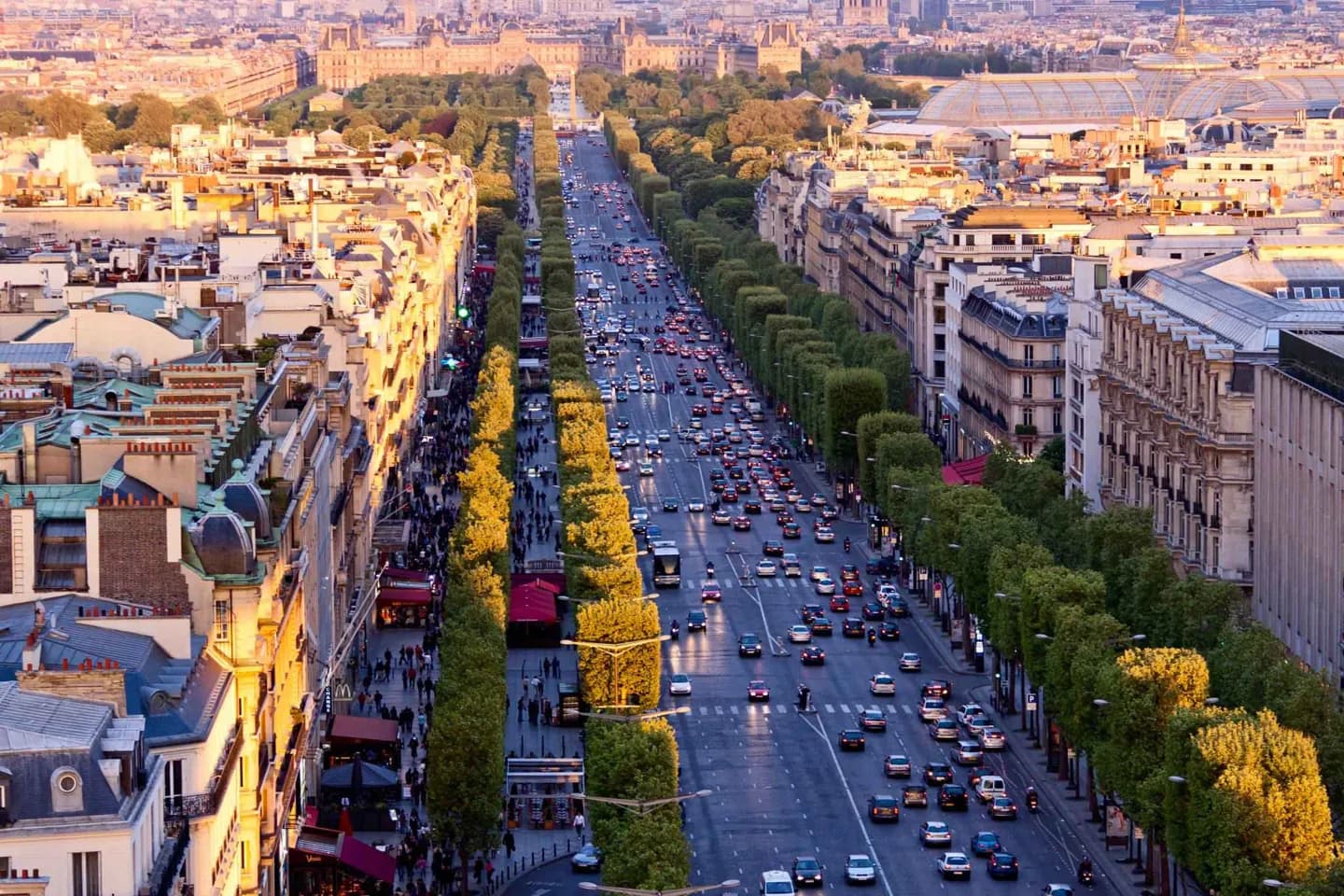
Walk it to see how Paris joins garden design, monuments and public ceremony in one straight line. The busiest stretch can feel commercial, but the planted gardens and the sequence from Concorde through the Grand Palais area give the avenue its real spatial logic.
What to look for
- The avenue began as André Le Nôtre’s extension of the Tuileries Garden under Louis XIV.
- The gardens beside the avenue retain a planted promenade within the larger monumental axis.
- The Grand Palais and Petit Palais mark the 1900 Exhibition precinct near the eastern end.
The full story
The Champs-Élysées began in 1667 as a broad promenade extending the Tuileries Garden. André Le Nôtre set out a formal route of trees and flowerbeds that carried the royal garden westward. It was extended over the following century toward today’s Arc de Triomphe, then became city property in 1828, when paths, fountains and lighting were added. Its role has changed repeatedly: nineteenth-century gardens held cafés, theatres and entertainments, and the 1900 Universal Exhibition added the Grand Palais and Petit Palais. The avenue still works as a ceremonial route, but its lasting interest is the way it frames a sequence of Parisian public spaces. It is also part of the Axe historique, linking the Tuileries side of central Paris to the Arc de Triomphe through a continuous monumental line.
Useful to know
- Walk one direction between Concorde and the Arc rather than retracing the whole avenue.
- Use Métro Line 1 to enter or leave at either end if you want to focus on a particular section.
- Large public events can reshape access and crowds, so check the city’s notices before planning a timed walk.
Your next visit
Estimated · Declared scenario and planning estimates; no live opening, weather, queue or booking service.
Outdoor visit · 30–45 min
World planning estimate; admission, opening, visit duration and access need checking.