
Why go
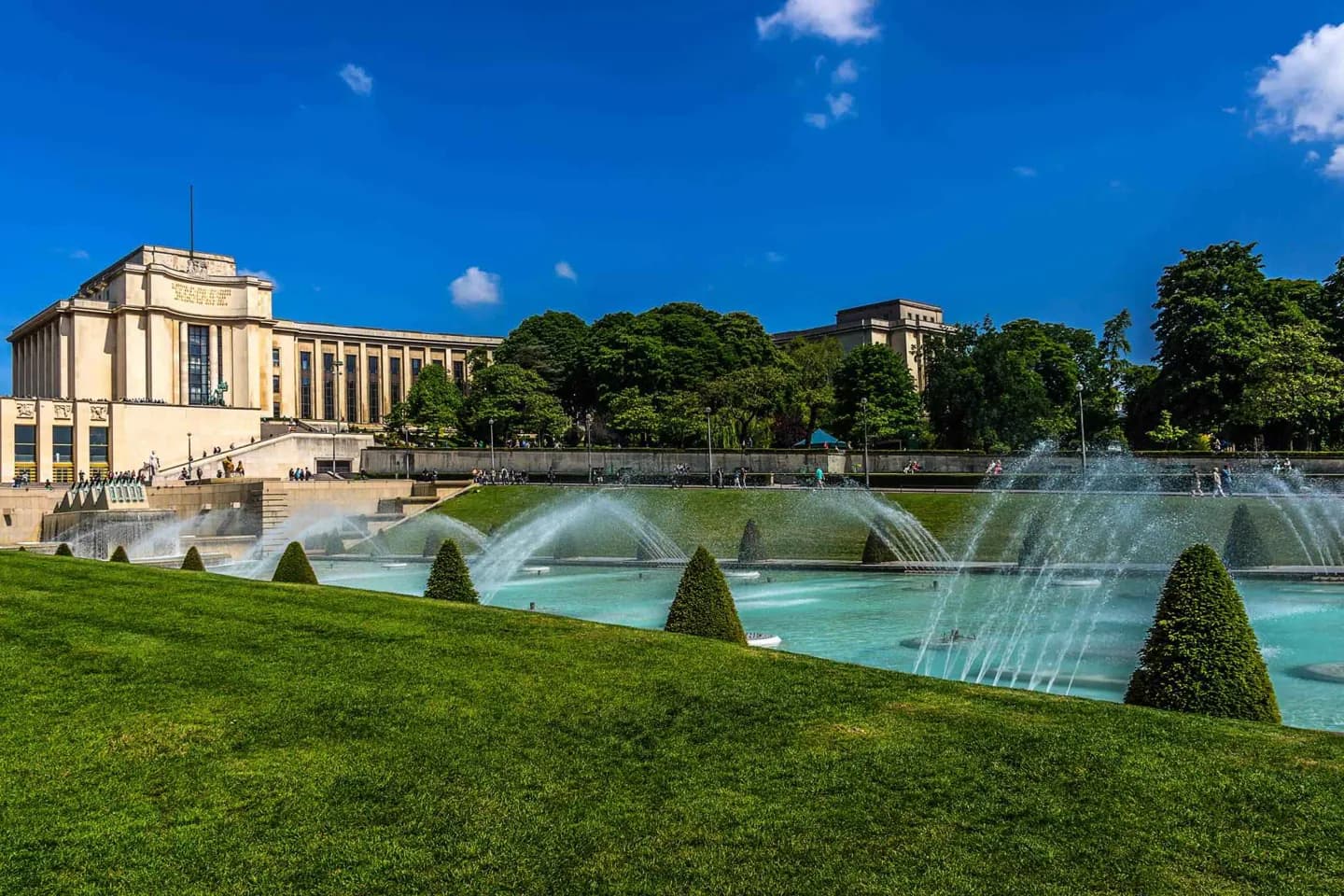
The gardens let you experience the Trocadéro axis at ground level, with the Eiffel Tower rising beyond the fountain and Pont d’Iéna. The long basin, cascades, gilded bronzes and 1930s stone figures create a richer stop than a quick photograph from the upper terrace.
What to look for
- The Warsaw Fountain’s long water mirror forms the centre of the downhill axis.
- Gilded bronze groups of animals stand in square basins above the main fountain.
- Stone and bronze sculptures from the 1930s appear along the terraces and lawns.
The full story
The gardens occupy the slope between the Palais de Chaillot and the Seine. Jean-Charles Alphand first laid out this ground for the 1878 Universal Exposition and its original Palais du Trocadéro. The present scheme came with the 1937 International Exposition, when architect Roger-Henri Expert redesigned the gardens alongside the new palace. Its centrepiece, the Warsaw Fountain, uses a long basin, cascades, vertical jets and water arches to extend the architectural axis toward Pont d’Iéna and the Eiffel Tower. Sculpture is part of the plan rather than an afterthought. Gilded bronzes show a bull and deer, and horses with a dog; other figures include paired representations of man and woman and monumental groups of Apollo and Hercules. Together, the planting, water and sculpture soften the formal exhibition layout while preserving its strong cross-river perspective.
Useful to know
- Walk downhill from the Chaillot terrace toward the Seine to watch the tower view change along the axis.
- The gardens are currently listed as continuously accessible, but temporary works or events can restrict sections.
Your next visit
Estimated · Declared scenario and planning estimates; no live opening, weather, queue or booking service.
Outdoor visit · 30–45 min
World planning estimate; admission, opening, visit duration and access need checking.