
Why go
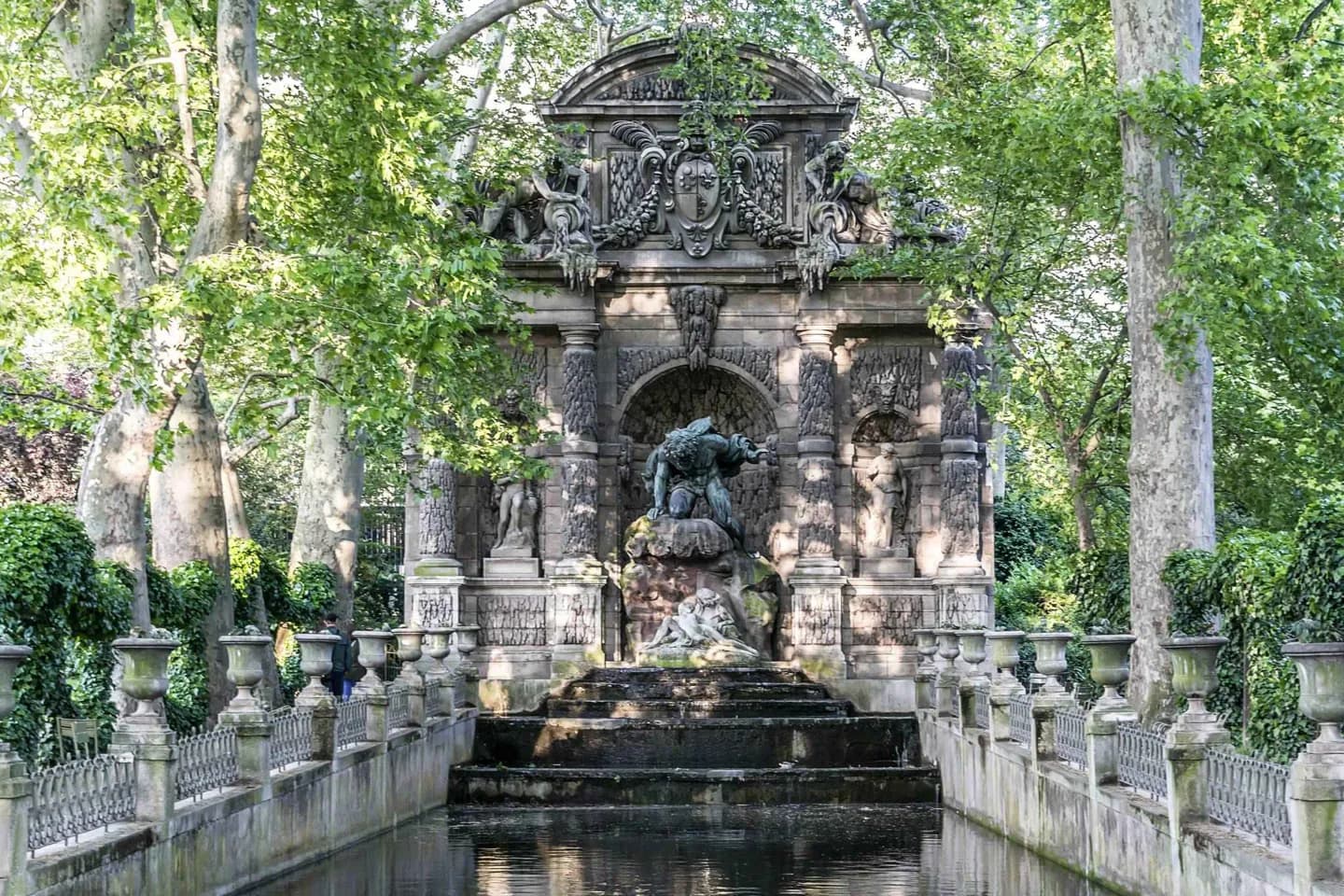
The fountain condenses three centuries of garden history into one quiet corner. Marie de’ Medici’s Italian-inspired grotto survives within a nineteenth-century reconstruction, while Auguste Ottin’s group of Polyphemus surprising Acis and Galatea supplies the dramatic focus. Reflections in the narrow basin make the stonework and plane trees part of the scene.
What to look for
- The long rectangular basin mirrors the grotto and surrounding trees.
- Polyphemus looms above Acis and Galatea in Auguste Ottin’s central group.
- Rusticated stone, columns and a broken pediment preserve the structure’s grotto character.
The full story
The shaded fountain is one of the garden’s most distinctive historical compositions. Marie de’ Medici commissioned a grotto for the gardens of her new palace around 1630, drawing on the fountains and artificial caves of Italian Renaissance estates. Water was difficult to supply on Paris’s Left Bank until the Arcueil aqueduct made such features possible. The monument changed repeatedly after the queen’s death. Jean Chalgrin restored it under Napoleon, and the most radical alteration came in the 1860s when Haussmann’s street works forced it to move. Alphonse de Gisors rebuilt the fountain in its present position, added the long basin and installed Auguste Ottin’s sculpture of Polyphemus, Acis and Galatea. That layered history explains why the site combines a seventeenth-century grotto idea with a strongly nineteenth-century theatrical composition.
Useful to know
- Enter during Luxembourg Garden opening hours; seasonal closing times change through the year.
- Approach along the pool’s length so the grotto and sculpture gradually align.
Your next visit
Estimated · Declared scenario and planning estimates; no live opening, weather, queue or booking service.
Outdoor visit · 10–25 min
Public-space walk and exterior observation only; no interior, garden, tower or ticketed admission included. Durations and walking are estimates. Check temporary restrictions and park or market opening times.
Outdoor visit · 30–45 min
World planning estimate; admission, opening, visit duration and access need checking.