
Why go
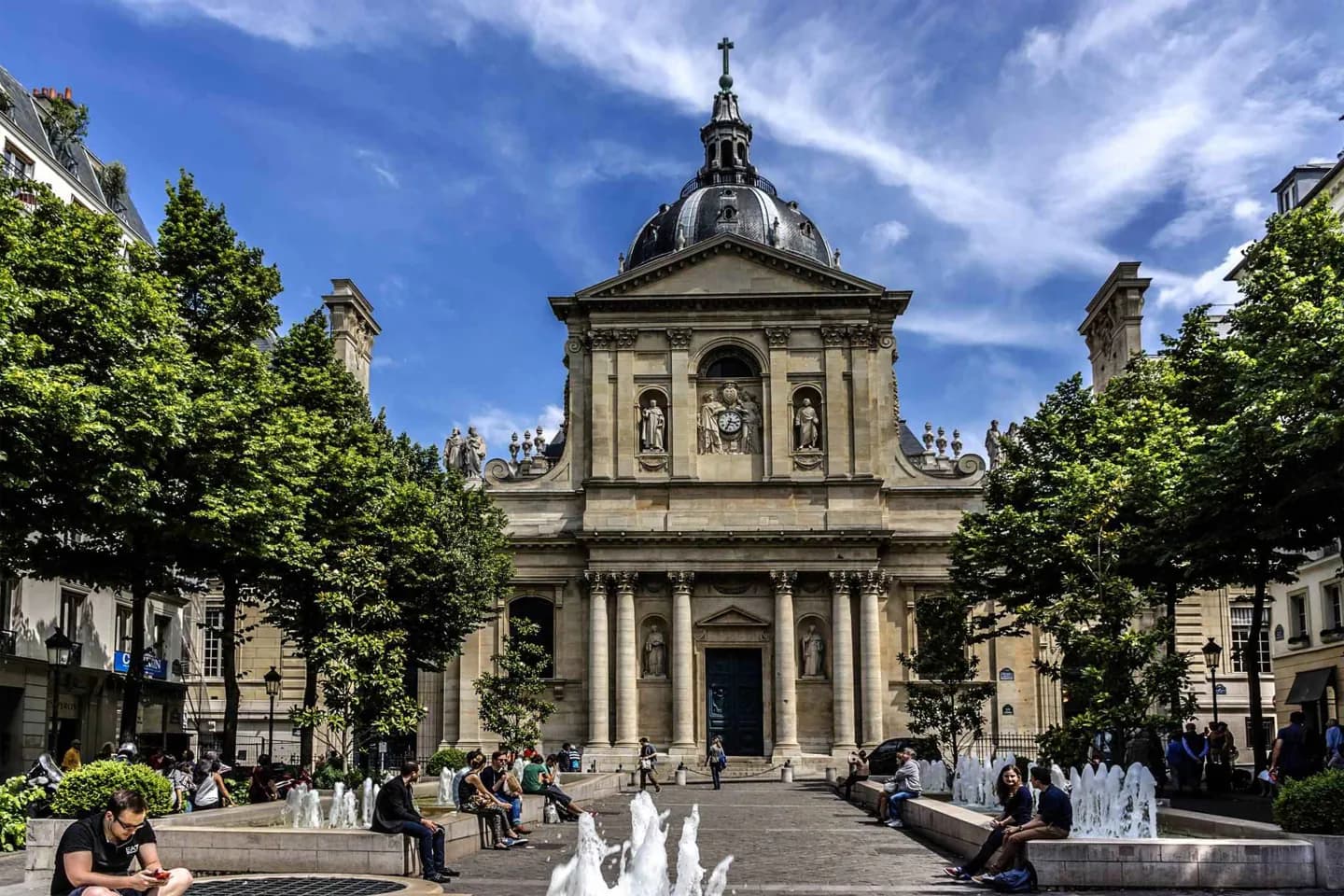
The Sorbonne gives physical form to an institution usually encountered as a name. Its honour courtyard, chapel, salons and amphitheatres connect scholarship with ceremonial architecture and the patronage behind it. It suits visitors interested in medieval Paris and university history; interior access should be planned around an available official guided route.
What to look for
- Historic amphitheatres form part of the Sorbonne’s academic palace.
- The honour courtyard faces the Sorbonne Chapel and Richelieu’s tomb.
- Salons and galleries show the ceremonial side of university life.
The full story
The Sorbonne began as a college, not as the whole University of Paris. Robert de Sorbon founded the theology college around 1257 within a university that had developed from the cathedral school associated with Notre-Dame. The university’s early schools at Notre-Dame, Sainte-Geneviève and Saint-Victor helped make the Left Bank a centre of learning. Over time, the college’s name became shorthand for the larger institution, which is why it appears across Paris in more than one setting. Its medieval structure of arts, medicine, law and theology gave the university an influence that reached beyond France. The name now also carries the changes that followed 1968, when the University of Paris was divided into thirteen autonomous universities in 1970. The historic palace represents that shared inheritance rather than a single, unchanged medieval institution.
Useful to know
- Check official guided-tour options before relying on an interior visit.
- Combine the Sorbonne with nearby Musée de Cluny for medieval art, or keep the walk within the Latin Quarter.
- The building is close to the RER B at Luxembourg and the Métro around Cluny–La Sorbonne.
Your next visit
Estimated · Declared scenario and planning estimates; no live opening, weather, queue or booking service.
Outdoor visit · 30–45 min
World planning estimate; admission, opening, visit duration and access need checking.