
Why go
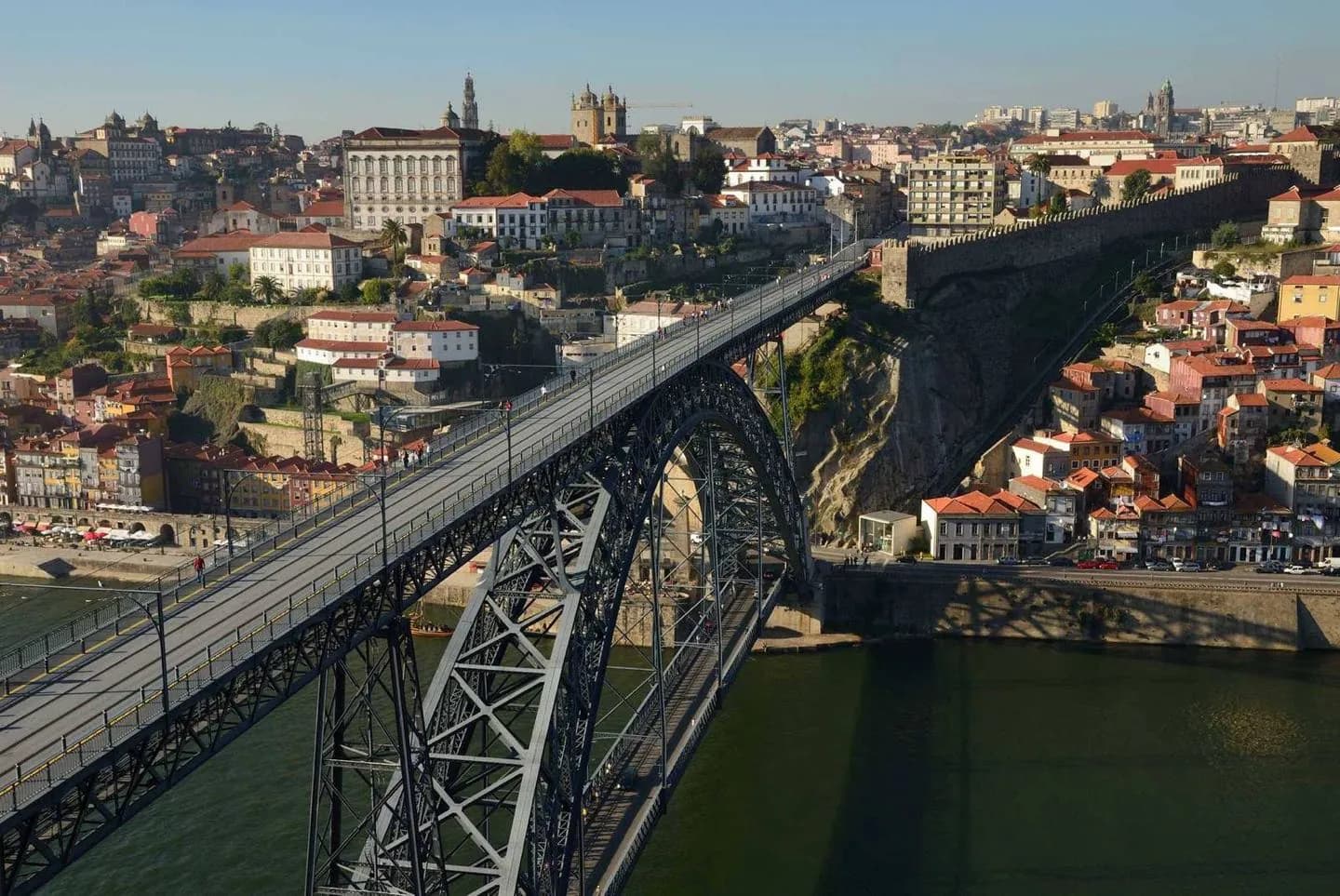
The bridge's slender crescent arch shows the engineering ambition that preceded Porto's later crossings. Seen alongside the neighboring rail bridges, it makes changes in structural design immediately visible and adds an industrial counterpoint to the historic riverfront below on the Douro.
What to look for
- A two-hinged wrought-iron crescent arch carries the former rail deck high above the Douro.
- The open lattice gives the bridge a striking lightness despite its long span.
- Nearby Ponte de São João reveals the modern crossing that replaced it in rail service.
The full story
Gustave Eiffel's design won an 1875 competition for a railway crossing over the Douro. Construction began in 1876, and the bridge opened in 1877 under the name of Queen Maria Pia. The new crossing removed a long rail detour around the river. Its wrought-iron arch answered a difficult site with an economical, visually spare structure; at completion, its 160-meter span set a world record for an arch bridge. Trains used the crossing for more than a century. In 1991, Edgar Cardoso's Ponte de São João replaced it, leaving the Maria Pia without its original transport role. That retirement makes the bridge especially useful today as an engineering landmark: its exposed metalwork can be read clearly against the newer concrete crossing.
Useful to know
- Plan to view the bridge from the Douro banks; public access onto the structure is not established.
- Look for an angle that includes Ponte de São João to compare the old and replacement railway crossings.
Your next visit
Estimated · Declared scenario and planning estimates; no live opening, weather, queue or booking service.
Outdoor visit · 30–45 min
World planning estimate; admission, opening, visit duration and access need checking.