
Why go
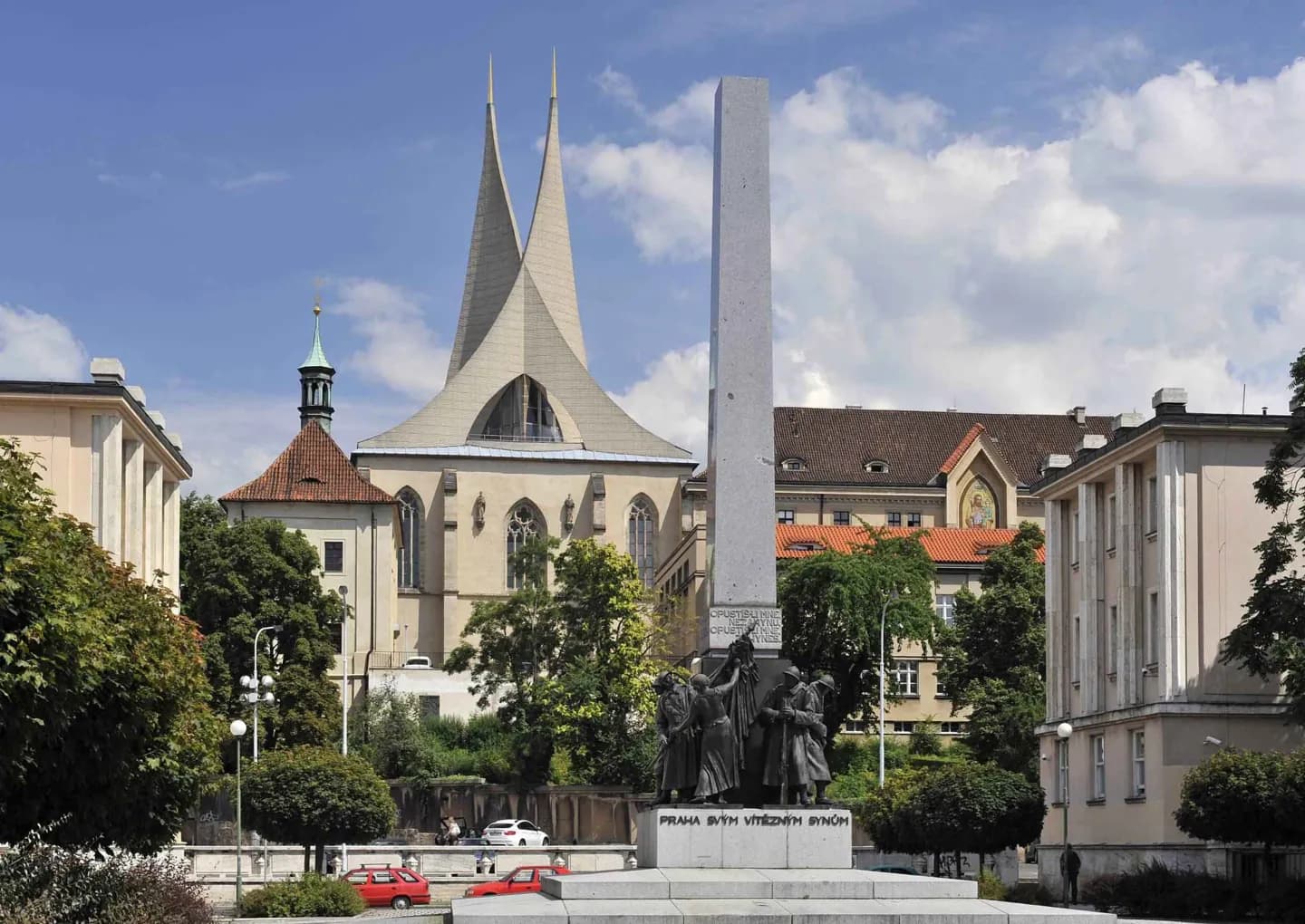
Emmaus offers an unusually clear contrast: Gothic remains and faded wall paintings inside, then striking twentieth-century spires above the church. Charles IV founded it for Benedictines who used Old Church Slavonic, giving the site a distinct place in the city's religious history.
What to look for
- The Gothic cloister retains fragments of medieval wall paintings.
- The church's paired modern spires rise above older monastery buildings.
- The monastic complex sits just south of Charles Square in the New Town.
The full story
Charles IV founded Emmaus Monastery in the fourteenth century for a Benedictine community that used Old Church Slavonic in worship. That choice set it apart from most monasteries around it. The surviving Gothic cloister carries faded fragments of a medieval painting cycle, so the historical interest is in the walls as much as in the church. The complex changed repeatedly over the centuries, but its most striking change came after the 1945 bombing of Prague damaged the church and monastery. The twin concrete spires added during the postwar rebuilding give its skyline a modern profile. From outside, look at how sharply they differ from Prague's older church towers. Inside, the quieter cloister preserves an earlier chapter that the spires alone cannot tell.
Useful to know
- Allow time for the cloister rather than stopping only for the spires outside.
- Combine it with Charles Square on a New Town walk; check the monastery's current visitor arrangements before entering.
Your next visit
Estimated · Declared scenario and planning estimates; no live opening, weather, queue or booking service.
Indoor visit · 30–45 min
World planning estimate; admission, opening, visit duration and access need checking.