
Why go
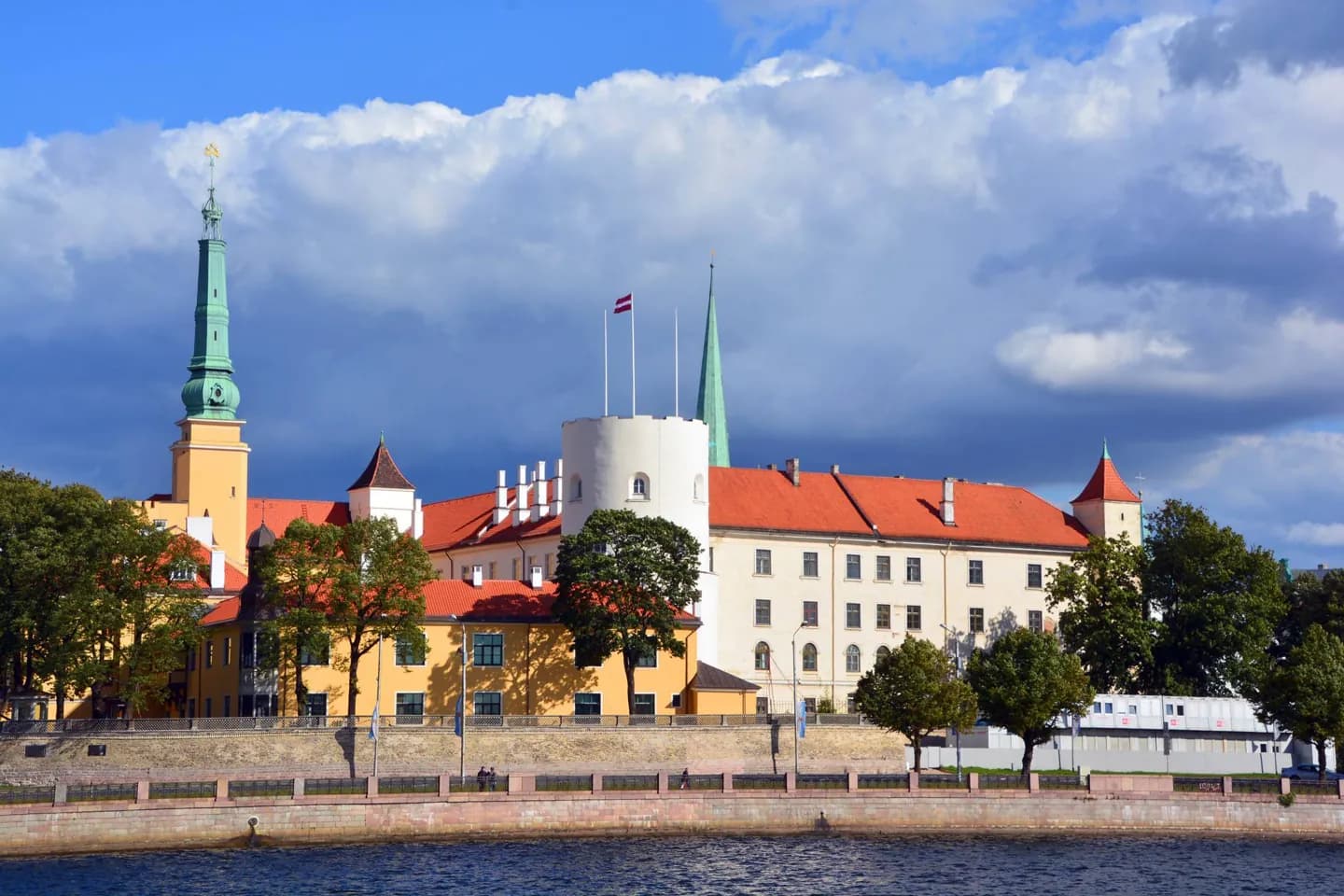
The riverside exterior lets you read Riga Castle’s successive roles in one building: a fortified medieval stronghold, a residence for rulers and a seat of government. Its towers and altered façade show how defensive architecture was adapted as political power changed, making the castle’s history visible from the public streets.
What to look for
- The castle's mass and towers face the Daugava at Old Town's edge.
- Round towers reflect the rebuilding after the castle's medieval destruction.
- Later additions reveal a building repeatedly adapted for rulers and governments.
The full story
Riga Castle began in 1330 as a fortress of the Livonian Order beside the Daugava. Conflict with Riga's citizens shaped its site and survival: townspeople destroyed an earlier Order castle, and the later castle itself was demolished in 1484. The rebuilt structure was completed in the early sixteenth century, with round towers replacing two earlier corner towers as defensive design changed. The building then served successive administrations under Polish-Lithuanian, Swedish and Russian rule. In independent Latvia it became a presidential residence; Soviet occupation interrupted that role, which returned after independence was restored. Its public-street exterior is therefore a different experience from a visit to the ceremonial rooms. On a short walk, the most revealing approach is to notice the fortified form first, then consider how a building designed for conflict became a setting for the modern state.
Useful to know
- Plan roughly 20 minutes for the exterior around Pils laukums.
- Treat a presidential interior tour as a separate visit arranged through the official tour programme.
- Pair the street view with the nearby cathedral quarter rather than assuming entry through the castle gates.
Your next visit
Estimated · Declared scenario and planning estimates; no live opening, weather, queue or booking service.
Outdoor visit · 30–45 min
World planning estimate; admission, opening, visit duration and access need checking.