
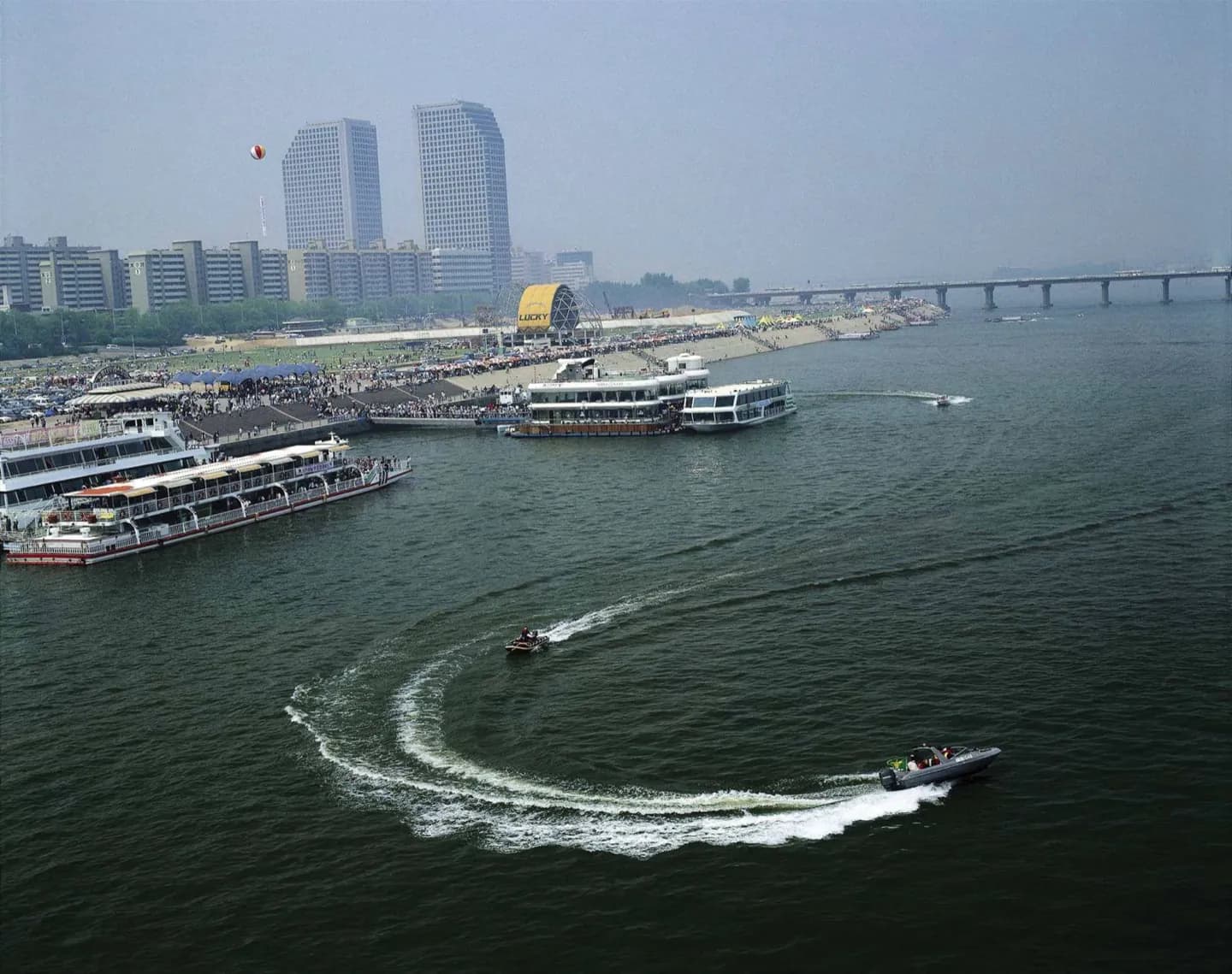
Why go
Yeouido works best for travelers interested in Seoul’s twentieth-century transformation. The National Assembly, corporate towers, broadcasting headquarters, and river edges show how a former sandbar became a center of public and economic power. Its broad scale also offers a revealing contrast with the compact lanes of Seoul’s historic core.
What to look for
- The National Assembly Building within Seoul’s main government setting
- The 63 Building rising beside the Hangang
- Riverfront parkland set against finance and broadcasting towers
The full story
Yeouido was once a low sandbar that remained largely unsettled because the Hangang flooded it. A small piece of higher ground stayed above the water, and the island’s name became associated with the dismissive idea that the otherwise inconvenient land could simply be given away. Its role changed sharply in the twentieth century. An airport opened here in 1924, serving civil and military flights as well as a flight school. A six-lane bridge connected the island to Yeongdeungpo in 1970, and rapid development followed. Yeouido became a distinct administrative neighborhood in 1971 and grew into Seoul’s major financial district. The National Assembly Building, Korea Exchange, corporate headquarters, broadcasting organizations, and the 63 Building now give the island a concentration of national institutions. Koreans even use “the size of Yeouido” as a familiar unit when describing large areas. That phrase makes sense on the ground: the island feels measurable and self-contained, with a planned scale very different from the alleys and palace walls north of the river.
Useful to know
- Plan the island by anchor—riverfront, National Assembly, or 63 Building—to avoid an unfocused walk.
- Combine built landmarks with time beside the Hangang for the clearest contrast.
- Expect longer distances than in Seoul’s compact historic neighborhoods.
Your next visit
Estimated · Declared scenario and planning estimates; no live opening, weather, queue or booking service.
Outdoor visit · 30–45 min
World planning estimate; admission, opening, visit duration and access need checking.