
Why go
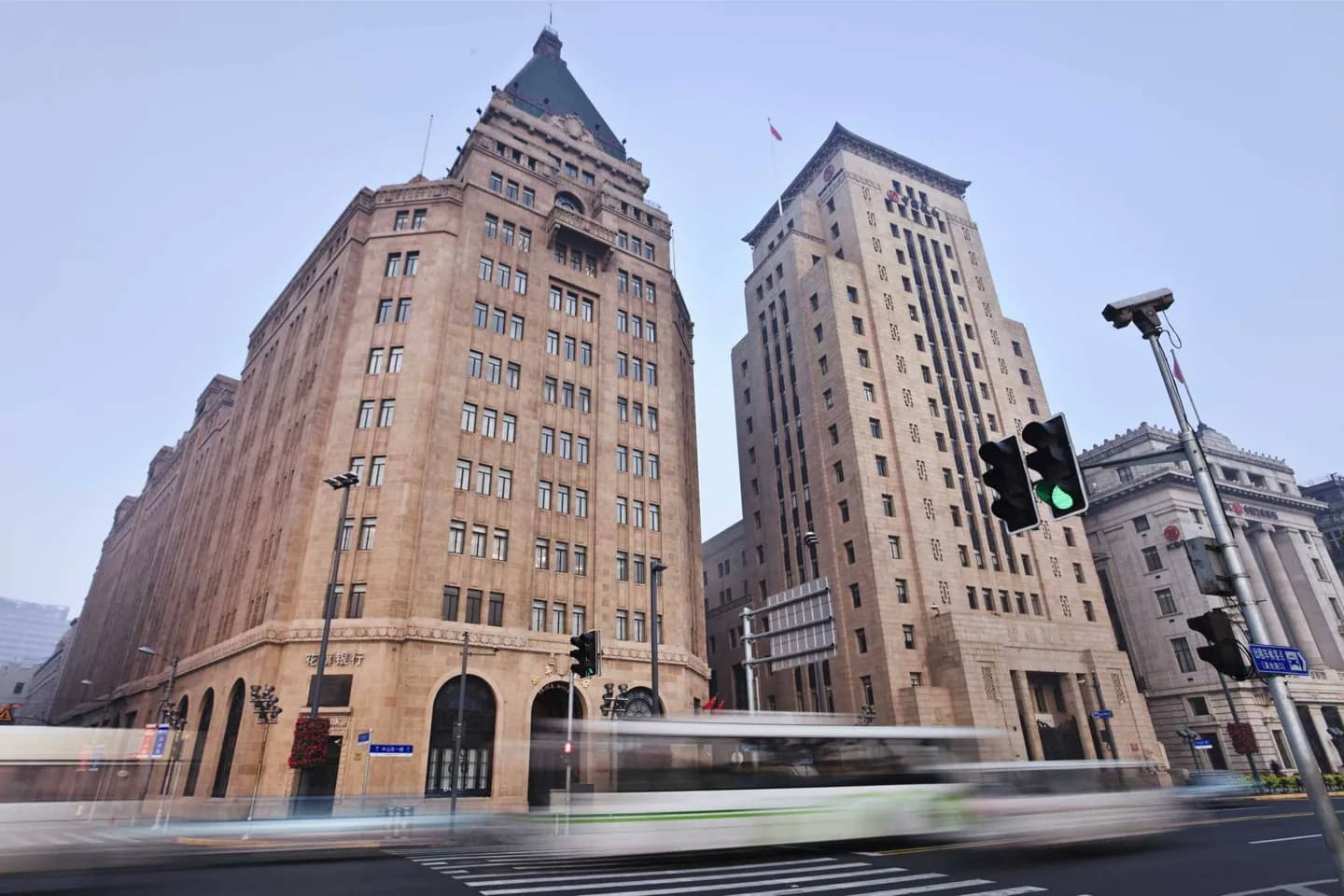
Its value lies in the way a Chinese bank presented itself among foreign-built commercial landmarks. Smooth stone surfaces give the main block a restrained appearance, while roof, window and railing details introduce a different decorative vocabulary. Seen beside the Peace Hotel, it makes the waterfront’s competing architectural identities easier to compare.
What to look for
- A square pyramidal roof above the river-facing main block
- Cut-out longevity characters on the sides of the floors
- Traditional patterns in window details and railings
The full story
The Bank of China built its Bund headquarters on the site of the former German Club. Its main eastern block faces the waterfront, while a lower western annex completes the complex. The exterior uses smooth Jinshan stone and a low square pyramidal roof, with traditional patterns in the railings and windows. Longevity characters provide a particularly readable Chinese motif within a street dominated by other banks’ classical columns and domes. The construction also had institutional significance: a Chinese-funded bank used Chinese workers to establish its presence among the foreign commercial buildings of the concessions. That context changes how the facade reads. Its decorative choices were part of a statement about who could commission a major waterfront headquarters, rather than simply an attempt to match the architectural fashions of its neighbors.
Useful to know
- Use No. 23 Zhongshan East First Road to distinguish it from the modern Pudong tower.
- Compare its roof and stone details with the Peace Hotel next door.
- Focus on the street-facing architecture unless visitor entry is confirmed.
Your next visit
Estimated · Declared scenario and planning estimates; no live opening, weather, queue or booking service.
Outdoor visit · 30–45 min
World planning estimate; admission, opening, visit duration and access need checking.