
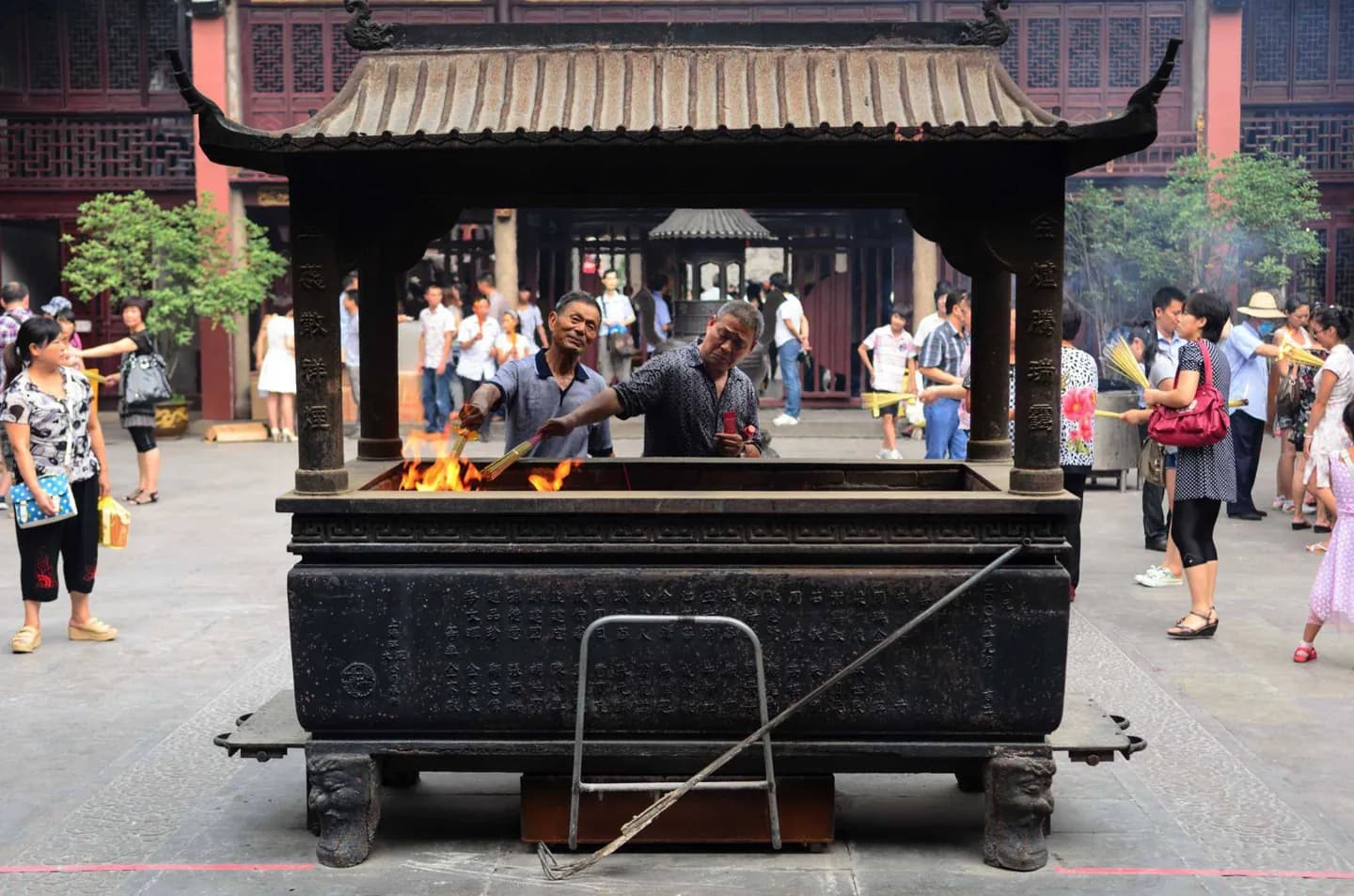
Why go
The deities honored here connect Shanghai’s civic identity with religious practice. Qin Yubo, a scholar and official, and Chen Huacheng, a general killed defending Shanghai, belong to that local tradition. This adds meaning to the temple halls beyond the commercial bustle of the surrounding streets.
What to look for
- Taoist halls honor figures revered as Shanghai’s city gods.
- The temple complex is separate from neighboring Yu Garden and Yuyuan Bazaar.
The full story
City-god temples gave many Chinese cities a spiritual protector. Shanghai’s temple developed from a shrine dedicated to the spirit of Jinshan, or Gold Mountain, and became a City God Temple in 1403. Residents came to pray for peace and good fortune, while the temple’s popularity helped businesses grow around it. This explains why the name Chenghuangmiao can refer both to the religious complex and to its commercial surroundings. Three historical figures are honored as Shanghai’s city gods: Huo Guang, Qin Yubo and Chen Huacheng. Their veneration gives the temple a specifically local civic meaning, alongside its role as a place of worship. Knowing that distinction helps separate the meaning of the temple from the neighboring bazaar. The shopping streets grew around a place of worship, rather than the temple being simply an ornamental part of a market.
Useful to know
- Combine the temple with Yuyuan Bazaar, treating worship and shopping as separate parts of the visit.
- Check temple and garden visitor information independently before arranging interior visits.
Your next visit
Estimated · Declared scenario and planning estimates; no live opening, weather, queue or booking service.
Outdoor visit · 30–45 min
World planning estimate; admission, opening, visit duration and access need checking.