
Why go
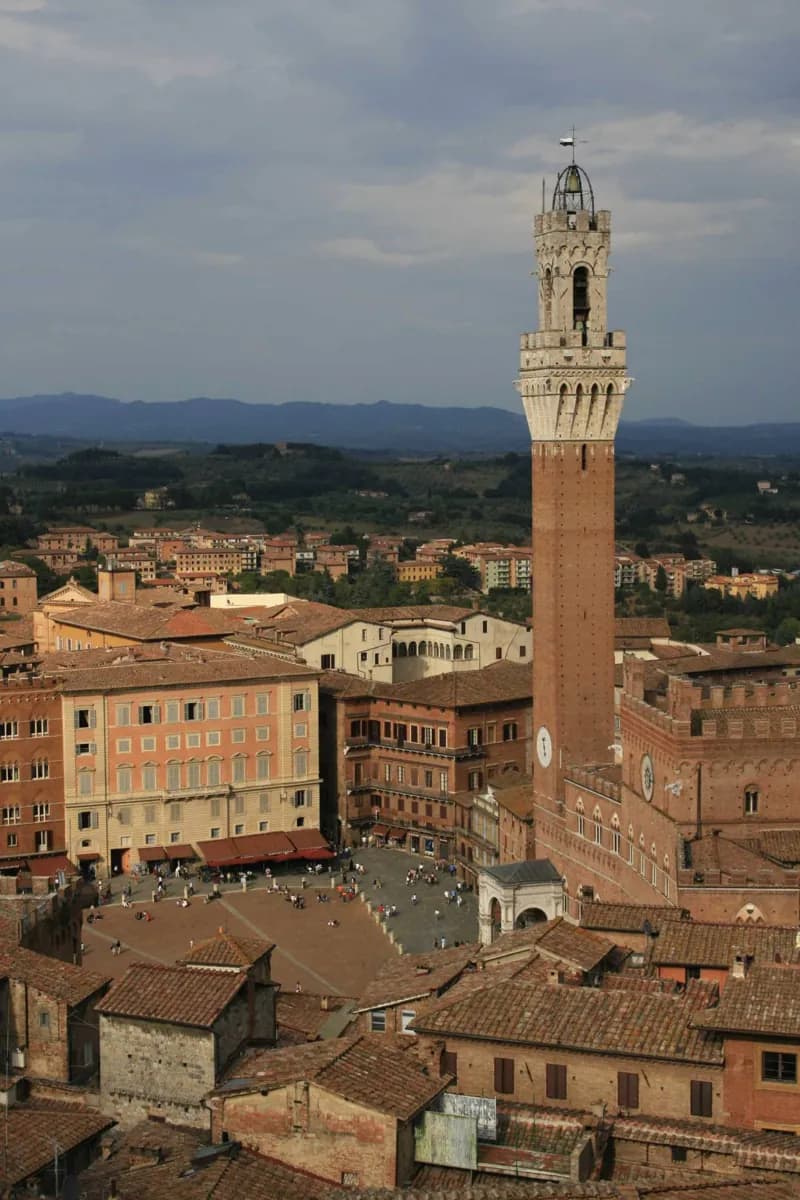
The tower makes Siena’s medieval civic ambition visible from both the square and the summit. From below, compare its long brick shaft with the marble crown; above, the shape of Piazza del Campo and the position of the cathedral become clear.
What to look for
- The brick shaft rises directly beside Palazzo Pubblico.
- The pale marble crown contrasts with the brick below.
- The summit opens a panorama across Siena and the surrounding hills.
The full story
Built between 1338 and 1348 beside Siena’s Palazzo Pubblico, Torre del Mangia made the republic’s civic authority a visible part of the skyline. Its name recalls Giovanni di Balduccio, an early bellringer nicknamed Mangiaguadagni, or “profit eater.” Look at the tower as two structures in one: the long, plain brick shaft draws the eye upward, while the pale stone and marble crown announces its summit across the city. At its foot, the Cappella di Piazza was added after the Black Death as a votive work. The tower and the nearby cathedral were conceived as comparable landmarks, a visual expression of the place held by civic and religious institutions in medieval Siena. That relationship is easier to grasp from Piazza del Campo than from a close view of either building alone. From the top, the fan shape of the square gives the civic center a scale that street level cannot show.
Useful to know
- Allow for roughly 400 steps with no lift; the official visit is limited to a maximum of 30 minutes.
- Check the civic museum before climbing: the tower may close in bad weather or for maintenance.
Your next visit
Estimated · Declared scenario and planning estimates; no live opening, weather, queue or booking service.
Outdoor visit · 30–45 min
World planning estimate; admission, opening, visit duration and access need checking.