
Why go
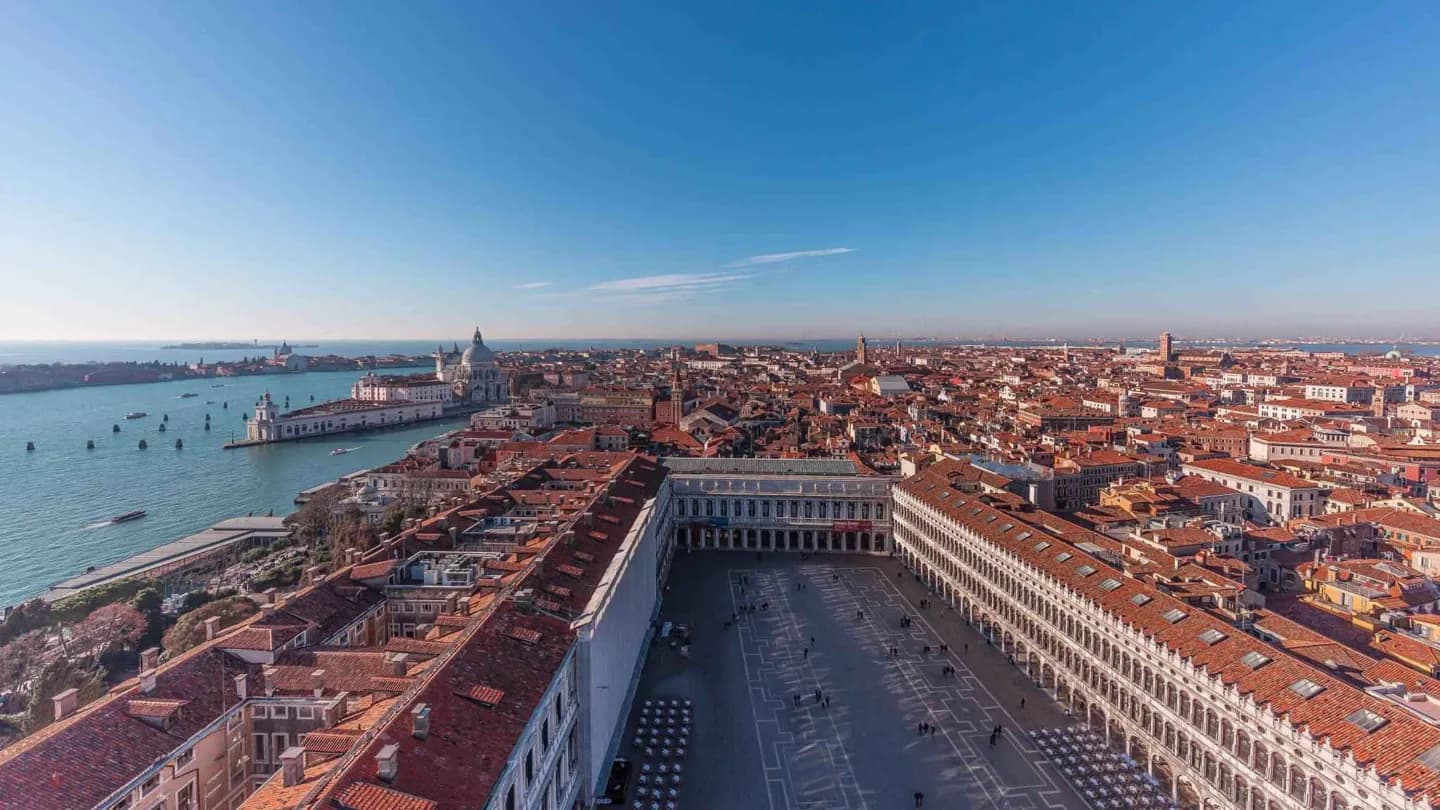
A slow circuit makes the square more legible than a quick crossing. Notice the Basilica’s patterned façade and horses, the Campanile’s freestanding profile, and the long Procuratie arcade. Together they show how Venice paired religious symbols with the offices and rituals of its republic.
What to look for
- The Basilica combines arches, patterned marble and sculpture in a dense ceremonial façade.
- The Procuratie Vecchie reveal the square’s former administrative role.
- The Campanile’s separation from the church gives the piazza its open central volume.
The full story
The square’s architecture was built to be read in sequence. At its eastern end, St Mark’s Basilica gathers marble, sculpture and mosaics around its portals, while the four horses above the central entrance became enduring symbols of Venice’s power. Along the north side, the Procuratie Vecchie once housed the Procurators of St Mark, senior officials of the republic. The Campanile stands apart from the Basilica rather than merging with it, making the open space between them part of the composition. Its reconstruction after collapse preserved the familiar silhouette visitors see today. The contrast between richly decorated church and regular arcades makes the square feel formal without becoming visually uniform, and clearly reveals the hierarchy of its former civic institutions today.
Useful to know
- Read the square from west to east, then turn back to compare the arcades and Basilica.
- Save interior-focused Basilica detail for a separate visit rather than trying to absorb it from the square.