
Why go
This guide turns a stroll into a way of reading the city. St Mark's Square shows state display, Campo San Polo shows a different civic scale, the Arsenal shows industrial organization, and the Zattere shows how waterfronts connect long stretches of the city. Each setting serves a different purpose.
What to look for
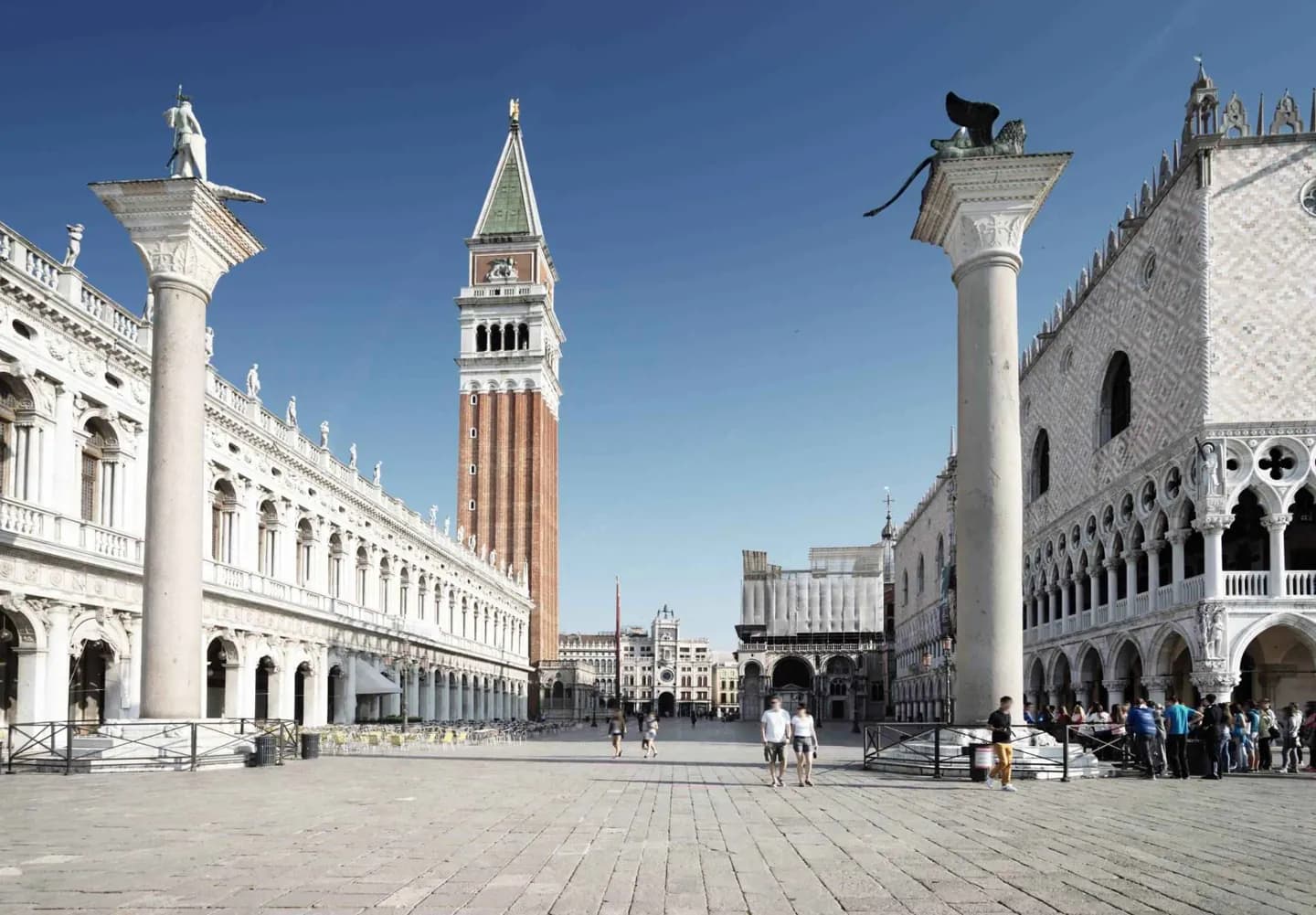
- St Mark's Square is framed by the basilica, Doge's Palace, and former state buildings.
- Campo San Polo offers a broad counterpoint to the formal space of St Mark's Square.
- The Arsenal's scale reflects Venice's historic need for organized ship production.
The full story
Venice's architecture is inseparable from the conditions under which it was built. The historic city occupies islands cut by canals, so each neighborhood developed around bridges, a campo, and a parish church rather than a continuous road network. Major spaces reveal distinct functions. St Mark's Square was the republic's setting for government and ceremony, enclosed by the basilica, Doge's Palace, Procuratie, and other public buildings. Campo San Polo offers a broader neighborhood square across the Grand Canal, while the Arsenal in Castello was a vast shipbuilding complex whose surrounding district housed workers. The western edge of the city was reshaped by rail and road links to the mainland, and the Zattere and Riva degli Schiavoni provide extended pedestrian waterfronts. Beneath all of it are piles and light masonry adapted to lagoon ground. The result is not one architectural style but a city whose form tells you what each place once did.
Useful to know
- Compare one major civic space with a neighborhood campo to see how Venice organized public life at different scales.
- Walk the Zattere or Riva degli Schiavoni for long waterfront views that are rare in the inner maze.