
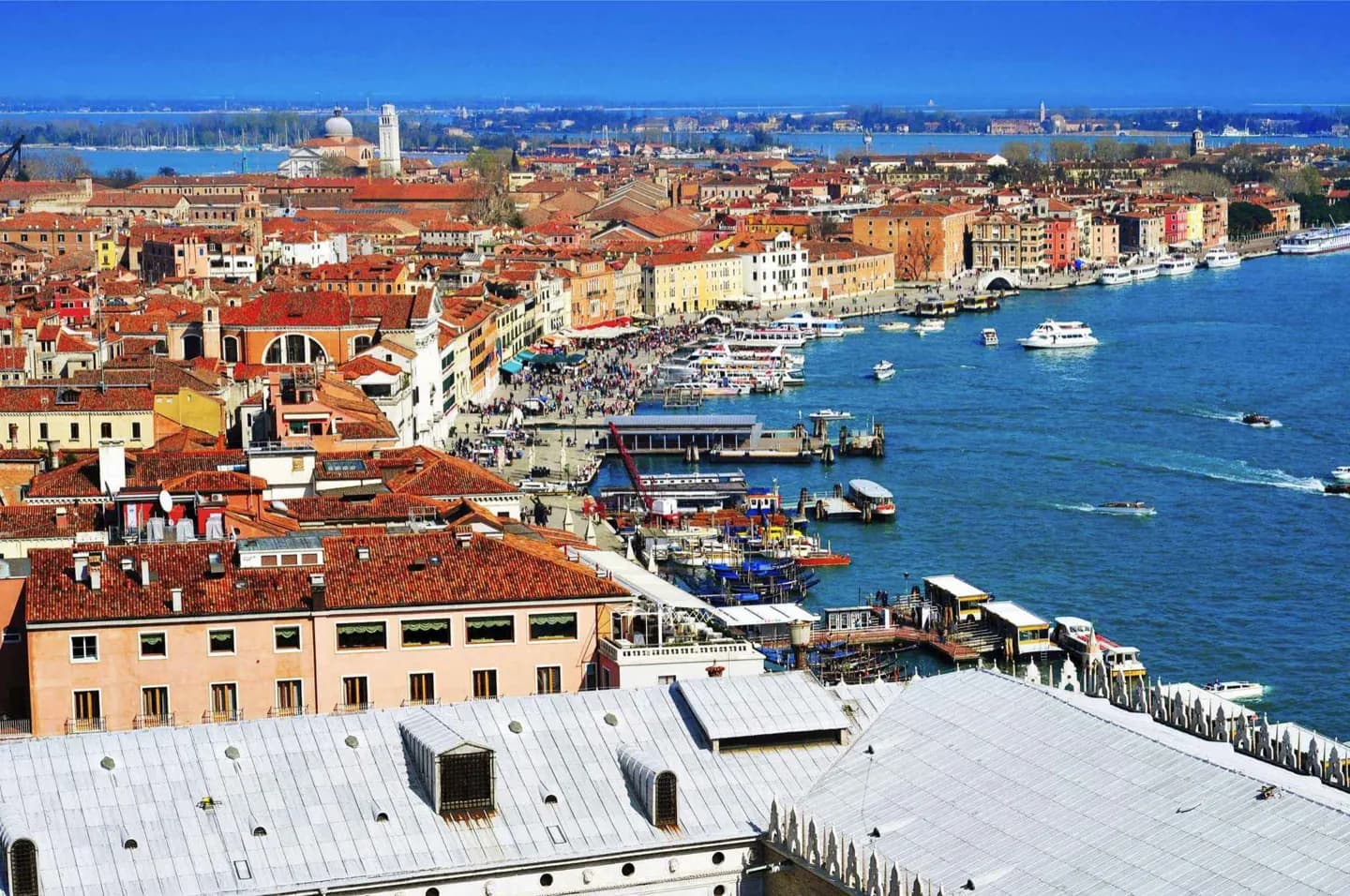
Why go
They are often the right answer when a walk crosses several sestieri, luggage is involved, or an island lies beyond the historic center. A Grand Canal ride gives orientation between Santa Lucia, Rialto, and San Marco; northern routes connect Murano, Burano, and Torcello. The compromise is waiting and crowding at busy stops.
What to look for
- Grand Canal services link Santa Lucia, Rialto, and San Marco areas.
- Northern lagoon services use Fondamente Nove as an important connection point.
- Vaporetti combine everyday transport with wide views of canal-facing architecture.
The full story
A vaporetto is Venice's water bus, and learning to use one makes the city far easier to understand. On the Grand Canal, the boat links Santa Lucia, Rialto, and the San Marco area while passing façades built for waterborne arrival. Elsewhere, routes circle the city or head north from Fondamente Nove toward Murano, Burano, and Torcello. This produces a different kind of navigation from a street network: landings, route direction, and the next bridge matter as much as a destination's distance. The journey can be slow at busy central stops, but it saves long detours and makes lagoon geography visible. Use it for a purposeful crossing, then walk within one neighborhood rather than hopping repeatedly between close stops. That balance keeps the transport system useful without turning the day into a sequence of queues and transfers.
Useful to know
- Check the official route map and live timetable before boarding, especially late in the day.
- For Grand Canal orientation, stand where you can see both banks without blocking boarding space.
- Leave extra time for island connections and do not assume every line serves every landing.