
Why go
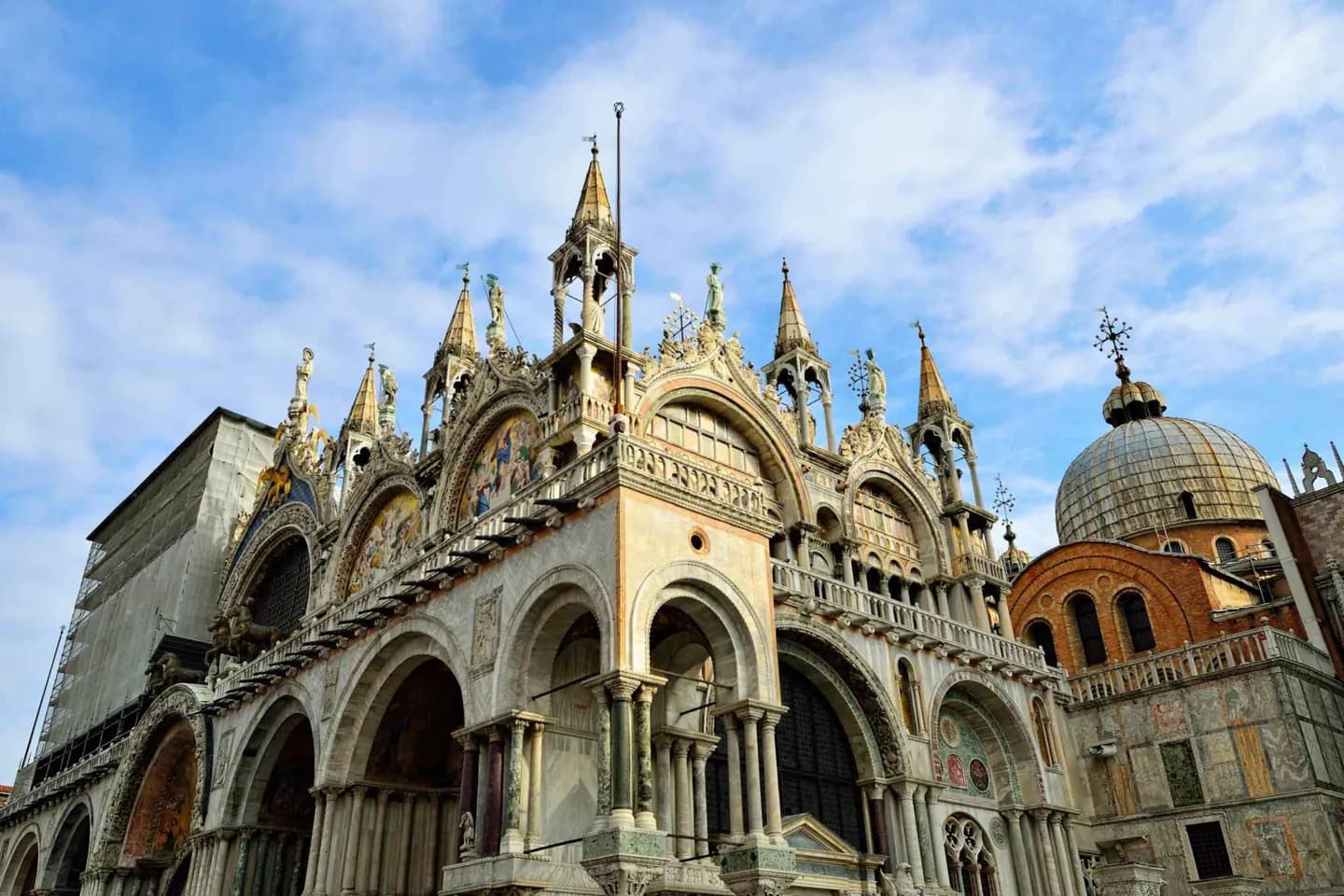
The façade is worth a deliberate pause because its details tell Venice’s story of trade, faith and public display. Look from the marble-clad portals upward to the winged lion and roofline statues, then notice how the horses occupy the balcony above the central entrance.
What to look for
- Five portals open through a façade rich in coloured marble and carved detail.
- The winged lion identifies St Mark and Venice at the top of the central composition.
- The exterior horses are replicas; the originals are preserved inside the Basilica.
The full story
The west façade is organized in rising layers. At ground level, five round portals sit among coloured marble columns and carved borders; above, mosaics and sculptures make the church read as a monumental screen facing the square. The winged lion of St Mark crowns the central composition, while the horses on the balcony carry a more complicated history. Taken from Constantinople after the Fourth Crusade, they were later removed to Paris and returned to Venice. The figures now on the façade are replicas, while the originals are protected inside. That substitution is a reminder that preservation changes what visitors see. The façade remains a public image, but its most vulnerable historic pieces require protection behind the visible surface, a balance between display and conservation.
Useful to know
- View the façade from several points in the square to separate its portals, mosaics and roofline.
- Do not assume the balcony horses are the originals; look for the protected originals inside if accessible.