
Why go
Home to the Berlin Philharmonic Orchestra, the building is acclaimed for both its acoustics and its architecture. The Philharmonie lies on the south edge of the city's Tiergarten and just west of the former Berlin Wall, an area that for decades suffered from isolation and drabness but that today offers ideal centrality, greenness, and accessibility.
What to look for
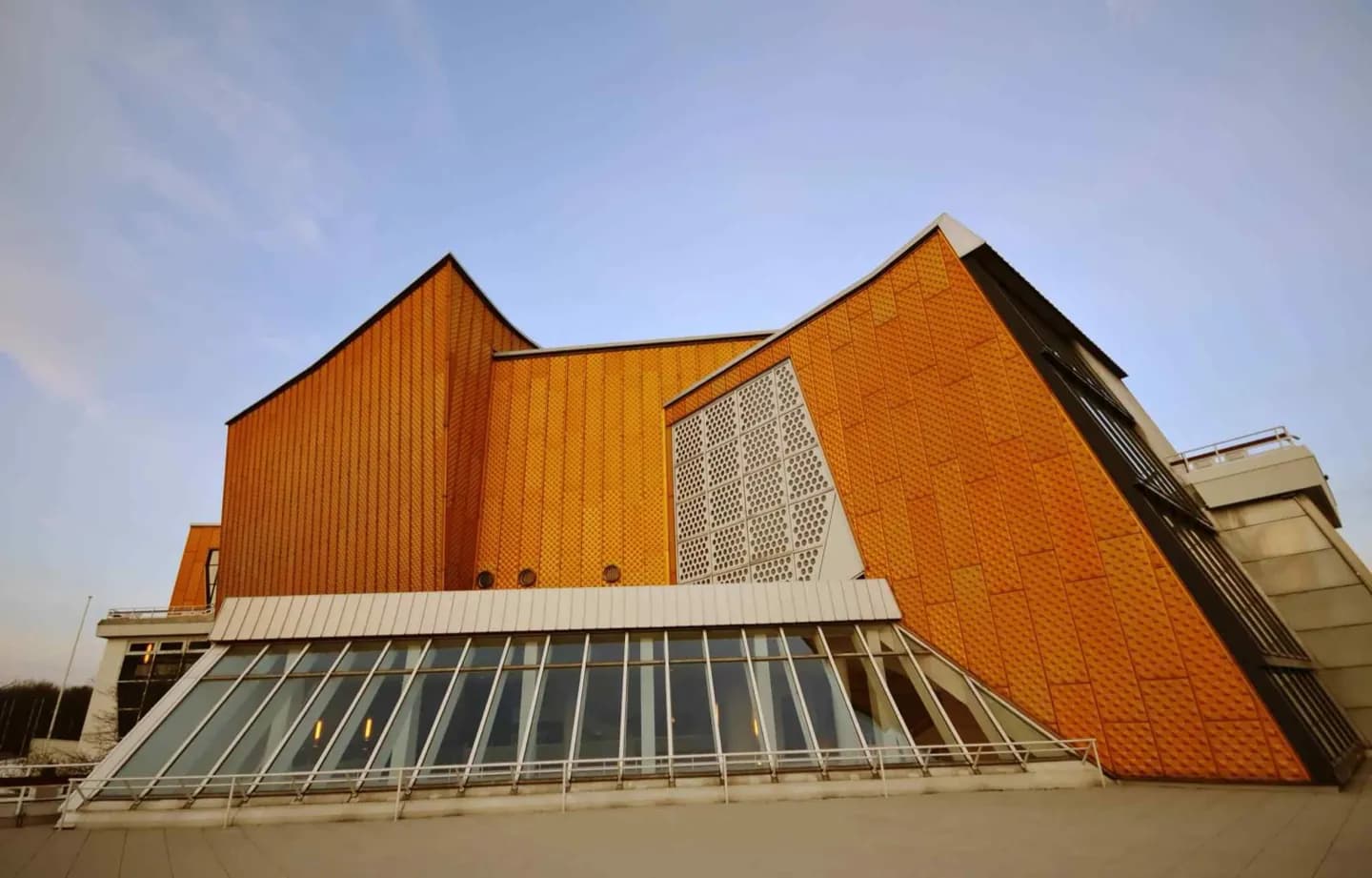
- Hans Scharoun's tent-like concert hall places the orchestra at the centre of a terraced audience.
The full story
The neighborhood, often dubbed the Kulturforum, can be reached on foot from the Potsdamer Platz station. Actually a two-venue facility with connecting lobby, the Philharmonie comprises a Großer Saal of 2,440 seats for orchestral concerts and a chamber-music hall, the Kammermusiksaal, of 1,180 seats. Though conceived together, the smaller venue was added only in the 1980s. History Hans Scharoun designed the hall, which was constructed over the years 1960–1963. It was built to replace the old Philharmonie, destroyed by British bombers on 30 January 1944, the eleventh anniversary of Hitler becoming Chancellor. The hall is a singular building, asymmetrical and tentlike, with the main concert hall in the shape of a pentagon. The seating offers excellent positions from which to view the stage through the irregularly increasing height of the seat rows.
Useful to know
- Check the current performance or guided-visit programme; ordinary daytime interior access may not be available.
- Use the exterior and surrounding square as the fallback when no event or tour fits your date.