
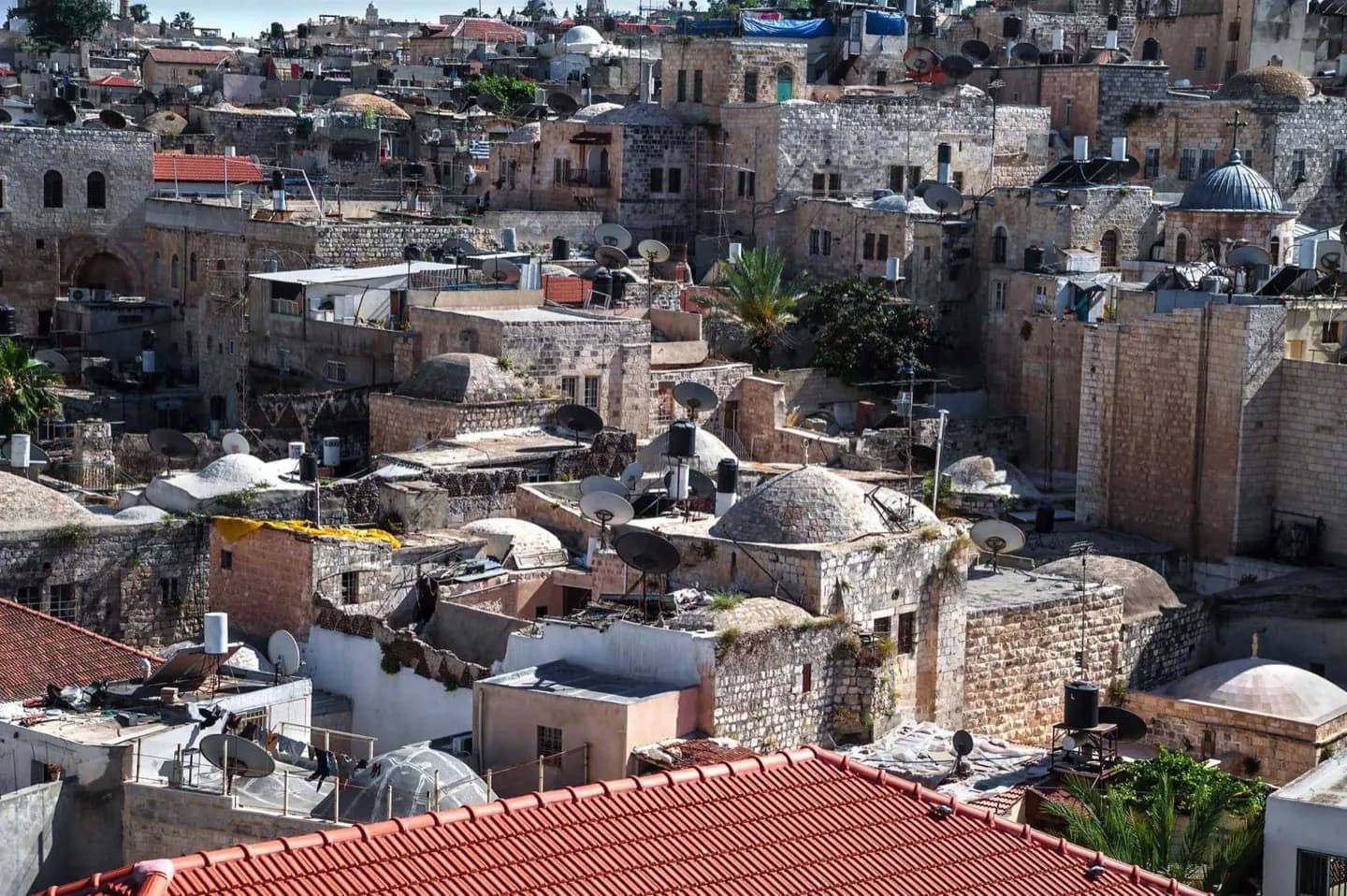
Why go
The Old City makes Jerusalem's layered religious history legible on foot. The Western Wall, Church of the Holy Sepulchre, and Temple Mount / Al-Haram al-Sharif sit within a small walled area, yet each has a different meaning and visitor arrangement. Moving between the Muslim, Christian, Jewish and Armenian Quarters shows how those landmarks relate to living neighborhoods rather than standing alone.
What to look for
- The city walls enclose four traditional quarters with different street patterns and landmarks.
- The Western Wall, Holy Sepulchre and sanctuary compound stand strikingly close together.
The full story
For much of Jerusalem's history, this walled area was the city itself; expansion beyond the walls began in the nineteenth century. The four familiar quarter names describe today's useful geography, although those designations took shape relatively late. Within the walls, Jewish, Christian and Muslim sacred places sit near one another: the Western Wall borders the sanctuary platform, while the Church of the Holy Sepulchre anchors the Christian Quarter. The streets around them are part of the experience, because they show how worship, homes and commerce share a compact urban space. The Jewish Quarter also carries a more recent layer of history: much was destroyed during the 1948 war and rebuilt after 1967. Looking at the Old City as a whole helps explain why a short distance on a map can cross several very different histories.
Useful to know
- Plan the Old City as a walking area, then check access separately for any religious building you hope to enter.
- Allow time to move between quarters rather than treating the major landmarks as isolated stops.
Your next visit
Estimated · Declared scenario and planning estimates; no live opening, weather, queue or booking service.
Outdoor visit · 30–45 min
World planning estimate; admission, opening, visit duration and access need checking.