
Why go
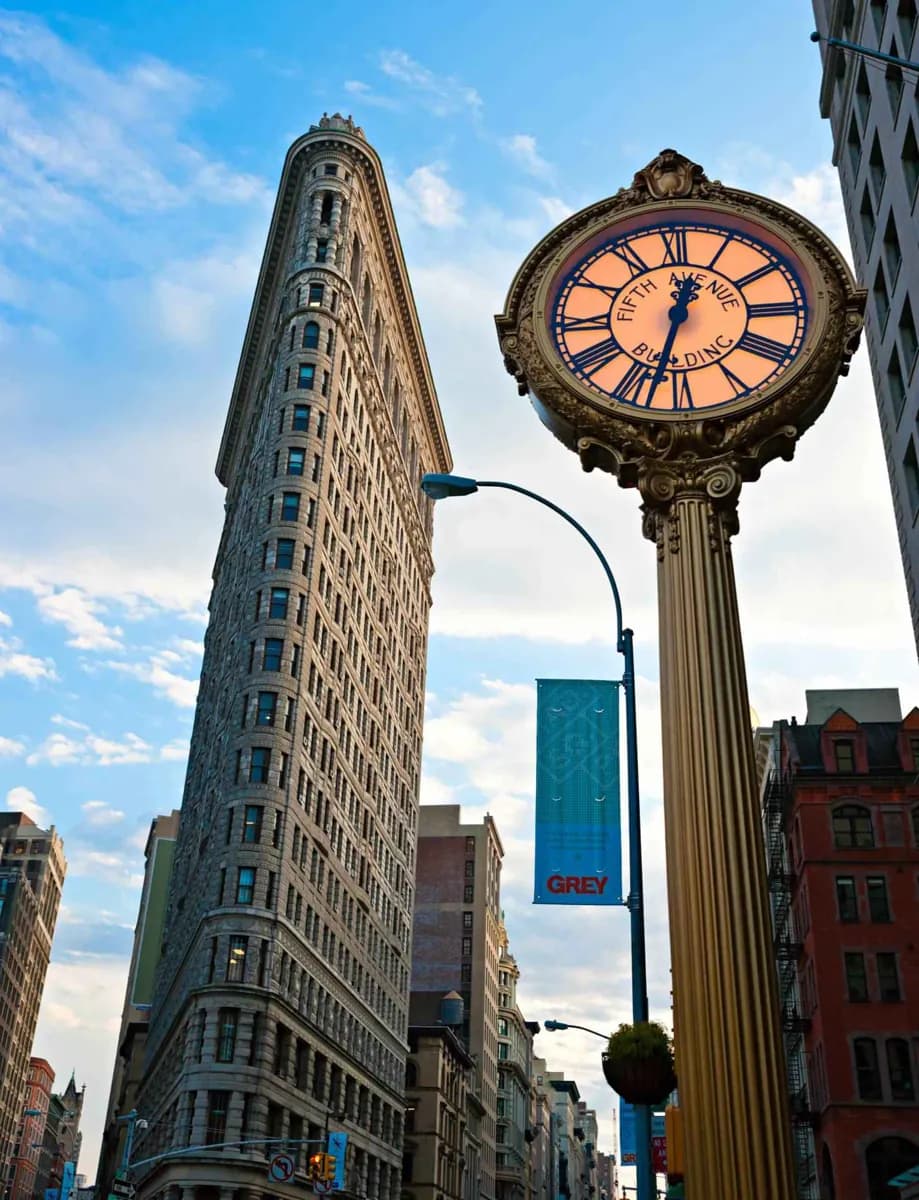
The building turns the meeting of Fifth Avenue and Broadway into an immediately legible architectural form. Its pointed end and long sides make more sense when viewed in relation to the streets around it. A walk around the public spaces gives a better understanding of the design than treating it as a single frontal photograph.
What to look for
- The triangular block is bounded by Fifth Avenue, Broadway and East 22nd Street.
- The narrow northern point faces toward 23rd Street and Madison Square.
The full story
Completed in 1902, the building was originally named for the Fuller Company. The Flatiron nickname came from its resemblance to a clothes iron and eventually gave the surrounding district its name. The steel frame allowed a tall building to occupy the wedge-shaped lot, making the unusual site part of the tower’s identity rather than an obstacle concealed by its design. Some visible features resulted from commercial demands during construction. The retail projection at the pointed end was added at Harry Black’s insistence to make fuller use of the lot and generate income, despite the architects’ concerns about its effect on the design. A penthouse was added after the main building and rented as artists’ studios. These changes show that the familiar outline reflects negotiations over space and revenue as well as the original architectural idea.
Useful to know
- Compare the pointed end with views along both long sides from public space.
- Combine the exterior stop with nearby Madison Square Park.
Your next visit
Estimated · Declared scenario and planning estimates; no live opening, weather, queue or booking service.
Outdoor visit · 10–15 min
Public-space walk and exterior observation only; no interior, garden, tower or ticketed admission included. Durations and walking are estimates. Check temporary restrictions and park or market opening times.
Outdoor visit · 30–45 min
World planning estimate; admission, opening, visit duration and access need checking.