
Why go
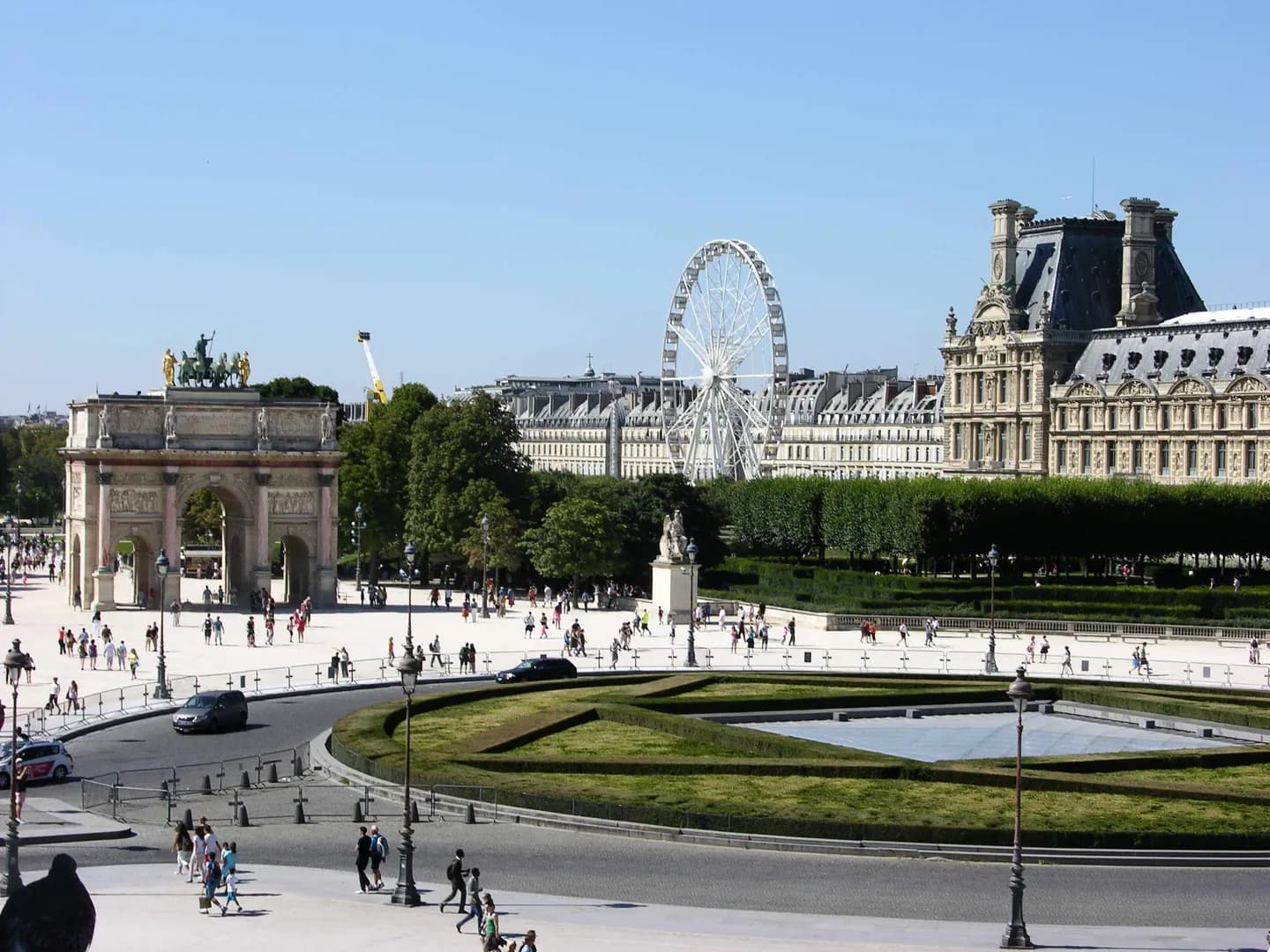
Place du Carrousel helps make sense of the Louvre–Tuileries axis. The Arc de Triomphe du Carrousel supplies a richly decorated focal point, while the unusually open space marks where the Tuileries Palace stood until its ruins were removed. It is a useful pause between museum architecture and garden landscape.
What to look for
- The Arc de Triomphe du Carrousel stands between the Louvre and the garden.
- The open square preserves the footprint and perspective left by the vanished Tuileries Palace.
- Views connect the Louvre façades with the long Tuileries axis.
The full story
The square takes its name from a mounted military display staged here for Louis XIV in 1662. For much of its history, the space was shaped by the Tuileries Palace, which stood between the Louvre and the garden. Revolutionary violence repeatedly reached this ground, and the palace was burned during the Paris Commune in 1871. Its surviving ruins were removed in 1883, opening the long view that exists today. The Arc de Triomphe du Carrousel predates that disappearance. Built under Napoleon between 1806 and 1808, it celebrated imperial victories on a scale smaller than the later Arc de Triomphe. The square now works as a hinge between two major Paris experiences: the dense architecture of the Louvre and the open, planted axis of the Tuileries.
Useful to know
- Cross the square when moving between the Louvre courtyard and the eastern end of the Tuileries Garden.
- Allow time to walk around the arch; its reliefs and coloured marble read poorly from a distance.
Your next visit
Estimated · Declared scenario and planning estimates; no live opening, weather, queue or booking service.
Outdoor visit · 10–15 min
Public-space walk and exterior observation only; no interior, garden, tower or ticketed admission included. Durations and walking are estimates. Check temporary restrictions and park or market opening times.
Outdoor visit · 30–45 min
World planning estimate; admission, opening, visit duration and access need checking.