
Why go
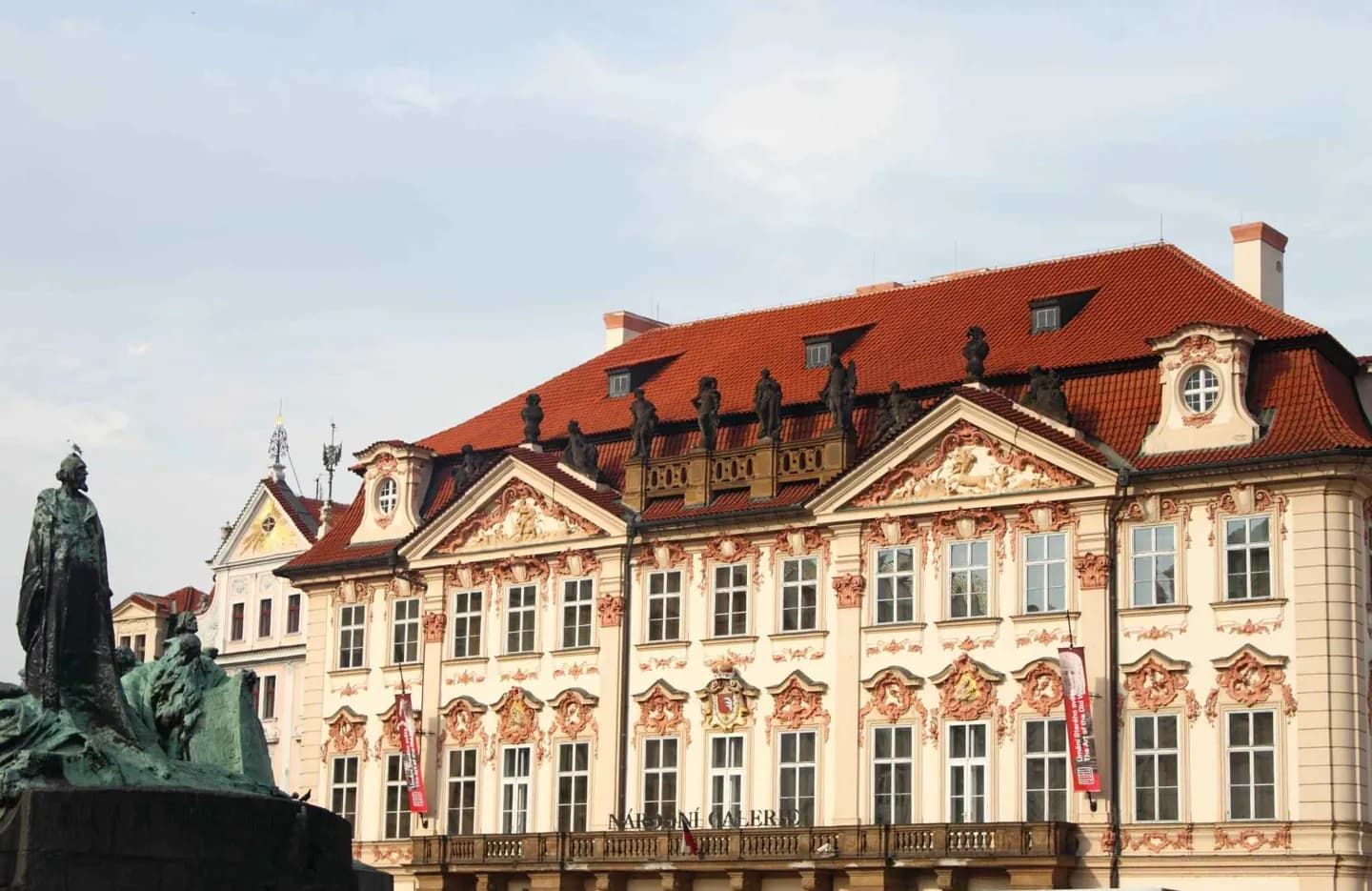
Its pale, richly modeled frontage stands apart from the Gothic buildings around the square. The balcony also links a grand aristocratic house to the communist seizure of power in 1948. This is a short but meaningful pause on an Old Town walk, especially if you look up from the busy square and compare its facade with the nearby Church of Our Lady before Týn.
What to look for
- The pink-and-white Rococo facade faces Old Town Square.
- Sculpted figures and ornate window surrounds give the palace a lighter rhythm than the nearby Gothic buildings.
- The balcony is associated with Klement Gottwald’s February 1948 speech.
The full story
Built for the Golz family between 1755 and 1765, the palace later passed to the Kinský family, whose name it carries. Its Rococo facade presents a very different face to Old Town Square from the Gothic Church of Our Lady before Týn nearby. Look at the pale stucco, sculptural decoration and repeated window bays as one composition rather than treating the building as a gallery entrance. The site also gathers two sharply different chapters of Prague’s history. Franz Kafka’s father ran a shop on the ground floor, and Kafka attended school in the palace during the 1890s. In February 1948, Klement Gottwald addressed a crowd from its balcony during the communist takeover. The balcony is easy to overlook from street level, but knowing that episode changes the view of the square. The National Gallery later used the building for exhibitions; the interior is closed, so its present visitor value lies in the exterior and these stories.
Useful to know
- View the building from Old Town Square; the gallery interior is closed.
- Pair the facade with the nearby Church of Our Lady before Týn for an architectural contrast.
Your next visit
Estimated · Declared scenario and planning estimates; no live opening, weather, queue or booking service.
Outdoor visit · 30–45 min
World planning estimate; admission, opening, visit duration and access need checking.