
Why go
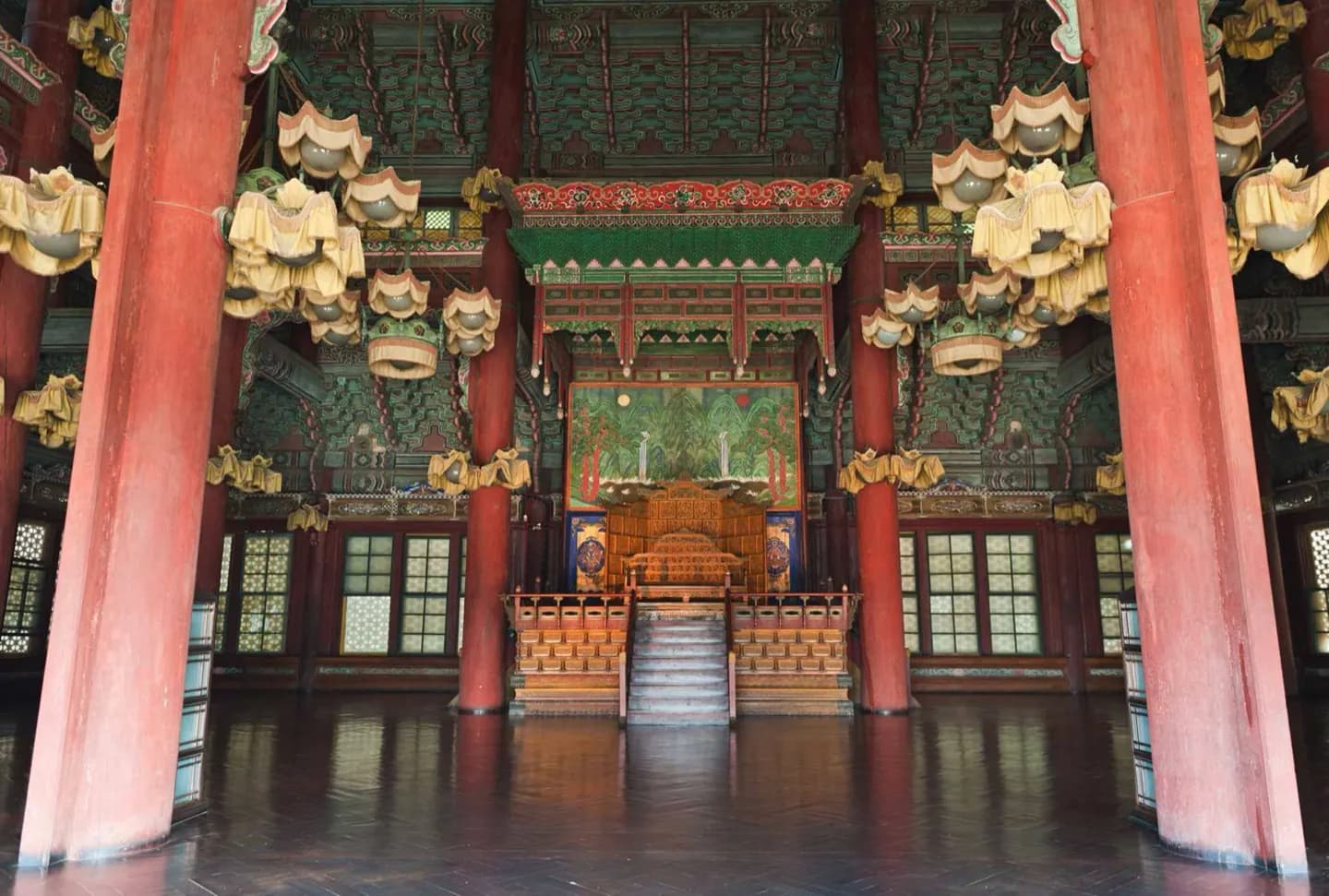
The palace makes Joseon court architecture easy to read in a relatively contained setting. Honghwamun and Okcheongyo establish the ceremonial approach, while the one-story Myeongjeongjeon reveals how a throne hall can feel dignified without matching the scale of Seoul's larger palaces.
What to look for
- Honghwamun opens onto Okcheongyo, where carved guardian figures sit between the bridge arches.
- Myeongjeongjeon stands on a raised stone court with a central route once reserved for the king.
- The grounds reveal successive losses, restorations and changes of use.
The full story
Changgyeonggung began as a residence associated with royal family life and was enlarged and renamed under King Seongjong in the late fifteenth century. That origin helps explain its smaller, more intimate scale. Myeongjeongjeon served as the principal hall, yet its single-story form differs from the more imposing throne halls at Gyeongbokgung and Changdeokgung. It was rebuilt in 1616 after the Japanese invasions and remains a key witness to the palace's long history of loss and repair. The approach carries its own symbolism. After passing the east-facing Honghwamun, visitors cross Okcheongyo, whose twin arches include carved dokkaebi intended to ward off evil. During the Japanese colonial period, a zoo, botanical garden and museum were imposed on the grounds, profoundly changing the royal site. Their later removal did not erase that history. The palace seen today is therefore both a courtly landscape and a record of repeated transformation, making reconstructed boundaries and altered spaces part of what is worth noticing.
Useful to know
- Check the official palace timetable because hours and substitute closure days can change.
- Start at Honghwamun and follow the bridge-to-throne-hall sequence before exploring the quieter grounds.
- Pair it with nearby Changdeokgung only if you want a sustained palace-focused visit.
Your next visit
Estimated · Declared scenario and planning estimates; no live opening, weather, queue or booking service.
Outdoor visit · 30–45 min
World planning estimate; admission, opening, visit duration and access need checking.