
Why go
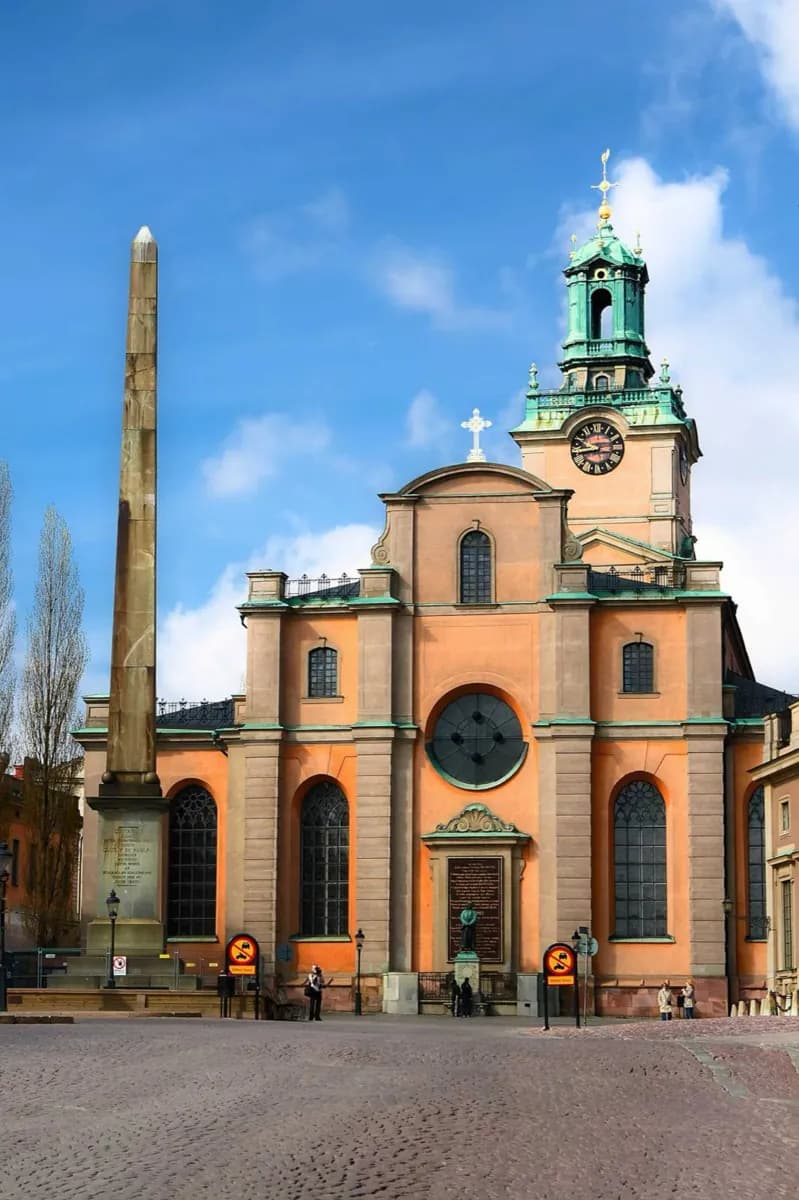
Enter when current access allows to see how Stockholm’s medieval parish church became a national ceremonial setting. The sculpture of Saint George and the Dragon, the Vädersol painting and the brick interior offer more specific rewards than the restrained exterior suggests.
What to look for
- The late-medieval wooden group of Saint George and the Dragon.
- The Vädersol painting, an early image of Stockholm.
- Brick Gothic space concealed behind the later exterior treatment.
The full story
Stockholm Cathedral is commonly called Storkyrkan, the Great Church, although its formal dedication is to Saint Nicholas. A written source mentions it in 1279, and it served the medieval parish covering the Old Town island. It became Lutheran in 1527 and has been Stockholm’s cathedral since 1942. The building’s layered appearance can initially mislead: its exterior was reshaped in a later classical language, while the interior retains the spatial force of Swedish Brick Gothic. The best-known object is the dramatic wooden Saint George and the Dragon, created in the late fifteenth century. The Vädersol painting records a sixteenth-century atmospheric phenomenon above Stockholm and doubles as evidence of the city’s earlier appearance. Together, architecture and objects make the church a concise record of religious, artistic and civic change.
Useful to know
- Confirm visiting hours around services and concerts.
- Pair the cathedral with the Royal Palace and Slottsbacken; all three share the same compact ceremonial zone.
Your next visit
Estimated · Declared scenario and planning estimates; no live opening, weather, queue or booking service.
Outdoor visit · 30–45 min
World planning estimate; admission, opening, visit duration and access need checking.