
Why go
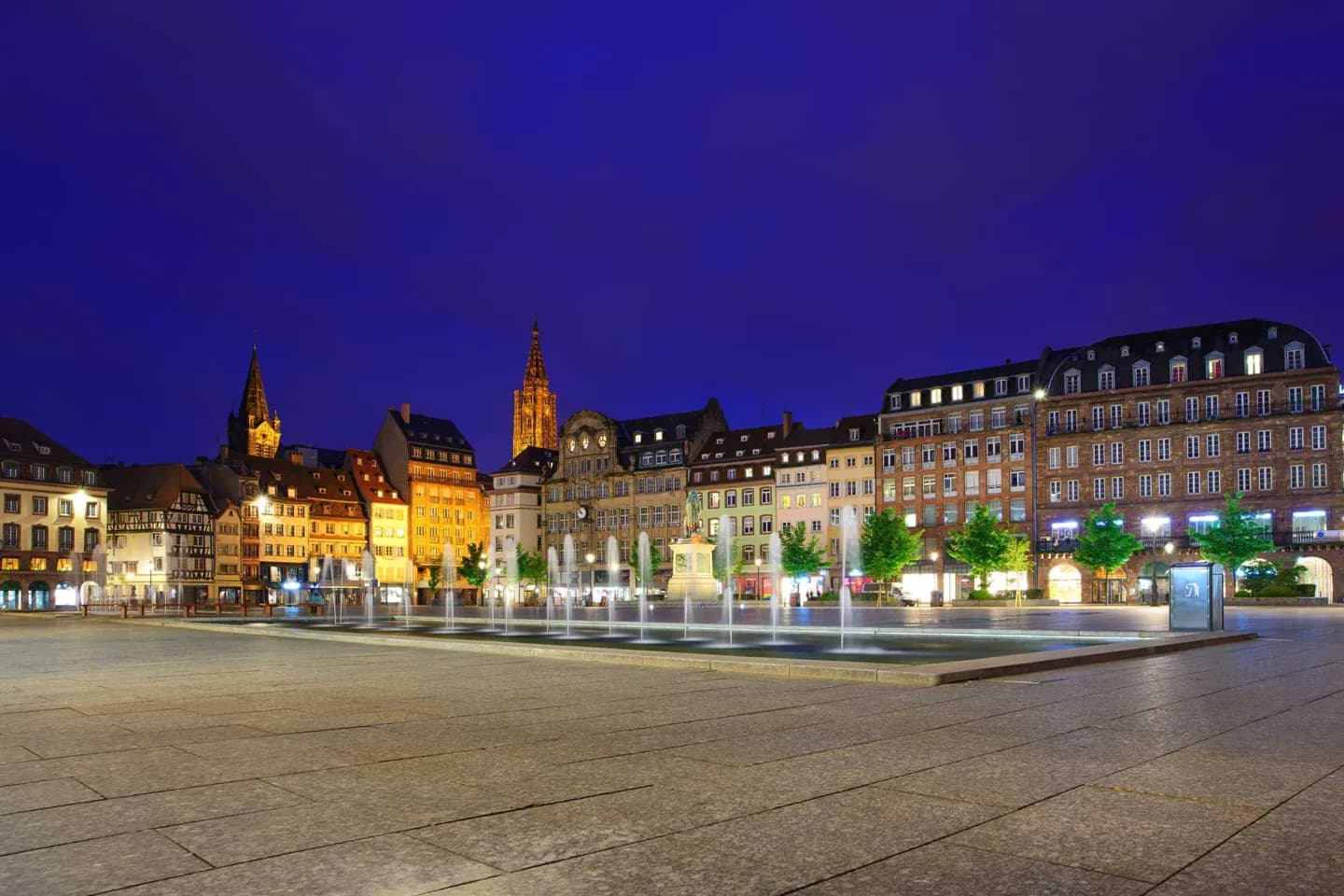
Place Kléber shows a different scale of Strasbourg from the cathedral quarter: broad, public and anchored by eighteenth-century architecture. The statue recalls a local figure with a national career, while the Aubette introduces a later artistic story behind its classical front. Seasonal events can change the square’s character.
What to look for
- The statue of Jean-Baptiste Kléber stands above his burial vault.
- The Aubette presents a long neoclassical façade on the square.
- A large Christmas tree is a seasonal feature.
The full story
The square bears the name of Jean-Baptiste Kléber, born in Strasbourg in 1753. His statue stands over a vault containing his remains, making the open space a civic memorial as well as a meeting point. Along the north side, the Aubette was built in the eighteenth century to a design by Jacques-François Blondel. The restrained façade hides another era: in the 1920s, Hans Arp, Sophie Taeuber-Arp and Theo van Doesburg created abstract interiors there. Their work belongs to a separate indoor visit, but knowing it changes how you look at the apparently formal building from the square. At Christmas, the large tree adds a temporary public ritual to this central space. Outside that season, the contrast between the broad paved area, the monument and the Aubette still helps explain Strasbourg as a civic city, not only a collection of narrow medieval streets.
Useful to know
- Cross the square while linking the cathedral area with western Grande-Île.
- Check Aubette 1928 separately if you intend to see its interiors.
Your next visit
Estimated · Declared scenario and planning estimates; no live opening, weather, queue or booking service.
Outdoor visit · 15–25 min
World planning estimate; admission, opening, visit duration and access need checking.