
Why go
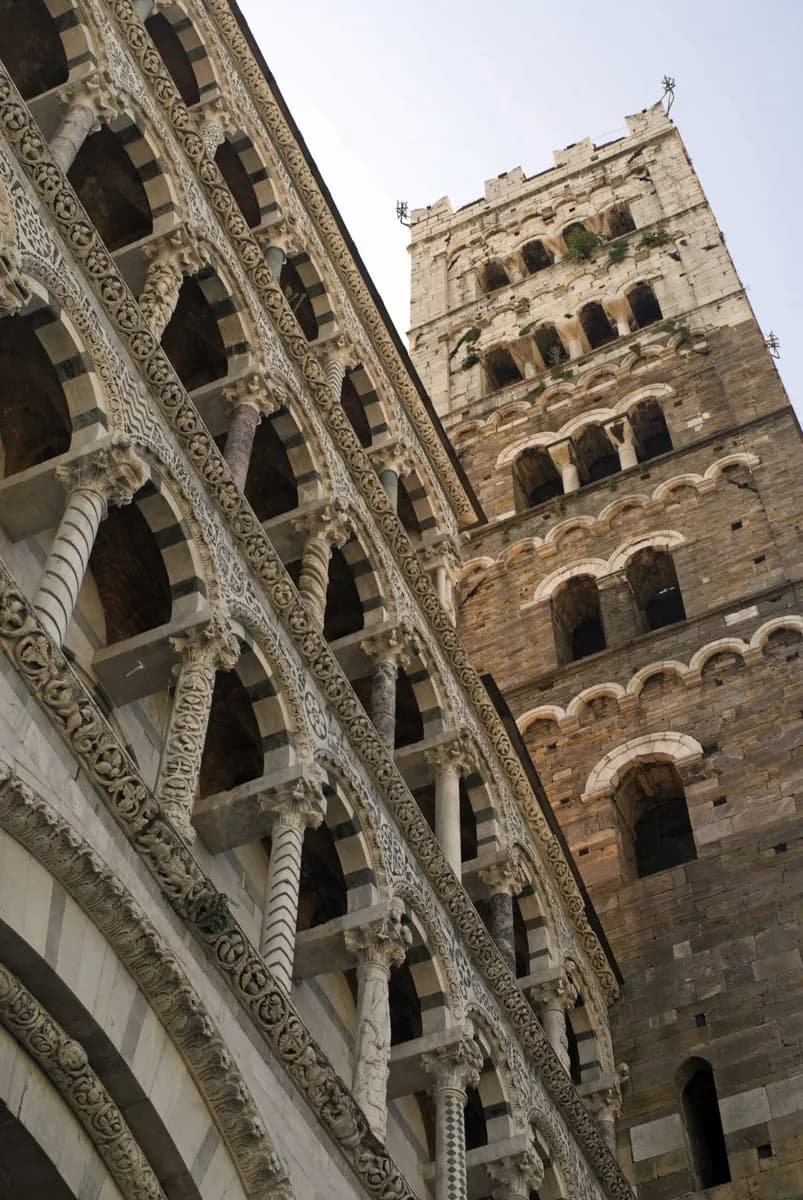
This is where Lucca’s civic devotion and sculpture meet. The portico invites close inspection before the interior shifts attention to the Volto Santo and Jacopo della Quercia’s tomb of Ilaria del Carretto; religious services may change visiting access. The carved maze on the portico adds another detail to seek out.
What to look for
- The asymmetrical portico carries three arcades and tiers of marble galleries.
- The Volto Santo is a clothed wooden crucifix central to Luccan devotion.
- Jacopo della Quercia carved the tomb of Ilaria del Carretto.
The full story
Work on San Martino began in the 11th century, though the cathedral visible today reflects several campaigns. Its apse and bell tower preserve early fabric; the western portico and galleries took shape in the 13th century, while the nave and transepts were rebuilt in Gothic forms in the 14th. The result is best read in sequence, from the elaborate, uneven façade to the more spacious interior. The Volto Santo, a wooden image of Christ in a long garment, has been a focus of Luccan devotion for centuries. Its traditional story attributes the carving to Nicodemus, but that account belongs to the image’s legend rather than verified history. Nearby, Jacopo della Quercia’s tomb for Ilaria del Carretto, commissioned by her husband Paolo Guinigi in 1406, offers a very different kind of memorial. Together, the crucifix and tomb explain why this cathedral deserves more than an exterior glance.
Useful to know
- Inspect the portico before entering; its columns and carved details deserve a pause.
- Check the cathedral’s visitor timetable around religious services.
Your next visit
Estimated · Declared scenario and planning estimates; no live opening, weather, queue or booking service.
Indoor visit · 30–45 min
World planning estimate; admission, opening, visit duration and access need checking.