
Why go
The compact island rewards looking at the relationship between houses, small waterways and bridges. Its lace tradition gives a different craft focus from Murano's glass, while Mazzorbo offers a nearby contrast to Burano's densely built residential streets. Torcello can add early lagoon history if the outing leaves room for another island.
What to look for
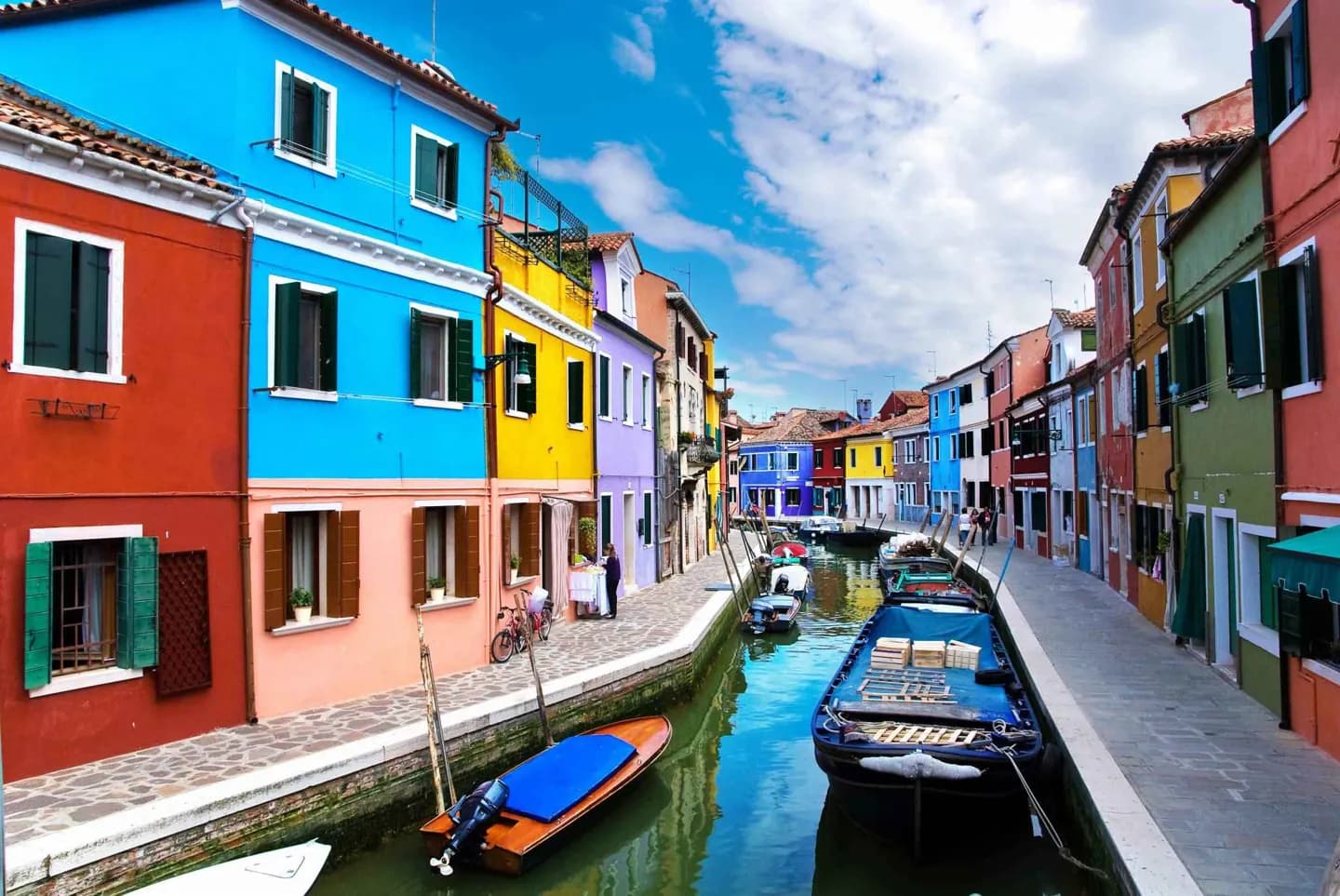
- Brightly painted homes line small canals.
- San Martino's campanile leans above the island.
- A bridge connects Burano with Mazzorbo.
The full story
Burano developed as a lagoon settlement administered from Torcello before its lace industry brought wider recognition. Needle lace travelled into European markets, linking work carried out on the island with distant customers. When trade declined, a school helped revive the craft and pass its techniques to another generation. The Lace Museum occupies the former teaching setting. The island's physical form has changed too. Separate pieces of land were joined when a canal was filled to create the area of Via and Piazza Baldassare Galuppi. Bridges still connect the remaining islands, making today's streets part of a landscape reshaped around waterways. These histories give the painted houses a useful context. Burano is a residential and working settlement rather than a decorative backdrop. Its association with fishing and lace, and its proximity to the more lightly built Mazzorbo, explain why a walk through its canals differs from both Murano and Torcello.
Useful to know
- Explore the residential canals as well as the central Galuppi area.
- Add Mazzorbo on foot when you want a contrast to Burano's tightly built streets.
- Check water connections before combining Burano with Torcello; allow each island its own walking time.
Your next visit
Estimated · Declared scenario and planning estimates; no live opening, weather, queue or booking service.
Outdoor visit · 90–180 min
World planning estimate; admission, opening, visit duration and access need checking.