
Why go
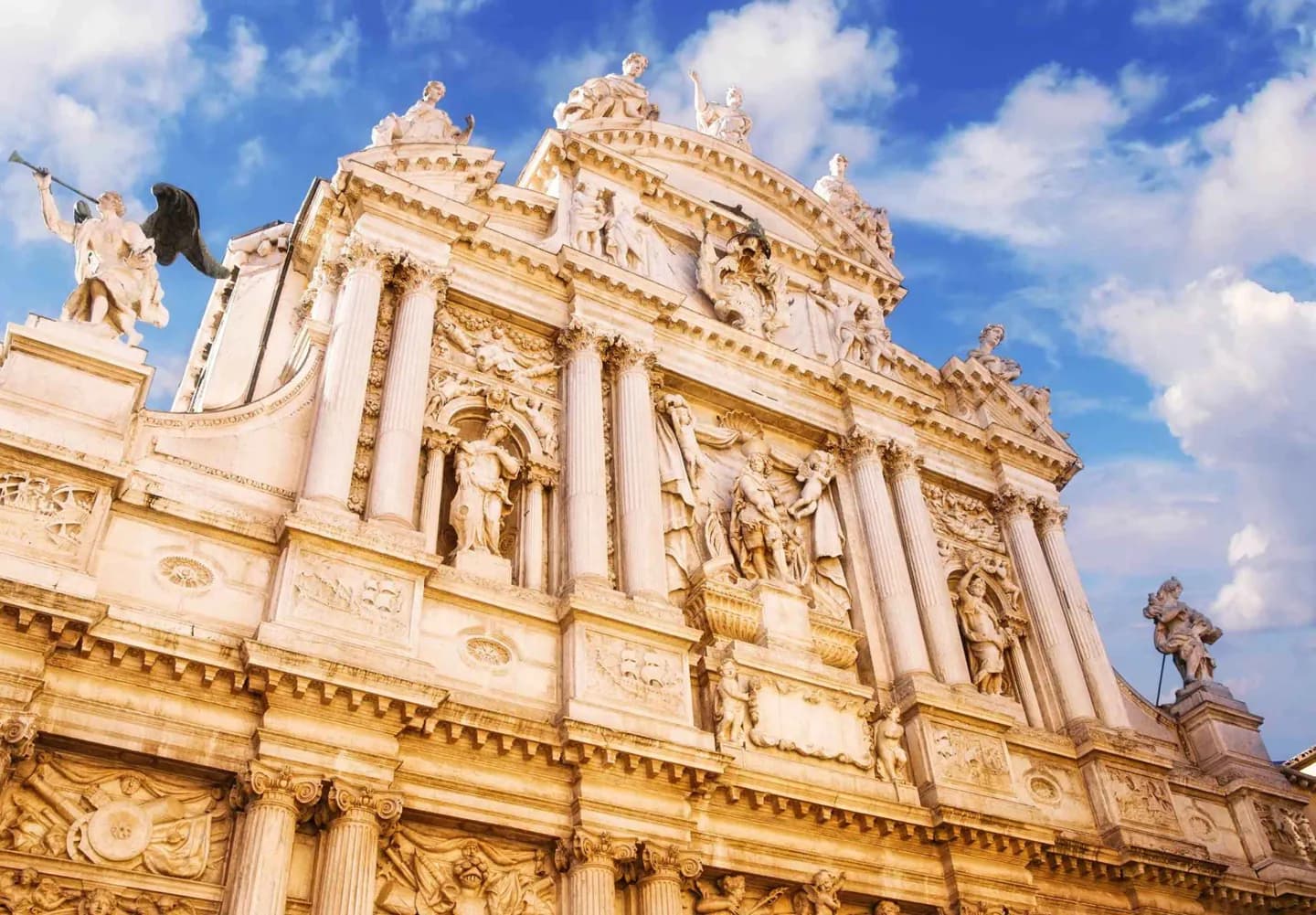
The façade rewards reading it as a public account of Antonio Barbaro's career. Maps, allegorical figures and family portraits occupy space where religious imagery might be expected. The contrast with the sacred interior, which contains a Rubens painting, makes the building a focused stop for both patronage and art.
What to look for
- Relief maps include Corfu, Split and Zadar.
- Antonio Barbaro's central statue is surrounded by allegorical figures.
- The Barbaro family arms appear at the top of the façade.
The full story
The church's two names preserve different associations. Santa Maria del Giglio refers to the lily linked with the Annunciation, while Zobenigo recalls the Jubanico family associated with its foundation. The later rebuilding by Giuseppe Sardi gave the church a façade dominated by another family's ambitions. Admiral Antonio Barbaro commissioned a frontage that commemorated places connected with his service. His own statue appears with figures of Honour, Virtue, Fame and Wisdom, while portraits of his brothers extend the tribute to the family. The absence of Christian statues and reliefs on this exterior makes the patron's programme especially conspicuous. Inside, the emphasis changes. The Molin chapel contains Rubens's Madonna and Child with the Young St John, and paintings of the Evangelists by Tintoretto occupy the sanctuary. The move from family commemoration outside to religious art within is the church's most useful contrast.
Useful to know
- Read the map reliefs from the campo before looking up at the family portraits.
- Check the operator's visit information before making the interior Rubens painting part of your plan.
Your next visit
Estimated · Declared scenario and planning estimates; no live opening, weather, queue or booking service.
Outdoor visit · 15–25 min
World planning estimate; admission, opening, visit duration and access need checking.