
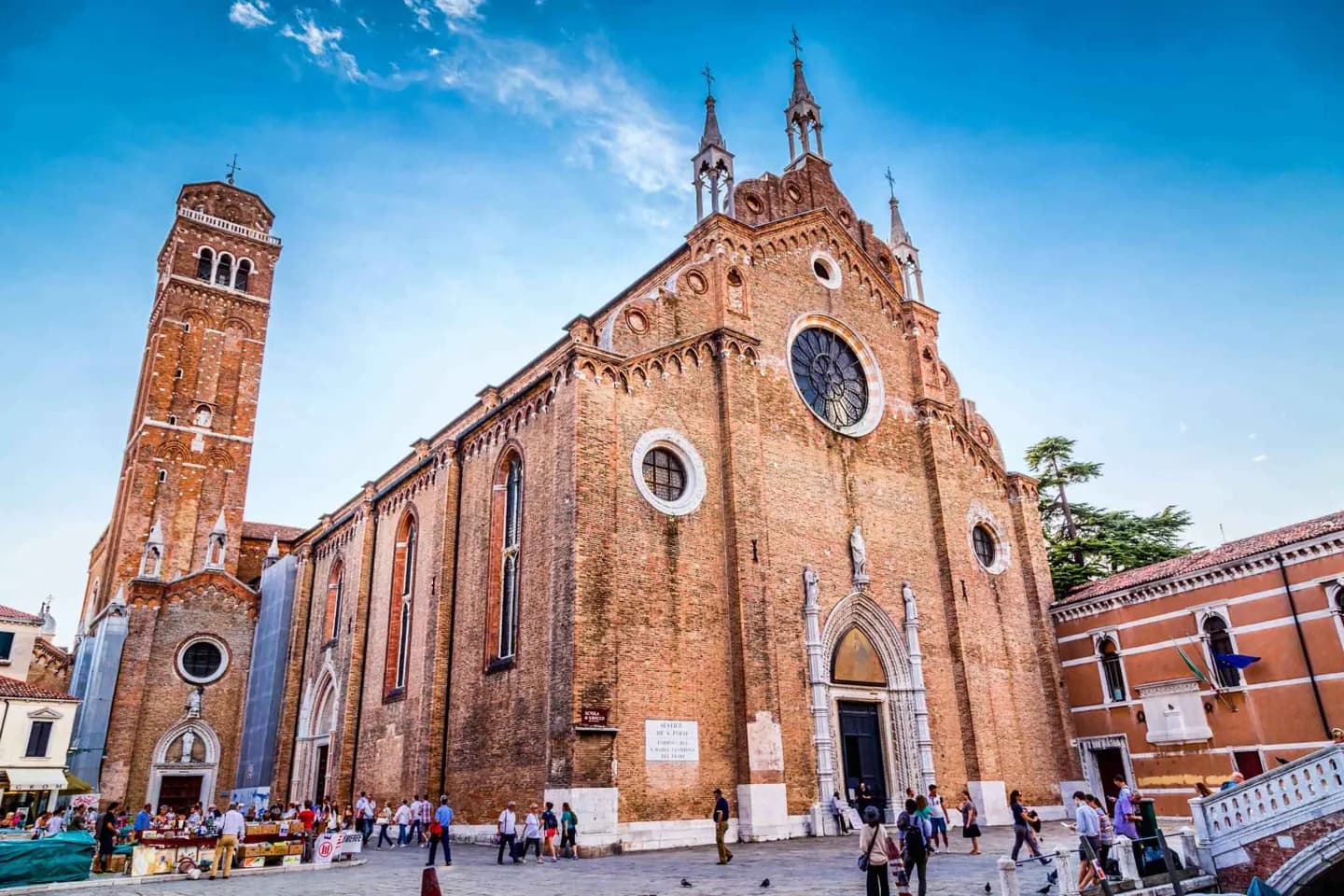
Why go
The basilica brings Franciscan history, monumental painting and civic memory into one setting. Titian's Assumption commands the main altar, while Bellini's sacristy altarpiece provides a more intimate contrast. Choir fittings and elaborate tombs broaden the visit beyond paintings, showing how worship and commemoration occupied the same large church.
What to look for
- Titian’s Assumption forms the large main altarpiece.
- The surviving rood screen separates the ritual choir.
- Bellini’s Madonna and Child with Saints occupies the sacristy altar.
The full story
The Franciscans received land for a church in the thirteenth century. A larger replacement followed, taking more than a century to complete. The resulting brick basilica gives Venice a substantial example of Italian Gothic architecture, with a scale very different from many neighborhood churches. Its interior also preserves the division between public space and ritual choir through a surviving rood screen. Choir stalls, chapels and large paintings organize attention within the broad building. Titian's Assumption places the church's dedication at the main altar, while his Pesaro Madonna introduces another major work into the nave. Burials and monuments add a history of Venetian memory. Titian and Claudio Monteverdi are commemorated here alongside doges and other civic figures. The monument associated with Antonio Canova contains his heart and was realized by his disciples. Looking at these tombs beside devotional art reveals how the church became a place to honor artistic achievement as well as political rank.
Useful to know
- Begin with the main nave and altar, then select chapels and monuments for closer attention.
- Combine the Frari with nearby San Rocco only if time allows two substantial art visits.
Your next visit
Estimated · Declared scenario and planning estimates; no live opening, weather, queue or booking service.
Indoor visit · 45–75 min
World planning estimate; admission, opening, visit duration and access need checking.