
Why go
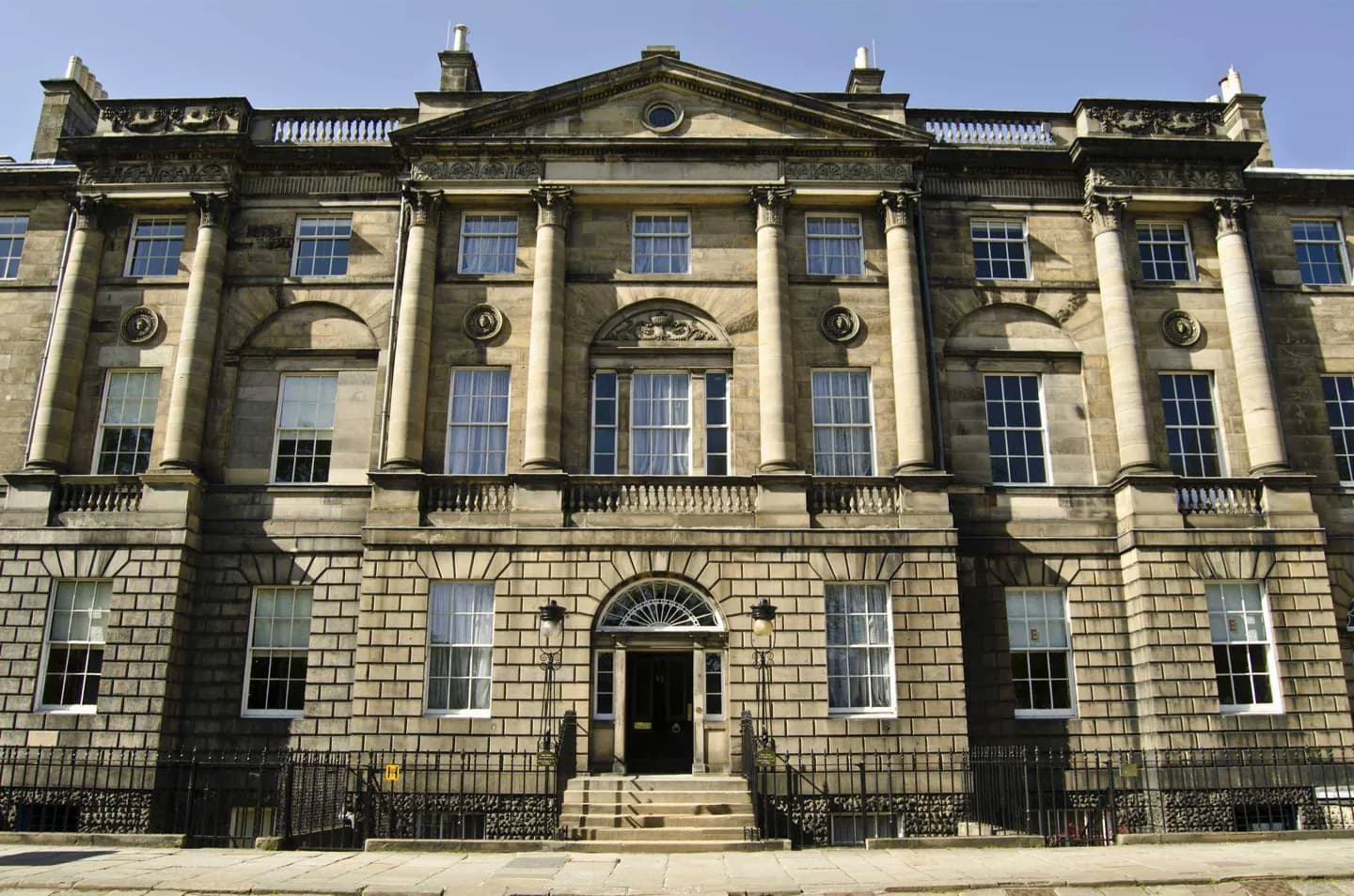
Its interest lies in the connection between Robert Adam’s unified north frontage and modern Scottish government. Seen from the square, it belongs to a composition of neighbouring houses rather than standing alone as a palace. A short exterior observation works best as part of a wider Charlotte Square visit.
What to look for
- The house is number 6, at the centre of Charlotte Square’s north side.
- Its facade forms part of Robert Adam’s Georgian composition.
The full story
Bute House’s government role is relatively recent compared with its Georgian setting. The house stands at the centre of Robert Adam’s north-side composition for Charlotte Square, so its prominence begins with the architecture of the whole frontage. It later belonged to the Marquess of Bute, whose family also held the adjoining houses. In 1966, numbers 5, 6 and 7 were conveyed to the National Trust for Scotland in settlement of estate duty. After refurbishment, Bute House became the Edinburgh residence of the Secretary of State for Scotland in 1970. That minister represented Scottish interests within the UK Government. Devolution changed its function in 1999, when it became the official residence of the First Minister. The house consequently links the preserved fabric of the New Town with Scotland’s devolved government. It is also a working venue, which explains why an ordinary visit means observing the facade from the square rather than touring the rooms.
Useful to know
- View the facade from Charlotte Square’s public perimeter pavements.
- Treat this as a working residence; there is no routine interior visit to plan.
Your next visit
Estimated · Declared scenario and planning estimates; no live opening, weather, queue or booking service.
Outdoor visit · 15–20 min
World planning estimate; admission, opening, visit duration and access need checking.