
Why go
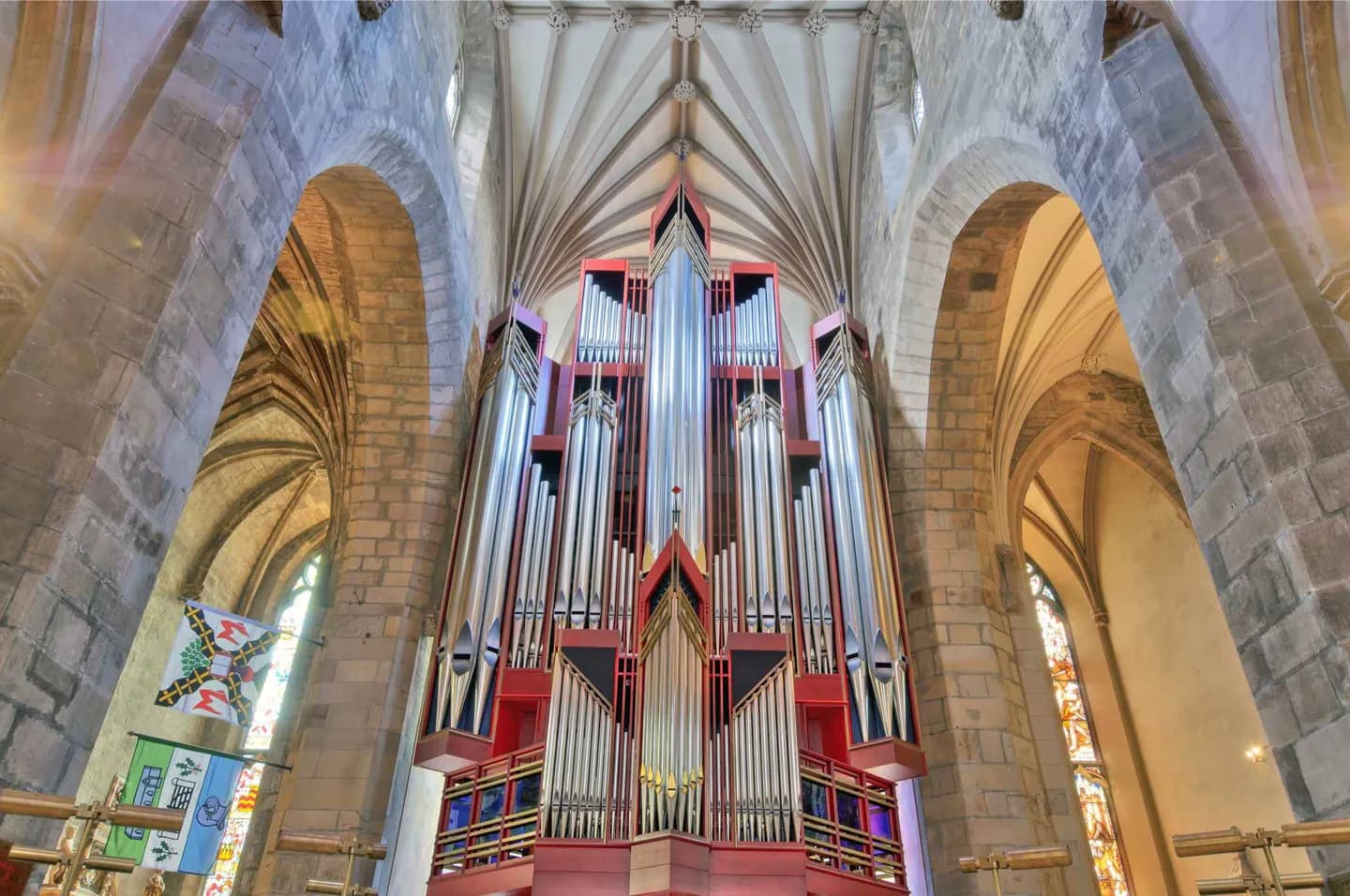
The interior reveals how a medieval church expanded and changed across centuries. Massive central pillars and added aisles give it an irregular plan, while nineteenth- and twentieth-century stained glass brings a much later layer of colour. The self-guided audio tour helps connect the architectural features and memorials with the stories they carry.
What to look for
- The crown steeple is a distinctive feature above the Royal Mile.
- Four massive central pillars belong to the oldest parts of the building.
- Stained glass includes Victorian windows and the Burne-Jones and Burns windows.
The full story
St Giles’ grew through repeated additions rather than a single building campaign. After fire damaged the church in 1385, rebuilding shaped much of the medieval interior. Chapels, known here as aisles, were added over time, enlarging the church and creating its irregular plan. Its elevation to collegiate status in 1466 was followed by the lantern tower around 1490 and changes to the chancel. The windows represent a later history. No medieval stained glass survives; the visible glass dates from the nineteenth and twentieth centuries. The exterior was also refaced, apart from the tower and crown spire, so the outer walls do not tell the full story of the medieval fabric inside. Memorials connect the building with Scotland’s political, religious and literary life, including monuments to Montrose, Argyll and Robert Louis Stevenson. A copy of the National Covenant of 1638 adds a further connection to the history of Scottish worship and public life.
Useful to know
- Combine the church with Parliament Square and the Heart of Midlothian just outside.
- Use the self-guided audio tour to connect the pillars, aisles and memorials rather than stopping at the exterior spire.
Your next visit
Estimated · Declared scenario and planning estimates; no live opening, weather, queue or booking service.
Indoor visit · 30–45 min
World planning estimate; admission, opening, visit duration and access need checking.