
Why go
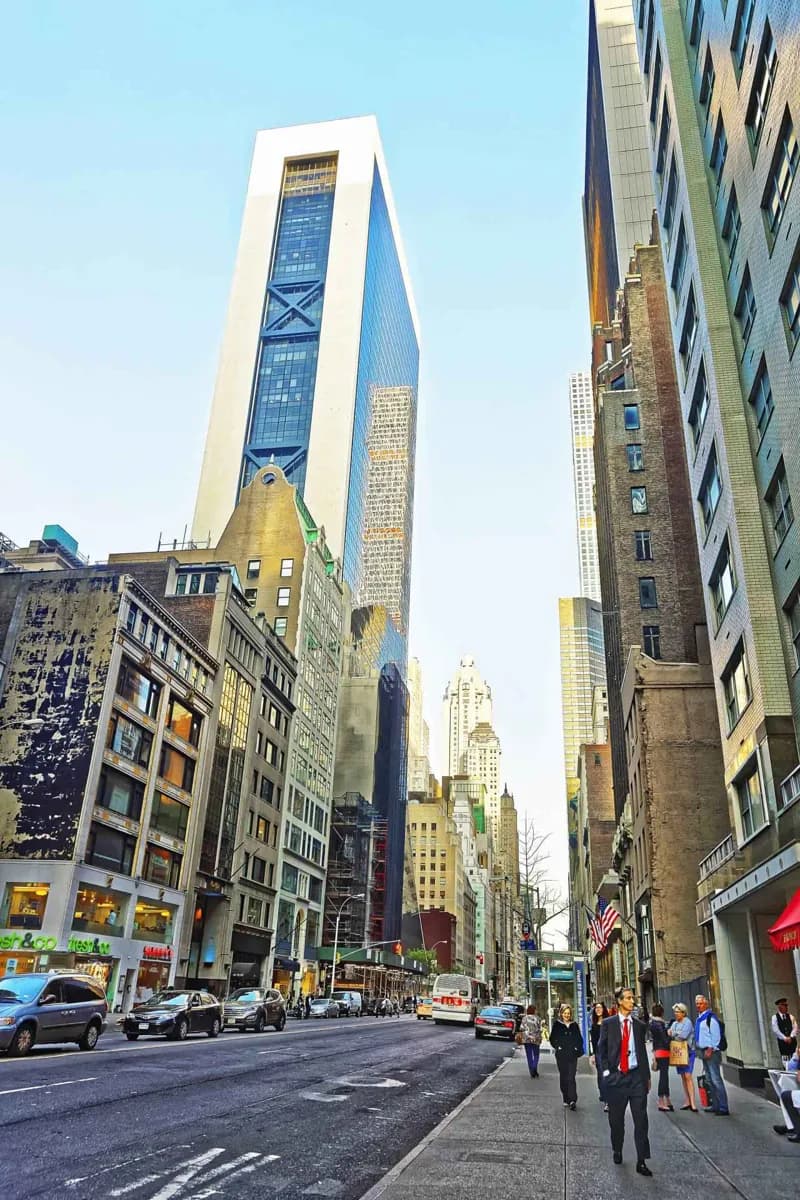
The street compresses several Midtown identities into a short central sequence: the concert venue at Seventh Avenue, towers around Eighth Avenue, and the Fifth Avenue shopping corridor. Continuing farther changes the character toward residential blocks. It is useful for seeing those transitions and linking nearby stops, rather than expecting every block to offer the same experience.
What to look for
- Carnegie Hall occupies the Seventh Avenue corner.
- Hearst Tower marks the Eighth Avenue intersection.
- The central retail blocks contrast with the residential street toward Sutton Place.
The full story
57th Street was designated in the Commissioners’ Plan of 1811 as one of the wider east–west streets in Manhattan’s grid. Its width and length made it a major cross-town corridor, but the street developed different identities along its course rather than a uniform character. The western end reaches the Hudson River, while the eastern end approaches Sutton Place and the East River. Its Midtown core became closely associated with culture and commerce. Carnegie Hall opened at Seventh Avenue, while the blocks toward Fifth Avenue developed a concentration of prestigious shops, galleries and hotels. Large commercial and residential towers later added a different scale to the same corridor. The contrast remains the most useful way to read the street: the concert hall, retail frontage and tower architecture belong to overlapping periods of development, followed eastward by blocks where apartment buildings take over from the commercial center.
Useful to know
- Focus on the Eighth Avenue to Fifth Avenue stretch when combining Carnegie Hall and retail architecture.
- Use the street’s position south of Central Park to connect a Midtown walk with the park’s southern entrances.
Your next visit
Estimated · Declared scenario and planning estimates; no live opening, weather, queue or booking service.
Outdoor visit · 30–45 min
World planning estimate; admission, opening, visit duration and access need checking.