
Why go
The main Stern Auditorium gives the landmark its central identity, with a tall, layered interior built around the stage. Its history reaches across classical and popular music, so the building has interest beyond any one repertoire. Planning around a particular performance makes this a substantial cultural stop rather than simply a famous facade.
What to look for
- The Stern Auditorium rises through multiple seating levels around the Perelman Stage.
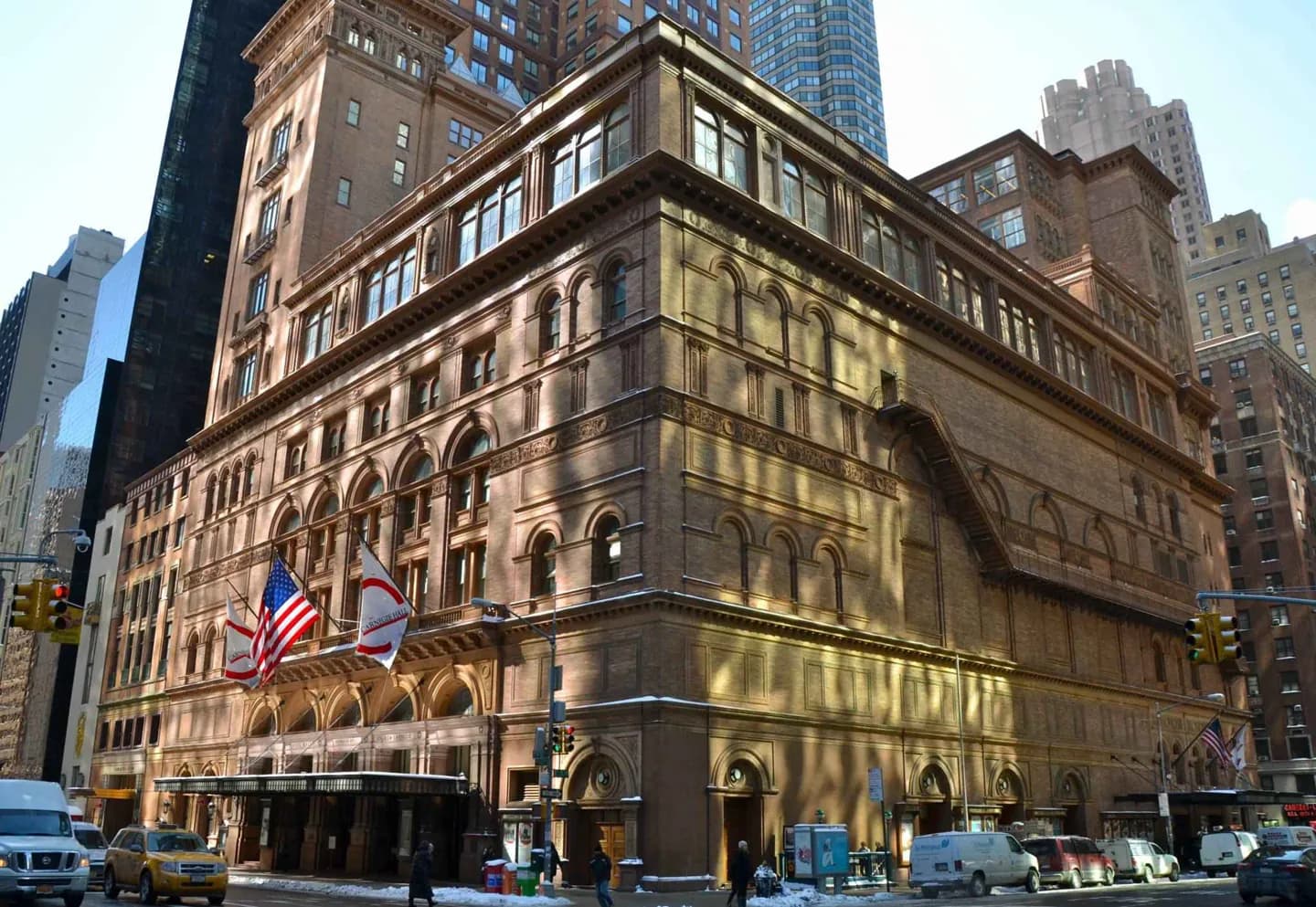
- The Seventh Avenue building stands two blocks south of Central Park.
- Separate auditoriums support different scales of performance within the same venue.
The full story
Andrew Carnegie funded the hall, which opened in 1891 to designs by William Burnet Tuthill. It became a major New York performance setting, with the New York Philharmonic using the main hall from 1892 until its move to Lincoln Center in 1962. The venue’s history extends beyond that orchestra to the many classical and popular musicians who have appeared on its stages. The name Isaac Stern attached to the main auditorium recognizes the violinist’s role in saving Carnegie Hall from demolition in the 1960s. That preservation history changes how the building is understood: the hall’s survival was a choice made during a period when Midtown could easily have lost it. Its other performance spaces also reflect adaptation. The room later rebuilt as Zankel Hall passed through use as a recital venue and cinema before returning to concert life, showing how the complex evolved around changing audiences.
Useful to know
- Choose a concert by program and auditorium before fitting it into a Midtown day.
- Check the official tour calendar if architecture and history are the main interests.
Your next visit
Estimated · Declared scenario and planning estimates; no live opening, weather, queue or booking service.
Indoor visit · 30–45 min
World planning estimate; admission, opening, visit duration and access need checking.