
Why go
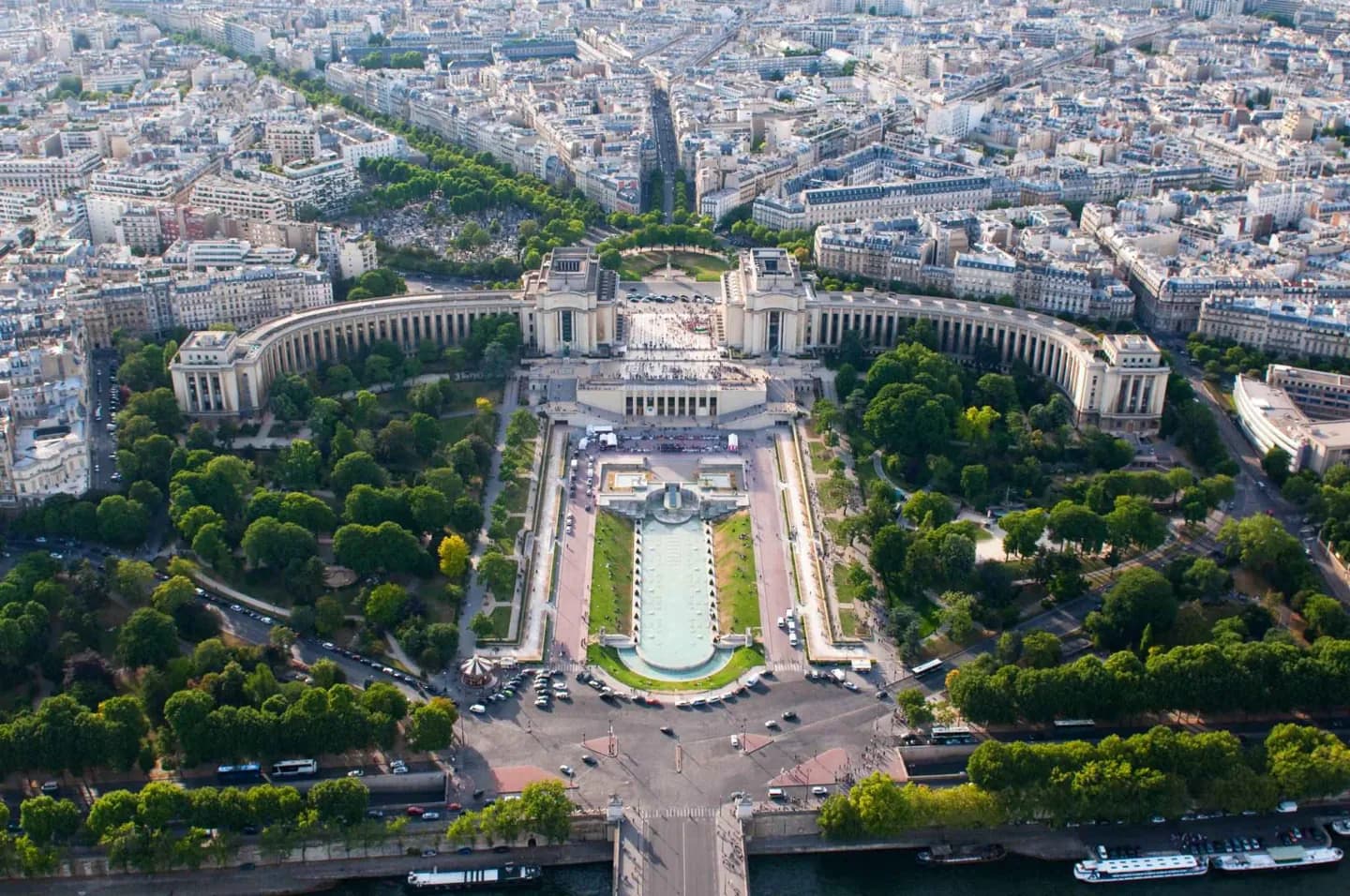
The area runs from the Palais de Chaillot on the hill down to the Seine and Pont d’Iéna. Its appeal is the long perspective through the gardens toward the Champ de Mars and École Militaire. Moving downhill changes that composition, while the palace wings give the upper viewpoint its architectural frame.
What to look for
- The Warsaw Fountain’s long basin organizes the gardens below the palace.
- Gilded figures stand on the terrace beside the Palais de Chaillot.
The full story
The present layout grew from two world exhibitions. Jean-Charles Alphand laid out gardens for the original Palais du Trocadéro in 1878. For the 1937 International Exposition, that palace gave way to the Palais de Chaillot, designed by Louis-Hippolyte Boileau, Jacques Carlu and Léon Azéma. Its curved wings reused the earlier foundations, but the architects left out a connecting central building. The gap created the open perspective that defines the site today. Roger-Henri Expert designed the replacement gardens below. The name Trocadéro recalls a French military victory in Spain in 1823, while the esplanade carries a different historical association. The United Nations General Assembly adopted the Universal Declaration of Human Rights in the palace on 10 December 1948. A commemorative stone marks that event, explaining the terrace’s name, Esplanade des droits de l’homme.
Useful to know
- Start on the upper esplanade, then descend through the gardens toward Pont d’Iéna and the Eiffel Tower.
- Treat a Chaillot museum visit as an additional stop beyond the outdoor terrace and gardens.