
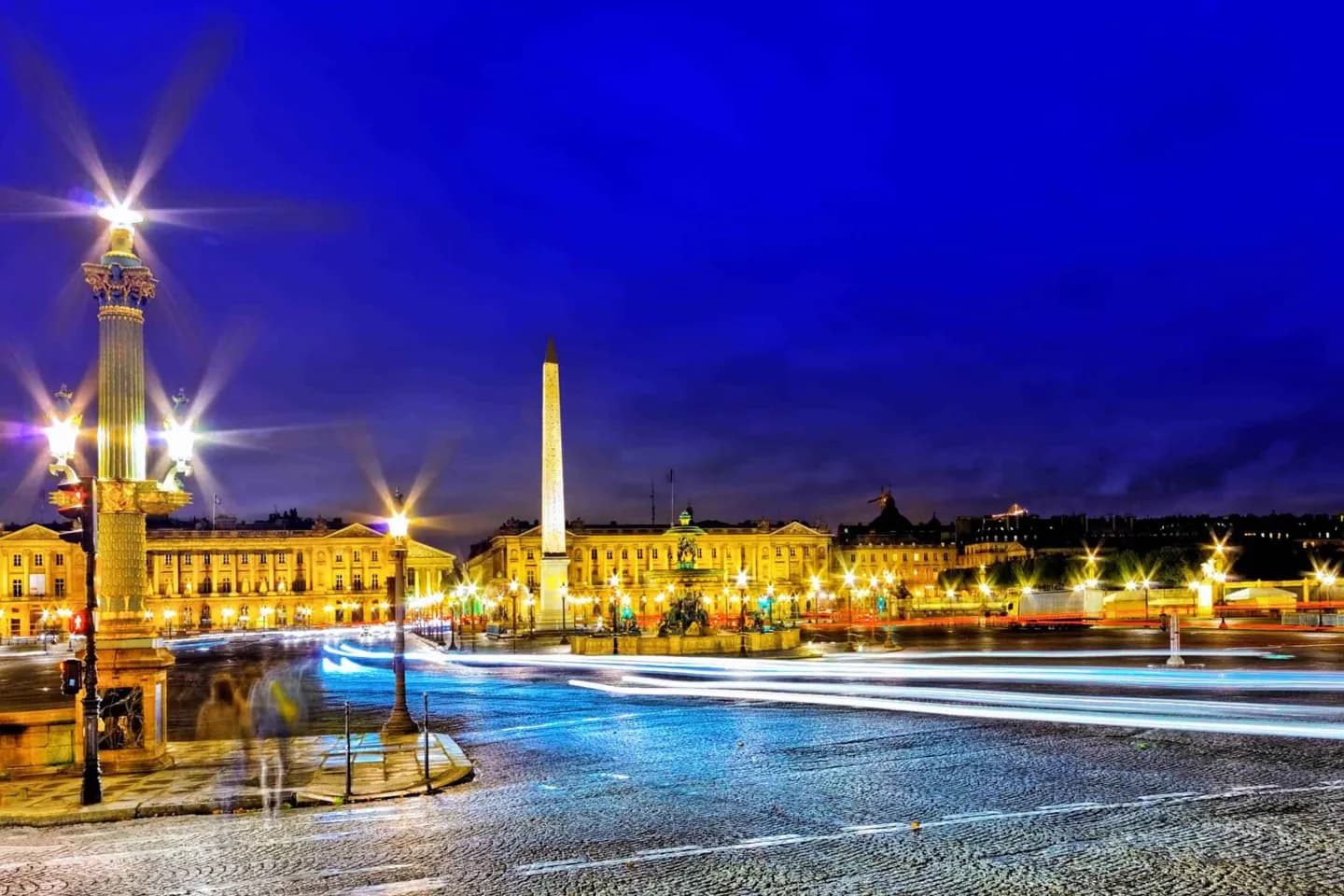
Why go
Walk through Place de la Concorde to understand how Paris's grand west-east axis is put together. The Tuileries Gardens lie to one side, the Champs-Élysées opens on the other, and Rue Royale points toward La Madeleine. Its fountains, obelisk and city statues make the square more than a crossing point, while its Revolutionary past gives the formal setting a sharper meaning.
What to look for
- The octagonal plan is marked by eight statues representing French cities.
- The Tuileries Gardens meet the square on its eastern side.
- Rue Royale creates a direct view toward La Madeleine.
The full story
Opened in 1772 as a royal square, Place de la Concorde was renamed during the French Revolution and became associated with its most violent years. Its later design deliberately restores a ceremonial scale: the two fountains were added in 1840, and the broad octagonal layout connects the Tuileries, Champs-Élysées and Seine. At the eight corners, statues represent French cities. Look for Strasbourg in particular: after the Franco-Prussian War, it was draped in mourning while Alsace-Lorraine was under German rule, a gesture that continued until the region returned to France after the First World War. The square therefore reads as a sequence of political changes as well as a grand urban crossroads. Its planned approaches remain the clearest way to grasp its scale.
Useful to know
- Use the square as the link between the Tuileries, Champs-Élysées and La Madeleine rather than treating it as a destination in isolation.
- It is an exposed, traffic-heavy space; allow time to reach the fountains and statues via the crossings.
- Check the city’s visitor information if an event may affect access to the square.
Your next visit
Estimated · Declared scenario and planning estimates; no live opening, weather, queue or booking service.
Outdoor visit · 30–45 min
World planning estimate; admission, opening, visit duration and access need checking.