
Why go
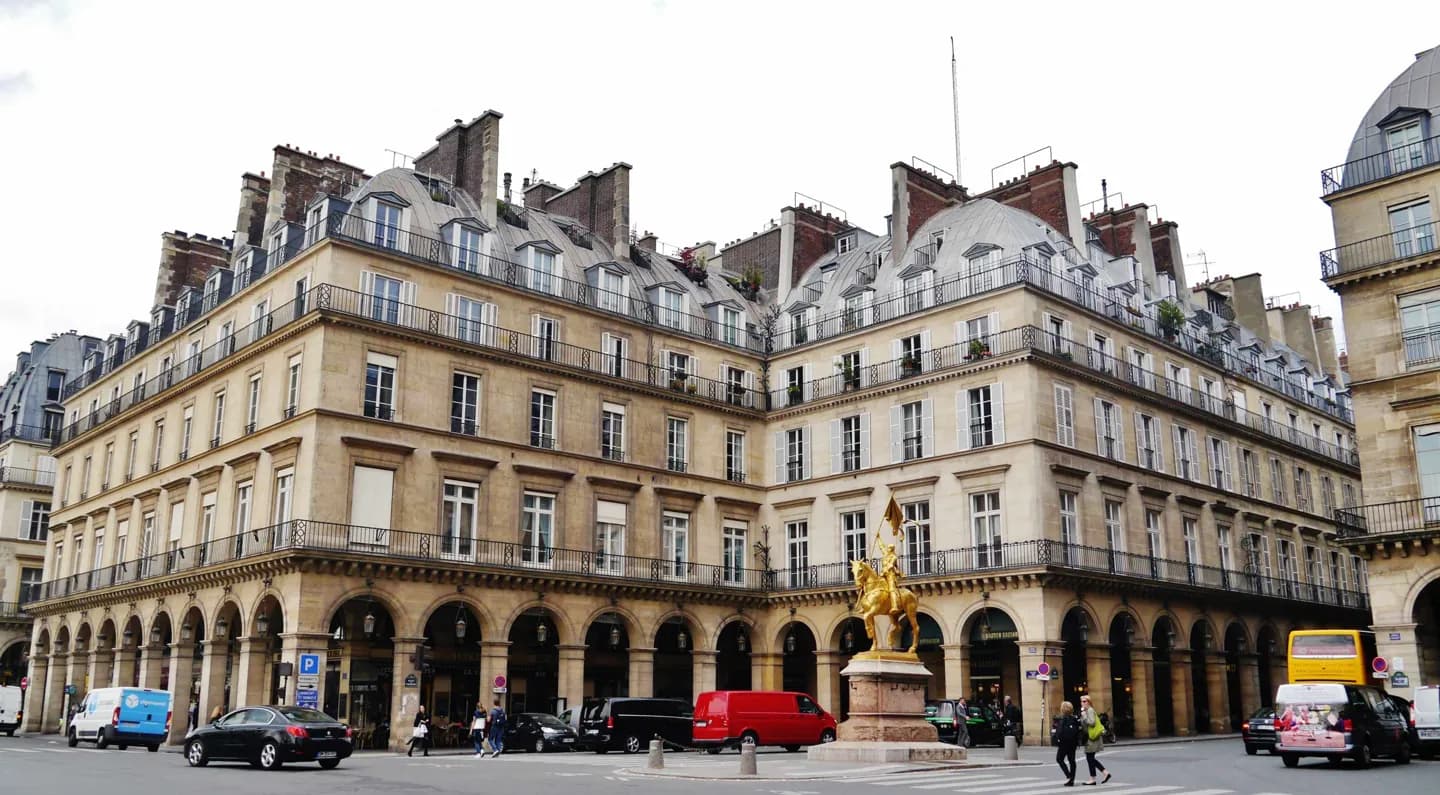
The square offers a focused contrast to the grand spaces nearby. Joan of Arc’s bright gold figure stands against restrained stone façades and the long Rue de Rivoli perspective. Its name recalls Napoleon’s Egyptian campaign, while the statue reflects the renewed national symbolism attached to Joan in the nineteenth century.
What to look for
- Emmanuel Frémiet’s gilded Joan of Arc rides at the centre of the square.
- The statue’s gold surface stands out against the arcaded Rue de Rivoli.
- The square opens toward the western edge of the Tuileries Garden.
The full story
The square packs several historical references into a very small site. Place des Pyramides takes its name from Rue des Pyramides, which commemorates Napoleon’s 1798 Battle of the Pyramids in Egypt. The location had an earlier equestrian association: a riding academy led by Antoine de Pluvinel operated nearby from the sixteenth century and helped develop traditions of classical horsemanship. The square’s defining monument came later. Sculptor Emmanuel Frémiet created the gilded bronze equestrian Joan of Arc in 1874, showing her in armour carrying a standard. Installed after France’s defeat in the Franco-Prussian War, the figure became part of a wider nineteenth-century revival of Joan as a national symbol. The monument turns this modest road junction into a legible historical stop between the Louvre, Rue de Rivoli and the Tuileries.
Useful to know
- View the statue from the pavement and use marked crossings around Rue de Rivoli.
- Combine the stop with the Tuileries or Place du Carrousel; the square itself needs little time.
Your next visit
Estimated · Declared scenario and planning estimates; no live opening, weather, queue or booking service.
Outdoor visit · 30–45 min
World planning estimate; admission, opening, visit duration and access need checking.