
Why go
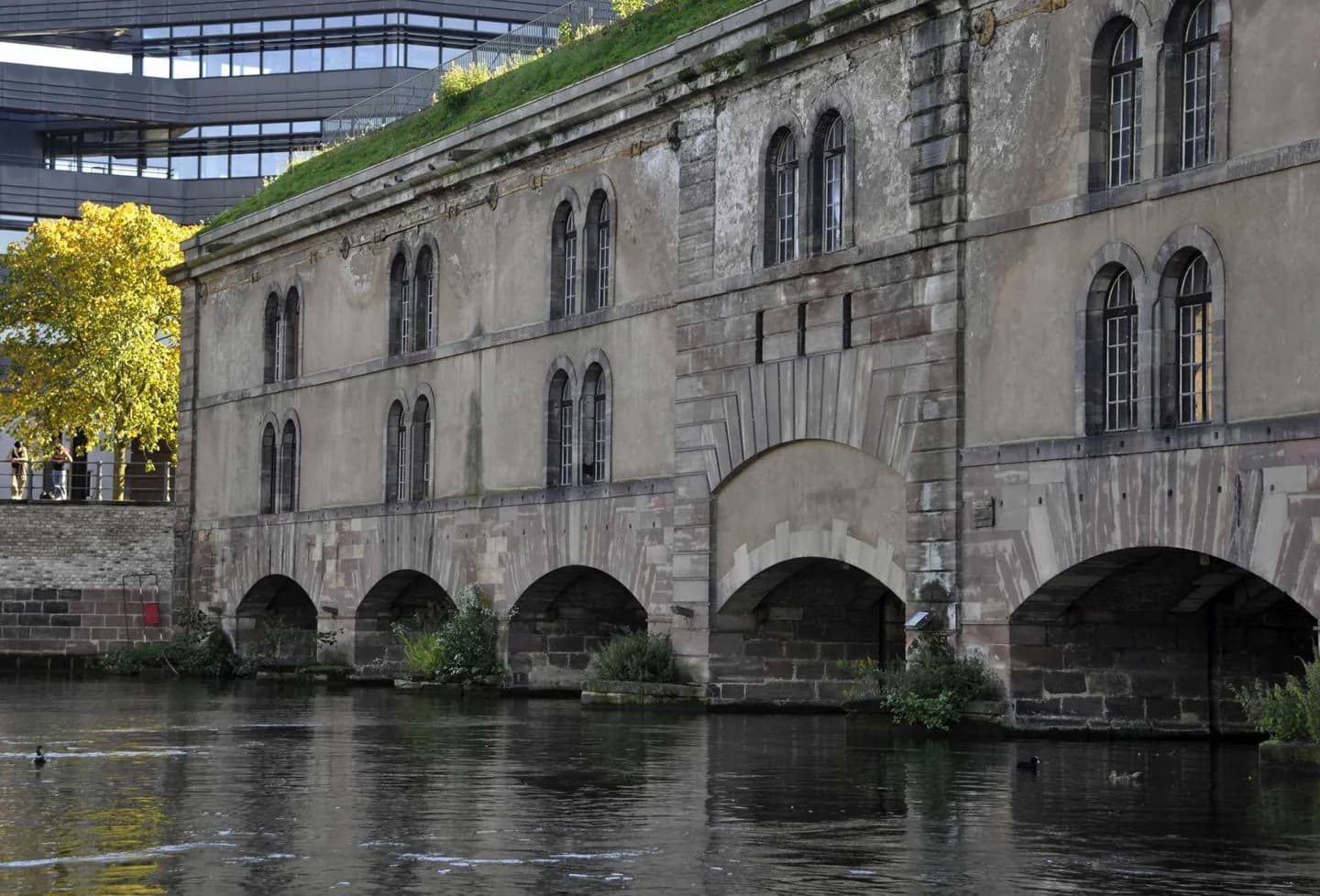
This seventeenth-century defensive work gives you one of the clearest ways to understand the western edge of old Strasbourg. From above, the towers, river branches and roofs line up in a single view. It makes particular sense at the end of a Petite France walk.
What to look for
- The terrace frames the towers of the Ponts Couverts.
- River channels and Petite France roofs spread out behind them.
- The barrage itself spans the Ill as a substantial defensive structure.
The full story
The barrage was built between 1686 and 1700 under engineer Jacques Tarade, following plans associated with Vauban. It was part of the city’s system of defence, placed where the Ill’s branches converge west of Petite France. Its mass can seem plain from outside, yet its position explains it: controlling this stretch of water mattered to a fortified city. Today the roof terrace reverses the old military gaze. Instead of watching an approach to Strasbourg, you can look back across the Ponts Couverts towers to the canals and roofs of the historic quarter. That view connects features that can feel separate at street level. The covered-bridge name survives even though the present bridges have changed, while the towers remain strong markers of the former defenses. Visit the barrage for that relationship between water, fortification and neighbourhood, not only for a skyline photograph.
Useful to know
- Approach from Petite France or the Ponts Couverts for a natural sequence.
- Check current terrace access before relying on the panorama.
Your next visit
Estimated · Declared scenario and planning estimates; no live opening, weather, queue or booking service.
Outdoor visit · 10–15 min
Public-space walk and exterior observation only; no interior, garden, tower or ticketed admission included. Durations and walking are estimates. Check temporary restrictions and park or market opening times.
Outdoor visit · 15–30 min
World planning estimate; admission, opening, visit duration and access need checking.