
Why go
The museum crosses subjects in a way that allows a visit to follow curiosity rather than one historical period. Dolly the sheep and the Millennium Clock are distinctive things to seek out, while the range of collections makes it useful when your group has different interests. Choose your priorities before moving between galleries.
What to look for
- Dolly the sheep connects the collection with the history of cloning.
- The Millennium Clock is a distinctive museum object.
- Collections span archaeology, natural history, science, technology and art.
The full story
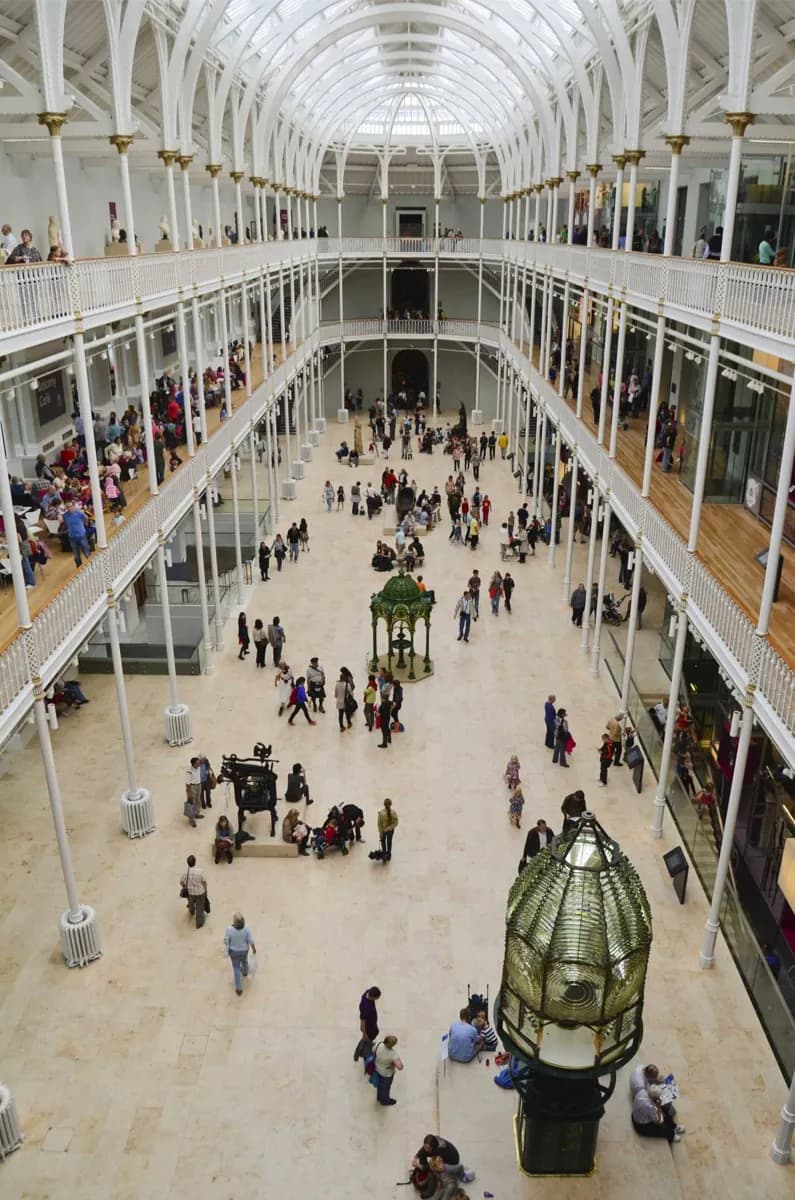
The older museum building opened on Chambers Street in 1866 as the Edinburgh Museum of Science and Art. Captain Francis Fowke and local architect Robert Matheson designed it with inspiration from London’s Crystal Palace. Glass, iron and a great central hall made engineering part of the public experience, rather than hiding the structure behind solid interior walls. The Grand Gallery’s columns and balustrades still express that Victorian ambition. The Museum of Scotland building opened in 1998 to tell the country’s history from its earliest periods into modern times. Its addition created a different architectural setting beside the older building, within the same Chambers Street destination. The contrast connects two approaches to museum-making: a nineteenth-century hall shaped by industrial design and a later institution organised around Scotland’s national history.
Useful to know
- Pick a few collection themes for a focused visit instead of trying to cover the whole museum.
- Use Chambers Street as the address; the current name is National Museum of Scotland.
Your next visit
Estimated · Declared scenario and planning estimates; no live opening, weather, queue or booking service.
Indoor visit · 60–150 min
World planning estimate; admission, opening, visit duration and access need checking.