
Why go
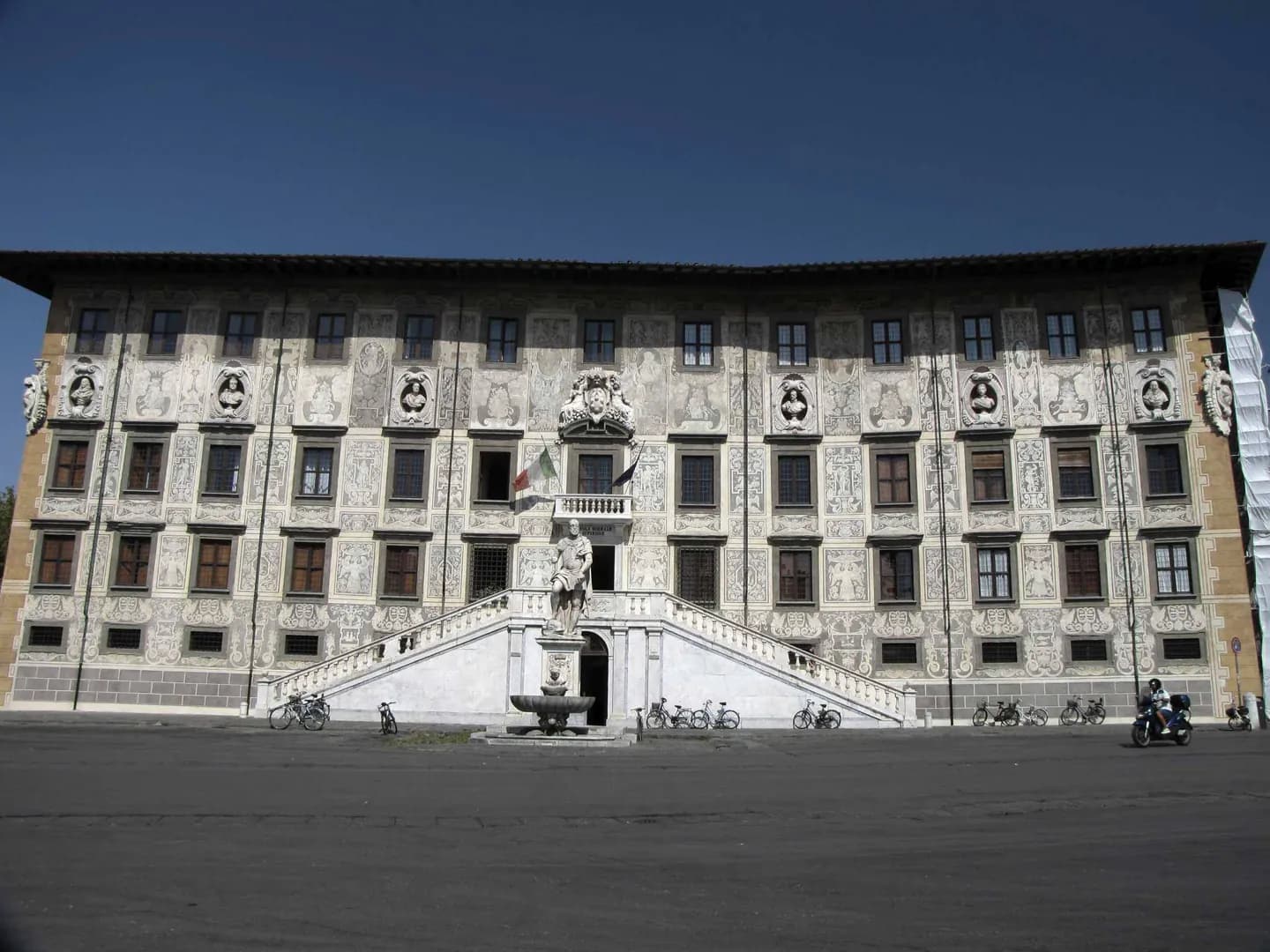
This was the medieval commune's political centre before Cosimo I reshaped it for the Knights of St Stephen. The square still reads as a statement of power: Vasari's patterned palace façade faces the statue of the grand duke, while the church and Clock Palace hold different chapters of Pisan history. It is rewarding even when interiors are closed.
What to look for
- Palazzo della Carovana's patterned façade dominates one side of the square.
- The statue of Cosimo I stands in front of the palace, linking the space to Medici rule.
- Palazzo dell'Orologio incorporates the medieval Gualandi tower.
The full story
In the Middle Ages, Piazza dei Cavalieri was a centre of Pisa's civic government. Public offices occupied buildings around it, and the square witnessed the city's transfer to Florentine control in 1406. In the sixteenth century Cosimo I de' Medici made the site the headquarters of the Knights of St Stephen. Giorgio Vasari's redesign did more than refresh old façades: it recast a Pisan political space as a setting for a Medici military and religious order. Palazzo della Carovana reused the older Palace of the Elders, while Santo Stefano dei Cavalieri gave the order a church. The statue of Cosimo I made its patron visible in the middle of the square. Today the Scuola Normale Superiore occupies several buildings, adding a scholarly use to the medieval and Renaissance layers. Look from the patterned palace across to the older Clock Palace to see those changes within a few steps.
Useful to know
- Walk around the square to compare the palace, church and Clock Palace as one ensemble.
- For interior tours, check the Scuola Normale's published booking calendar in advance.
Your next visit
Estimated · Declared scenario and planning estimates; no live opening, weather, queue or booking service.
Outdoor visit · 30–45 min
World planning estimate; admission, opening, visit duration and access need checking.