
Why go
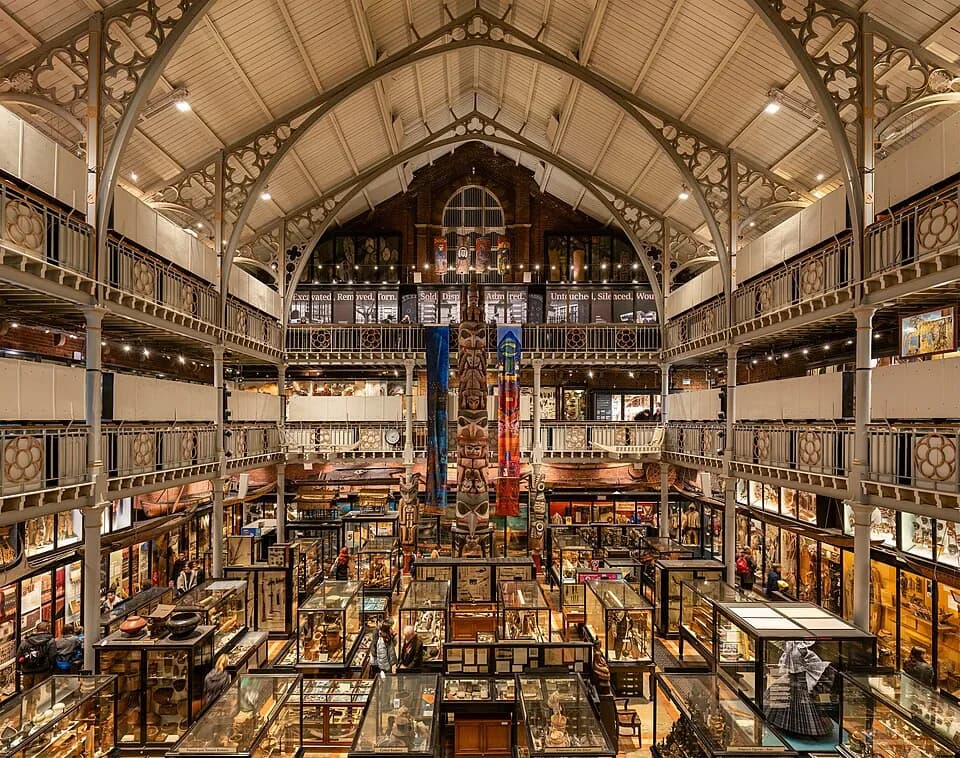
The unusual arrangement places objects made for similar purposes side by side, inviting comparisons across cultures and periods. It also reveals the collecting assumptions of the museum's nineteenth-century founder, so the displays are worth reading critically as well as visually.
What to look for
- Cases group related tools and objects by use, making comparisons easy to spot.
- A tall Haida pole from Old Massett stands among the museum's largest displays.
- The dense galleries reward a slower look at a few cases rather than a rapid circuit.
The full story
Augustus Pitt Rivers gave his collection to the University of Oxford in 1884, on the condition that anthropology be taught there. A separate building followed behind the Museum of Natural History, where visitors still enter today. The collection grew far beyond the original gift, but its most distinctive feature remains the arrangement by object type. Rather than moving through a region or century, you see many examples of things made for a similar purpose together. Pitt Rivers intended this layout to suggest a progression in design and human culture. That evolutionary theory is no longer accepted as a neutral way to describe cultures, and the cases now offer a chance to question the history of collecting as well as examine the objects. The Haida pole is a particularly clear reminder that objects in these galleries came from specific communities and places, even when displayed within broad categories.
Useful to know
- Go through the Oxford University Museum of Natural History to reach the entrance.
- Pick one or two object themes to follow if your time is limited.
Your next visit
Estimated · Declared scenario and planning estimates; no live opening, weather, queue or booking service.
Outdoor visit · 30–45 min
World planning estimate; admission, opening, visit duration and access need checking.