
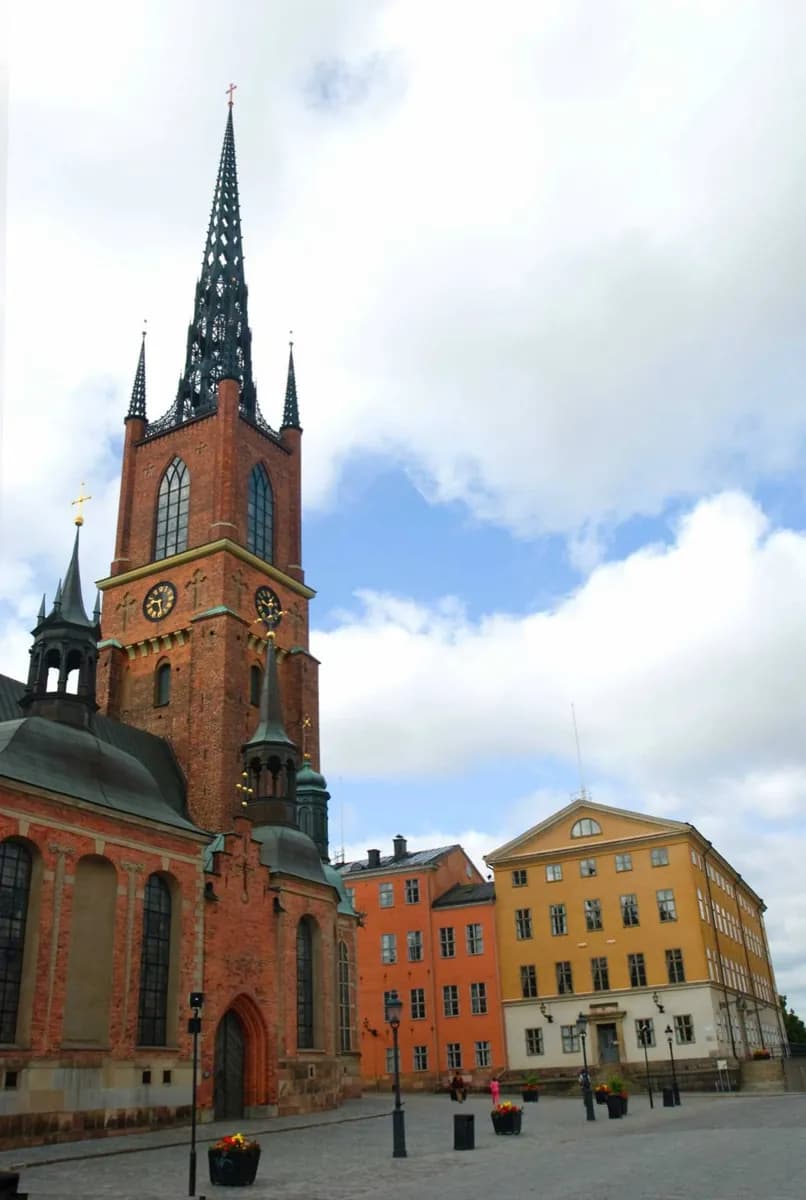
Why go
Stop for the striking contrast between the church precinct and the dense city rebuilt around it. The tower provides a useful central landmark, while the graveyard and older fabric preserve a quieter scale largely erased from the surrounding Klara district.
What to look for
- The prominent tower rising above lower Norrmalm.
- The graveyard enclosed by much newer buildings.
- Architectural traces of the post-Reformation church founded on an older religious site.
The full story
Klara Church stands on a religious site that predates the present building. A convent and church dedicated to Saint Clare were founded here in the thirteenth century, then demolished under Gustav Vasa after the Reformation. Construction of the current church began in 1572 during the reign of Johan III. The graveyard has occupied the same location since the seventeenth century. Modern Norrmalm grew densely around this precinct, especially during twentieth-century redevelopment, so the church now feels enclosed by commercial and transport infrastructure. That contrast is historically revealing. Klara was once a recognizable district of smaller streets and buildings; much of it disappeared, while the church and burial ground remained. Rather than viewing only the tower, walk the perimeter and notice how the older boundary, trees and graves create a separate spatial world within the rebuilt center.
Useful to know
- Confirm current church access before planning to enter.
- The exterior is an easy short detour between the central station, Sergels torg and Drottninggatan.
Your next visit
Estimated · Declared scenario and planning estimates; no live opening, weather, queue or booking service.
Outdoor visit · 30–45 min
World planning estimate; admission, opening, visit duration and access need checking.