
Why go
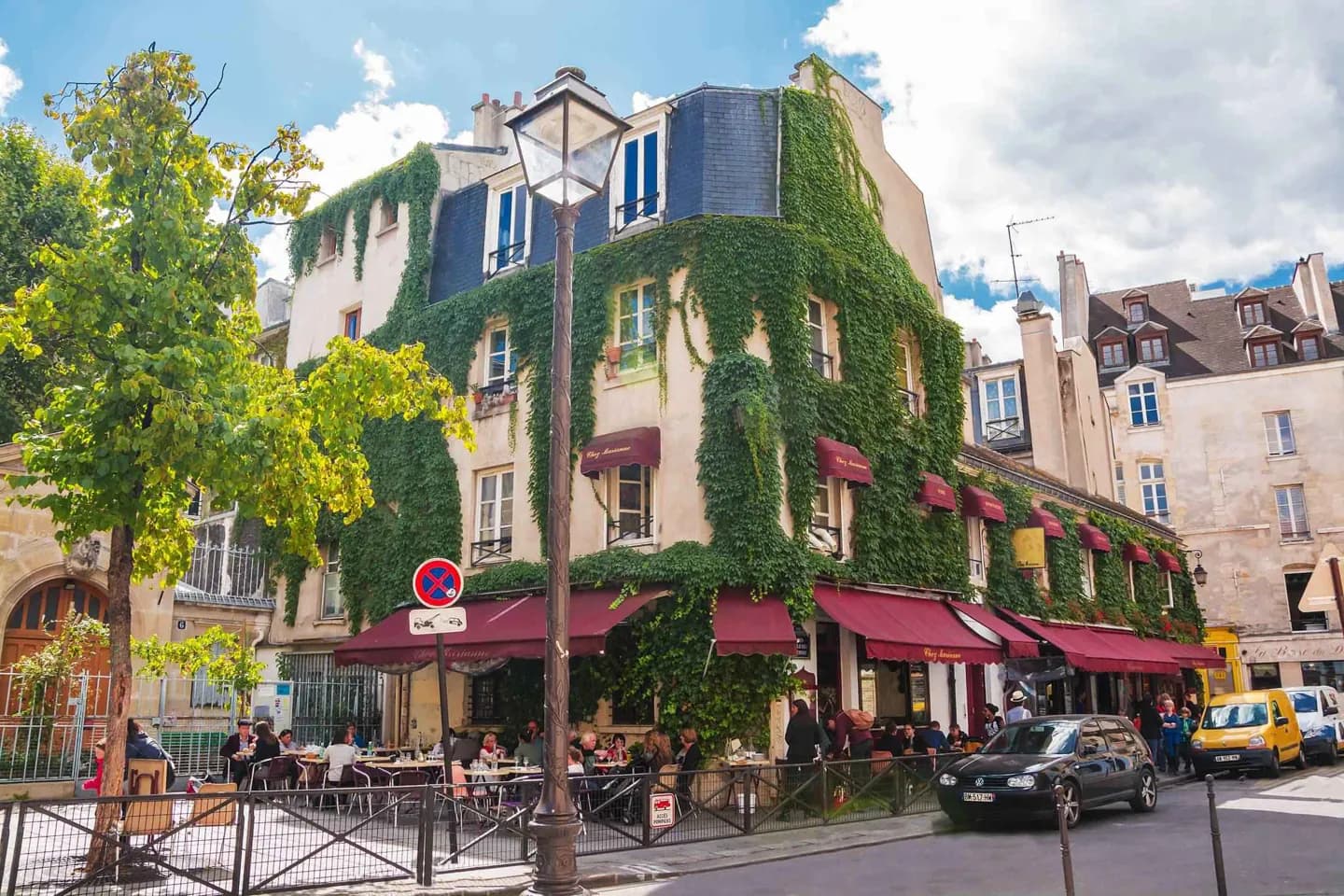
Place des Vosges gives the walk a clear architectural focus, while Rue des Rosiers introduces the Jewish history of the Pletzl. Nearby hôtels particuliers, meaning urban mansions, reveal the district’s former aristocratic role. The contrast between these streets, grand residences and religious buildings gives the Marais more depth than a shopping-only visit.
What to look for
- Place des Vosges repeats red-brick and stone façades above vaulted arcades.
- The taller King’s and Queen’s pavilions interrupt Place des Vosges’s unified roofline.
- The Temple du Marais on Rue Saint-Antoine has a domed design by François Mansart.
The full story
The Marais became a favored residential district for the nobility, especially after Henri IV commissioned the Place Royale, now Place des Vosges, in 1605. Mansions such as the Hôtel Carnavalet and Hôtel de Soubise expressed that aristocratic geography. When nobles moved toward Faubourg Saint-Germain and Île Saint-Louis in the late eighteenth century, commerce became more prominent. Eastern European Jewish immigrants later reinforced the clothing trades around Rue des Rosiers, the area known as the Pletzl. The district’s buildings also record changes of religious use: the Temple du Marais began as a Catholic convent chapel and was later given to a Protestant congregation. By the 1950s many historic buildings were in poor condition. Protection as a safeguarded sector in 1964 helped establish the restoration policy behind the architectural streetscape seen today. These successive changes explain why the neighborhood cannot be reduced to one period or community.
Useful to know
- Build a compact walk around Place des Vosges, Hôtel de Sully and Rue des Rosiers.
- Add the Temple du Marais exterior when continuing along Rue Saint-Antoine toward Bastille.