
Why go
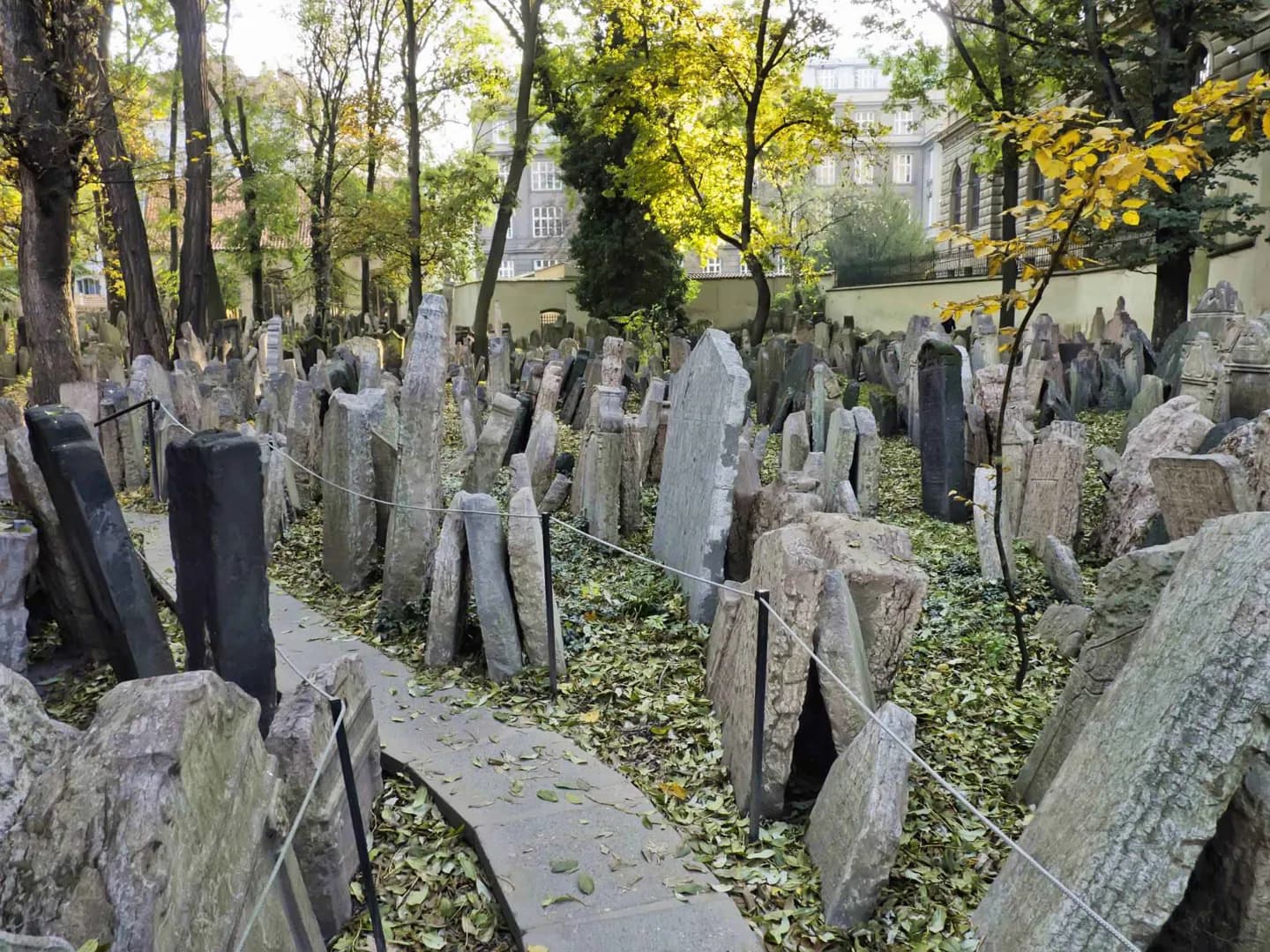
The cemetery's leaning stones are evidence of long use and scarce burial ground, not a picturesque arrangement. More than 12,000 tombstones remain, with symbols that can reveal names, families or roles. A slow walk makes the site's depth clearer than a glance from its edge.
What to look for
- Rows of old stones overlap because burials accumulated in layers.
- Carvings include crowns, grapes, raised hands and jugs.
- The cemetery contains graves associated with figures such as Rabbi Judah Loew and Mordechai Maisel.
The full story
The Old Jewish Cemetery served Prague's Jewish community from the fifteenth century into the late eighteenth century. Limited ground and religious respect for earlier burials meant that soil was added and graves were layered rather than cleared. The crowded, uneven field of stones is the visible result. Some carvings offer clues about the people buried here: a crown, grapes, raised hands or a jug could carry family or religious meaning. The cemetery also holds figures central to Josefov's history, including Rabbi Judah Loew and Mordechai Maisel. Its long period of use makes it more than a collection of famous graves. It is a record of a community sustaining burial traditions within the boundaries imposed on it. Take the symbols and dates as individual records; their crowded setting is the consequence of communal practice and restricted space, not a planned visual effect.
Useful to know
- Give the narrow cemetery path time and space; pause to examine carvings without blocking the route.
- Pair it with Pinkas Synagogue to understand the contrast between centuries of burial and the memorial to twentieth-century loss.
Your next visit
Estimated · Declared scenario and planning estimates; no live opening, weather, queue or booking service.
Outdoor visit · 30–45 min
World planning estimate; admission, opening, visit duration and access need checking.