
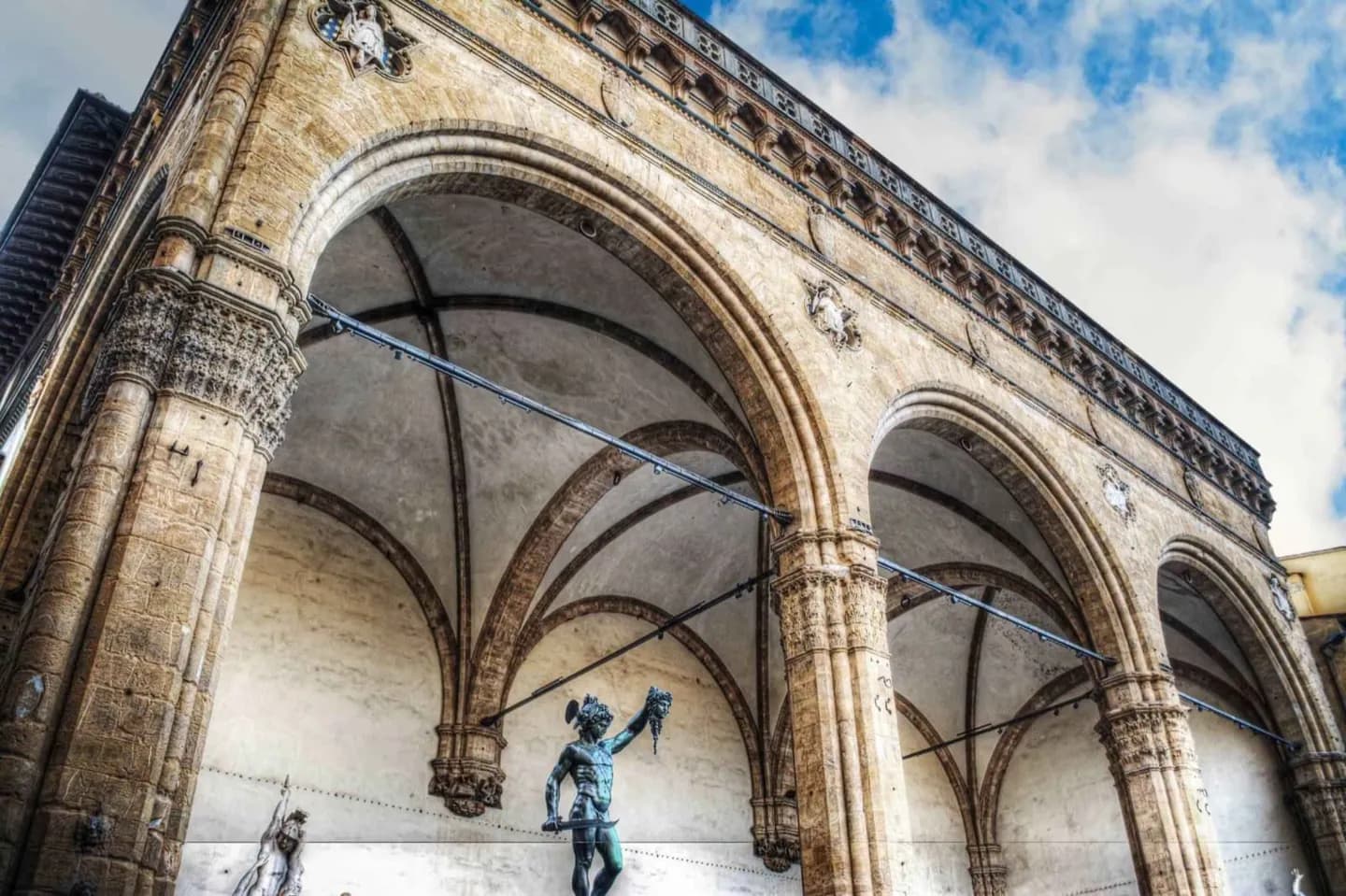
Why go
It offers a concentrated sculpture stop without separating art from civic space. Cellini’s bronze Perseus, the Medici lions and the ancient group of Menelaus with Patroclus occupy arches originally built for Florentine assemblies and public ceremonies in the surrounding square.
What to look for
- Under the left bay, find Cellini’s Perseus raising Medusa’s severed head.
- Inspect the pedestal for small bronzes and the relief of Perseus freeing Andromeda.
- Compare the two Medici lions: one ancient Roman, the other carved by Flaminio Vacca in 1598.
The full story
Benci di Cione and Simone di Francesco Talenti built the loggia between 1376 and 1382 for public assemblies and civic ceremonies. Its broad street-facing arches created a more open counterpoint to Palazzo Vecchio’s fortified mass. Under Duke Cosimo I, German mercenary guards known as landsknechts were housed here, giving the building the name Loggia dei Lanzi. After the Uffizi rose behind it, Bernardo Buontalenti adapted the roof as a terrace from which the Medici court could watch events in the square. Sculpture gradually transformed the civic shelter into an open-air gallery. Cellini’s bronze Perseus makes political theater from the myth of Medusa, while Roman marbles and later restorations link the collection to antiquity. The loggia still performs both roles at once: architecture frames official Florence, and figures beneath its arches turn the piazza into a stage.
Useful to know
- Approach from the center of Piazza della Signoria to see sculpture, arches and Palazzo Vecchio together.
Your next visit
Estimated · Declared scenario and planning estimates; no live opening, weather, queue or booking service.
Outdoor visit · 10–15 min
Public-space walk and exterior observation only; no interior, garden, tower or ticketed admission included. Durations and walking are estimates. Check temporary restrictions and park or market opening times.
Outdoor visit · 30–45 min
World planning estimate; admission, opening, visit duration and access need checking.