
Why go
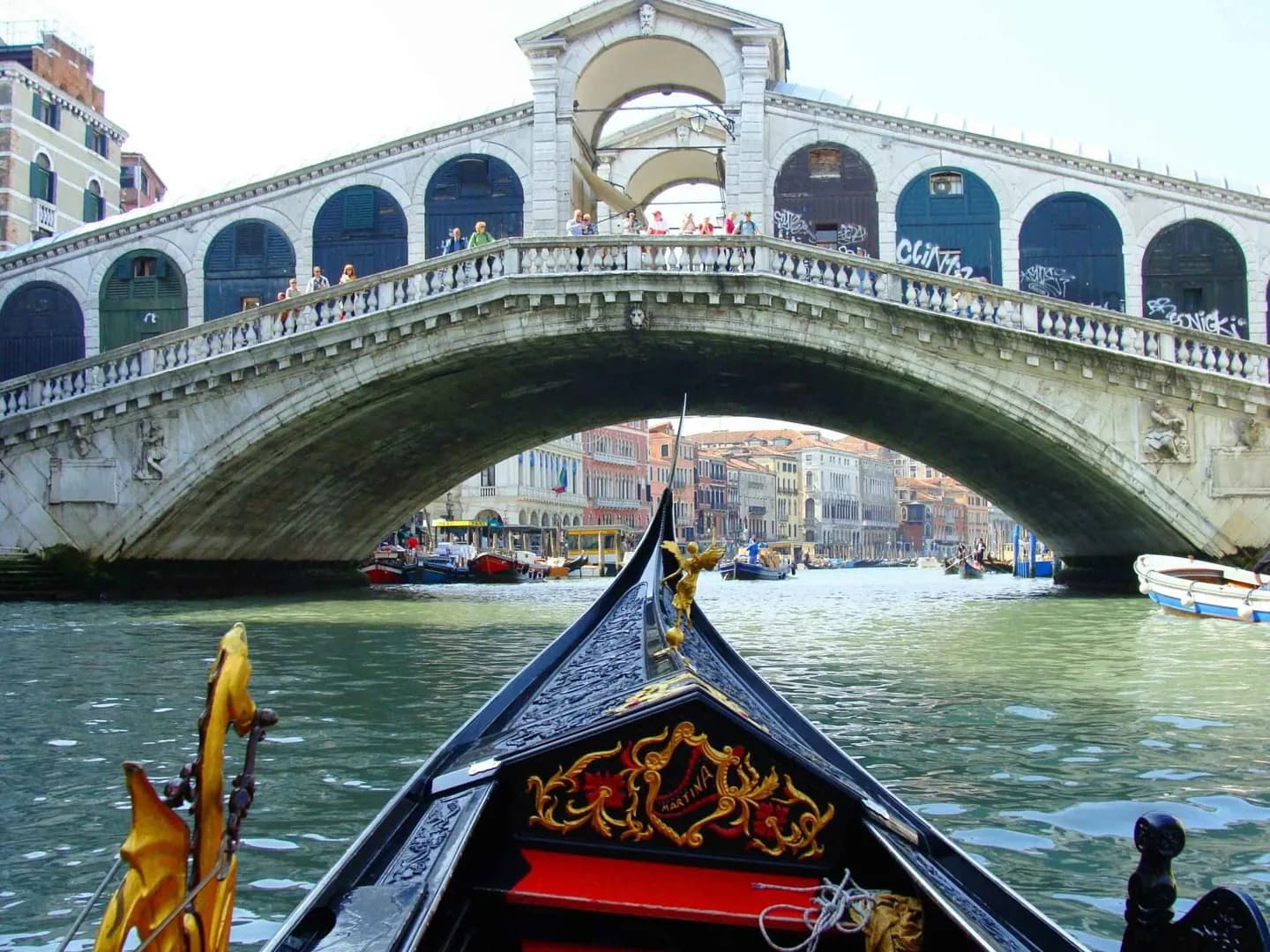
The bridge makes commerce and engineering visible together. Its rising ramps and shop-lined passages preserve the arrangement of an earlier wooden crossing, while the single arch leaves the waterway beneath undivided by intermediate piers. From the bridge, the Grand Canal becomes easier to understand as the axis around which Rialto's trading district developed.
What to look for
- Two inclined ramps meet beneath the central portico.
- Rows of shops occupy the covered passages.
- A single stone arch spans the Grand Canal.
The full story
Rialto's earliest crossing was a pontoon bridge built in 1181. As the nearby market grew, a timber bridge replaced it. That structure had rising ramps and a central section that could lift for tall vessels. Shops were later added along its sides, with rents helping pay for upkeep. The bridge was commercial property as well as transport infrastructure. Timber demanded maintenance and proved vulnerable to fire and collapse. Proposals for a stone replacement attracted architects including Palladio and Sansovino, whose designs used several arches. Antonio da Ponte's completed bridge of 1591 instead crossed the canal in a single span. Its arrangement retained the inclined approaches and central meeting point of the wooden predecessor. The design was bold enough to attract predictions of failure. Its survival gives the familiar silhouette another meaning: the bridge embodies a successful engineering choice at a place where land traffic, shops and canal navigation all had to coexist.
Useful to know
- Use the bridge itself for the canal outlook, then continue into the Rialto market district.
- Expect an ascent and descent on the ramps when planning a crossing.
Your next visit
Estimated · Declared scenario and planning estimates; no live opening, weather, queue or booking service.
Outdoor visit · 10–15 min
Public-space walk and exterior observation only; no interior, garden, tower or ticketed admission included. Durations and walking are estimates. Check temporary restrictions and park or market opening times.
Outdoor visit · 20–30 min
World planning estimate; admission, opening, visit duration and access need checking.