
Why go
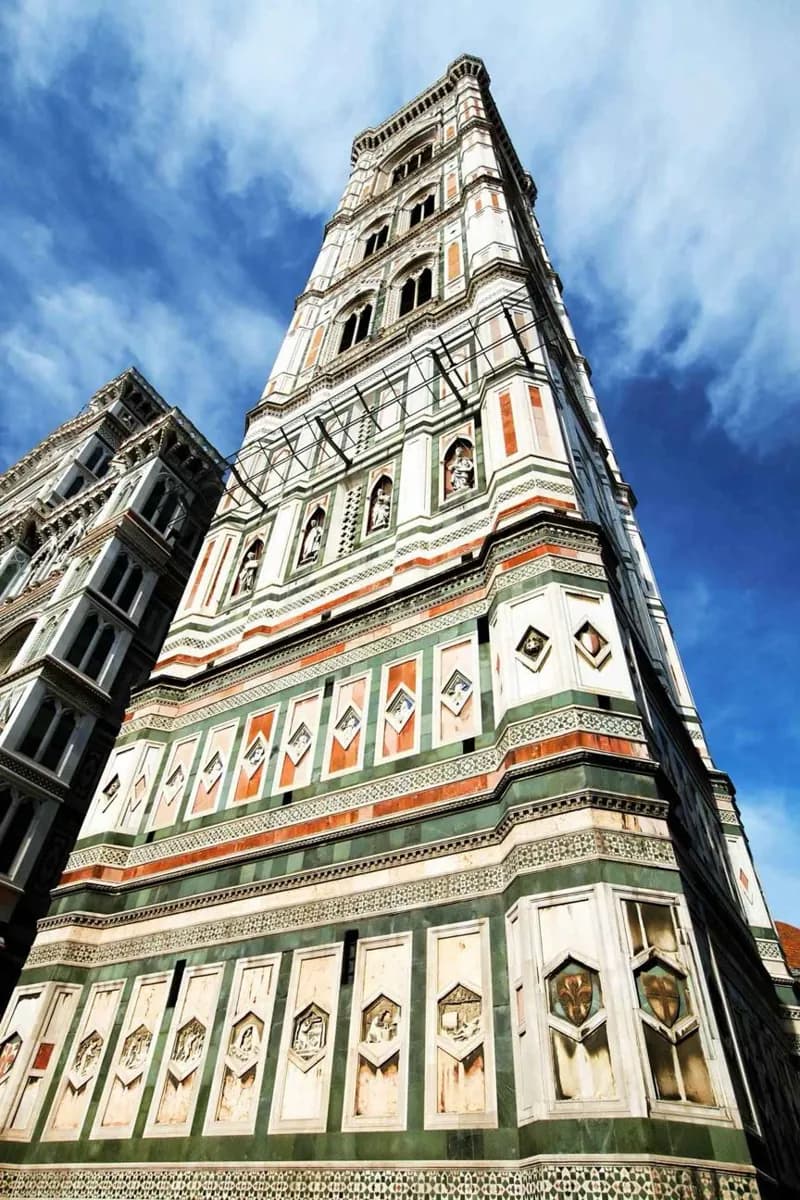
Climb for an elevated view across the cathedral complex, but save attention for the building itself. Giotto treated white, green and red marble almost like painted surface, while the lower reliefs connect biblical history with human labor, music and craft.
What to look for
- Follow the geometric bands of white Carrara, green Prato and red Siena marble.
- Read the lower hexagonal reliefs as a sequence of work, invention and biblical history.
- From the terrace, look back toward the cathedral and Brunelleschi’s dome.
The full story
Giotto became master of the cathedral works in 1334, more than three decades after Arnolfo di Cambio’s death. Already 67, he concentrated on the new campanile and laid its first stone that July. His design rejected a skeletal Gothic effect in favor of a solid surface animated by colored marble, geometry and sculptural relief. Giotto died in 1337 after completing only the lower level. Andrea Pisano succeeded him and continued a project that other hands would finish. The result still carries Giotto’s core idea: architecture that reads almost like a painted object, with shifts of color and shadow organizing the tall square shaft. At its base, the relief program turns the tower into more than a lookout. Figures associated with farming, metalwork and music place human making within a biblical sequence, linking the labor behind Florence’s monuments to the stories carved on their walls.
Useful to know
- Examine the reliefs before climbing; their detail is easy to miss when attention shifts to the terrace.
- Check the current restoration notice before booking, as work can partly reduce the view from the top.
Your next visit
Estimated · Declared scenario and planning estimates; no live opening, weather, queue or booking service.
Outdoor visit · 10–15 min
Public-space walk and exterior observation only; no interior, garden, tower or ticketed admission included. Durations and walking are estimates. Check temporary restrictions and park or market opening times.
Outdoor visit · 30–45 min
World planning estimate; admission, opening, visit duration and access need checking.