
Why go
San Rocco explains why this corner of Venice became associated with care and protection during plague. The saint's relics and scenes of healing give the church its devotional focus. Its Tintoretto paintings can be considered alongside the neighboring scuola's biblical cycle, allowing two related buildings to tell different parts of the same institutional history.
What to look for
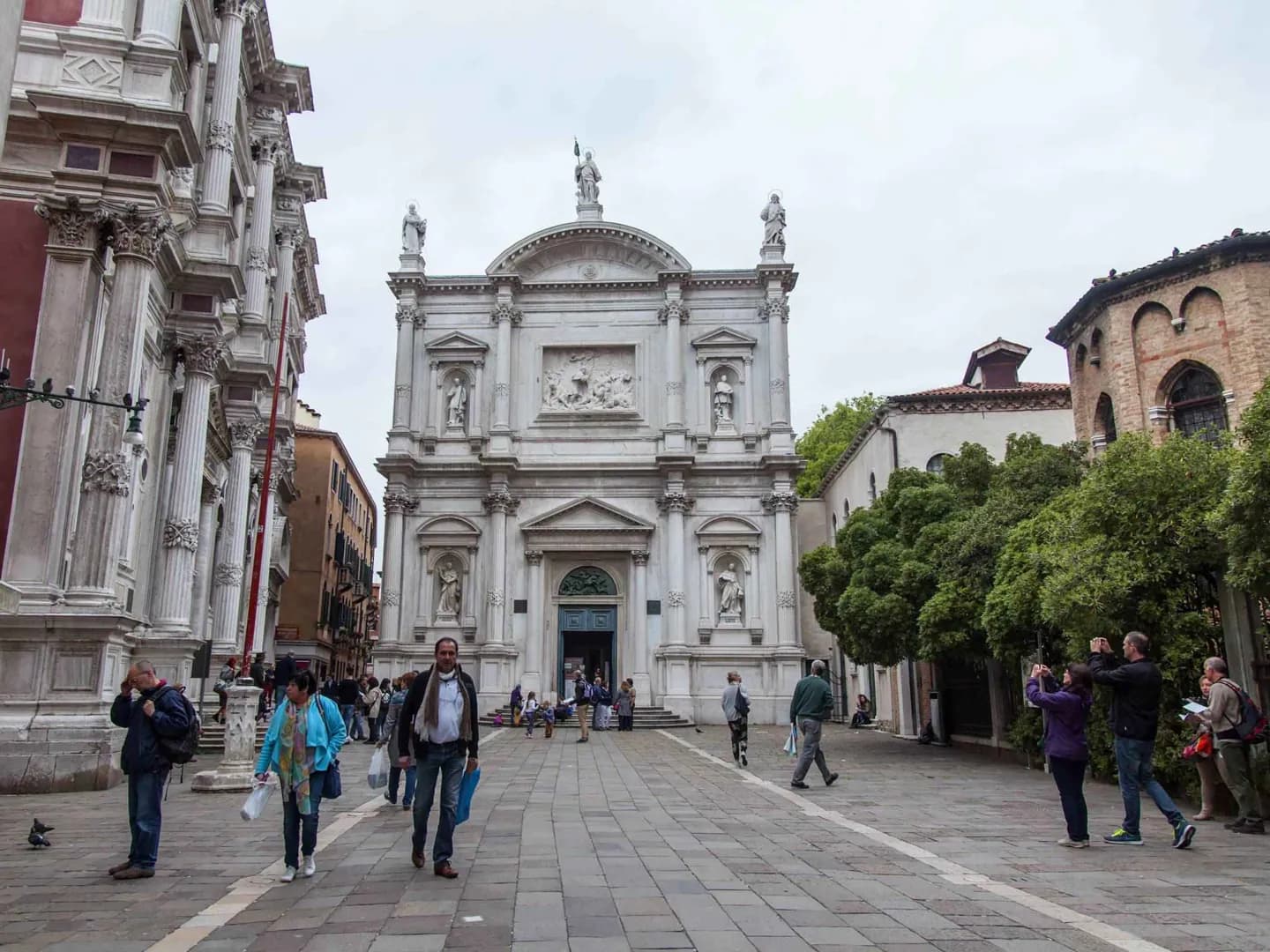
- A relief above the entrance depicts San Rocco healing plague victims.
- Tintoretto’s chancel paintings include San Rocco Comforted by an Angel.
- Sculpted saints decorate the eighteenth-century façade.
The full story
San Rocco, or Saint Roch, was invoked as a protector against plague. His relics were brought to Venice, and he became a patron saint of the city in 1576. The doge's historical pilgrimage on his feast day made the church part of the Republic's public devotional life. The building began in the late fifteenth century but underwent substantial later alterations. Its eighteenth-century façade gives the older foundation a different architectural face. The relief of the saint healing plague victims states the church's purpose before a visitor reaches the paintings inside. Tintoretto's images follow the saint through healing, solitude and consolation. That concentrated narrative differs from the Old and New Testament programme he developed next door for the confraternity. Together, church and scuola show how a devotional cult supported both public worship and lay charitable identity. Their proximity makes the relationship unusually easy to understand on the ground.
Useful to know
- Visit the church and neighboring Scuola Grande as distinct stops.
- Compare the church’s saint-focused imagery with the scuola’s broader biblical cycle.
Your next visit
Estimated · Declared scenario and planning estimates; no live opening, weather, queue or booking service.
Indoor visit · 20–30 min
World planning estimate; admission, opening, visit duration and access need checking.