
Why go
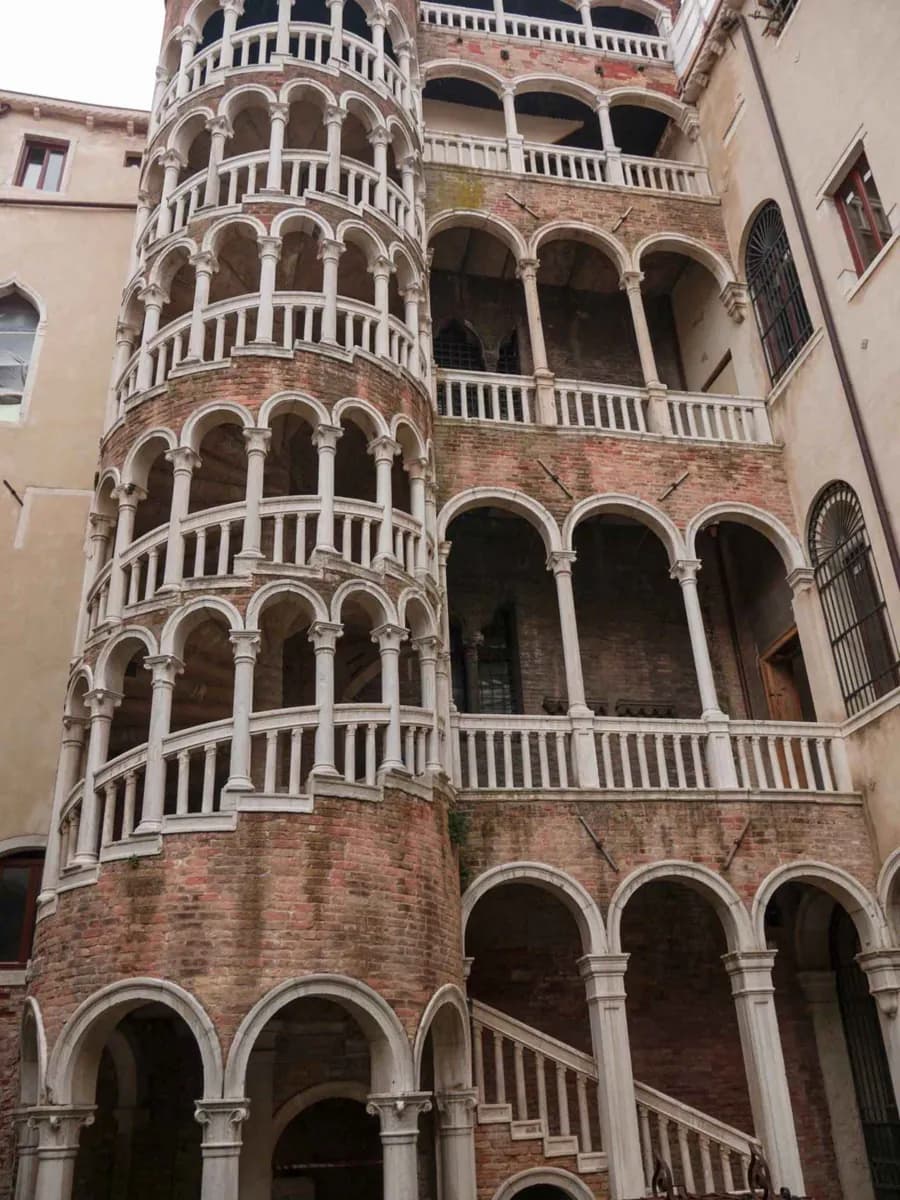
The staircase turns circulation into the palace’s defining feature. Repeated open arches wrap the ascending spiral, allowing its structure to be read from outside. The Venetian name Bovolo, meaning snail, makes the shape memorable. Its use in Orson Welles’s Othello adds a film association to a building whose interest is unusually concentrated in one architectural addition.
What to look for
- Open arches wrap the external spiral stair.
- The stair rises to an arcaded upper level.
- The spiral shape explains the name Bovolo, or snail.
The full story
The Contarini palace took its fifteenth-century form as one of the family’s Venetian residences. The external spiral staircase was a later addition, traditionally associated with Giorgio Spavento and the end of that century. It changed how the small building presented itself, making a means of reaching upper floors into an architectural statement. The repeated arches reveal the stair’s rising movement. Its form supplied the Bovolo name, the Venetian word for snail, which distinguishes this palace from the many other properties associated with the Contarini family. The name directs attention to a visible feature rather than to a long genealogy. Orson Welles used the palace as Brabantio’s house in his 1952 adaptation of Othello, prominently featuring the staircase. That cinematic use offers another way of understanding its appeal: the open spiral creates a strong setting for movement and layered views. Architecture, naming and film history all converge on the same compact structure.
Useful to know
- Find the palace in the side streets near Campo Manin rather than along the Grand Canal.
- Check staircase visiting arrangements before planning a climb or rooftop outlook.
Your next visit
Estimated · Declared scenario and planning estimates; no live opening, weather, queue or booking service.
Outdoor visit · 30–45 min
World planning estimate; admission, opening, visit duration and access need checking.