
Why go
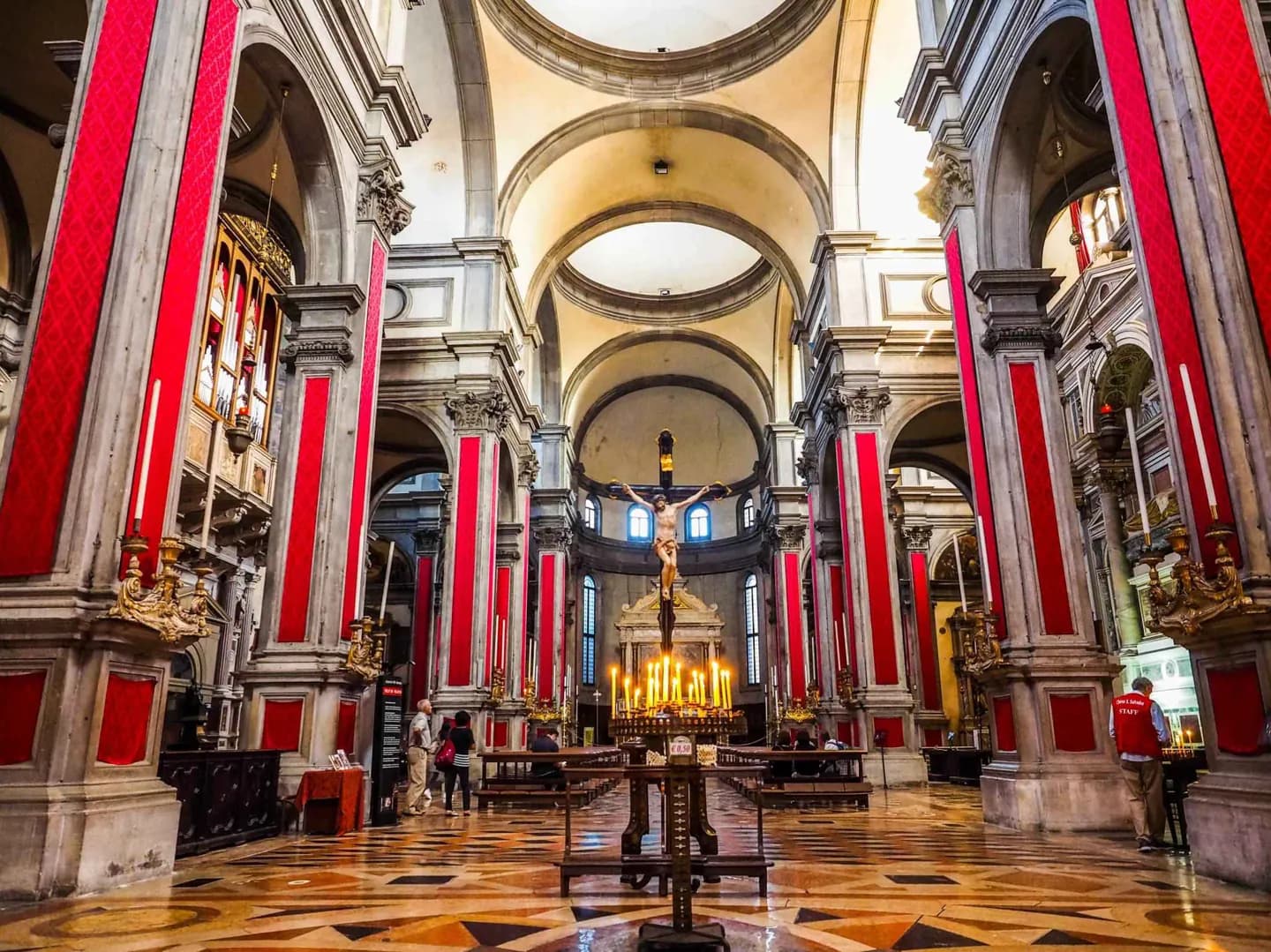
Three Greek-cross units placed in sequence create an unusual spacious interior, each lit through a dome's lantern. Titian's Annunciation and Transfiguration give the visit clear artistic targets. Outside, a cannonball embedded at the base of a façade column adds a sharply different layer of civic history to the religious setting.
What to look for
- Titian's Transfiguration serves as the high-altar painting.
- Titian's Annunciation hangs on the south wall.
- A cannonball is embedded below the façade's left column.
The full story
The current church was built by a succession of architects, beginning with Giorgio Spavento and continuing through figures including Tullio Lombardo. Its plan gives the interior its character: three Greek crosses are placed end to end, with domes and lanterns bringing light into the large hall. The later façade belongs to another phase, so exterior and interior do not represent a single building campaign. Funerary monuments connect the church with the Republic's elite. They include doges and Caterina Cornaro, Queen of Cyprus, whose presence links a Venetian church with the city's wider Mediterranean relationships. Sansovino's tomb for Doge Francesco Venier is one such expression of rank in a sacred setting. The cannonball outside belongs to a different conflict. It came from the Austrian bombardment during Venice's attempt to recover independence under Daniele Manin. This small object places political resistance beside monuments to the old ruling class, giving the façade a history that extends beyond its architectural design.
Useful to know
- Fold San Salvador into the Merceria walk between Rialto and San Marco.
- Inspect the left column's base before entering to compare the church's military trace with its sacred art.
Your next visit
Estimated · Declared scenario and planning estimates; no live opening, weather, queue or booking service.
Indoor visit · 20–30 min
World planning estimate; admission, opening, visit duration and access need checking.